
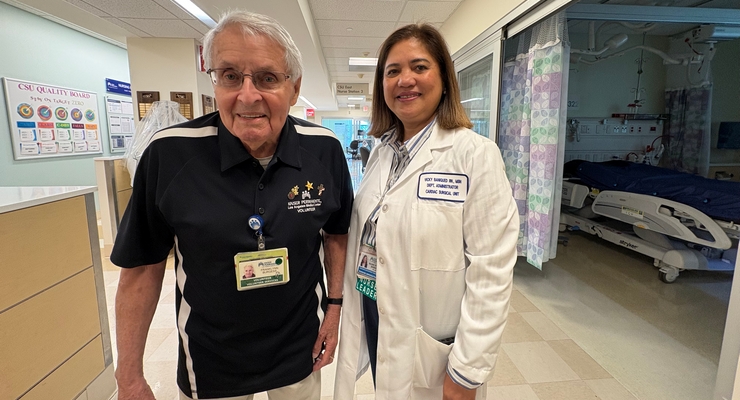
Franklynn Burgess, a longtime surgical services volunteer at Los Angeles Medical Center, stands next to Vicky Baniqued, department administrator for the hospital’s Cardiac Surgery Department.
When Tracy Watson recently arrived at Kaiser Permanente Los Angeles Medical Center (LAMC) – which serves Kaiser Permanente members in Pasadena – on the morning of her husband’s heart surgery, the uncertainty felt overwhelming.
Her husband, Richard “Dick” Watson, a newly enrolled Kaiser Permanente member and school crossing guard, was scheduled for a triple bypass and valve replacement—procedures that all began with what they believed would be a standard checkup. “If it hadn’t been for that physical, we never would have known anything was wrong,” Tracy said.
Watson’s path to that day had moved quickly. After his primary care physician detected a heart murmur during his initial physical exam, he was referred for further testing at Kaiser Permanente Anaheim Medical Center.
A series of evaluations—including an EKG, a stress test and cardiac catheterization—found that Watson’s heart wasn’t functioning as it should, leading to a referral to the cardiac surgery clinic at LAMC for evaluation with Cardiac Surgeon Dr. Kwok Yun.
The coordinated communication between primary care, cardiology and cardiac surgery ensured that Watson reached the operating room at the right time. Before the surgery even began, Tracy felt reassured by the way the teams approached his care. “From the very beginning, everyone made us feel like we were in good hands,” Tracy said. “Every person we met took the time to help us understand what was happening.”
By the time she arrived at the hospital for the surgery itself, Tracy trusted the care team—but the emotional weight of waiting alone was still heavy. That’s when Franklynn Burgess, a longtime LAMC surgical services volunteer, introduced himself.
Burgess has supported families in LAMC’s surgical waiting area for years, helping them navigate what can be an intimidating and uncertain process. He walked Tracy step‑by‑step through what the day would look like: when she could expect updates, how long each phase of surgery typically takes, what communication from the surgeon usually includes, and what the first hours of recovery tend to involve.
As more families arrived, he gently brought them into a shared conversation, creating a small community of people experiencing the same fears, hopes and long hours. His clarity and calmness transformed the environment.
“It completely changed how I got through those hours,” Tracy said. “He helped me feel supported. It made all the difference.”
Burgess’ ability to connect with families comes from his own lived experience. A retired Kaiser Permanente member, he has undergone both major cardiac and spinal surgeries. “When you’ve been through things as a patient, you don’t forget it,” he said. “You remember what it feels like to wait; to worry. That’s why I volunteer—so no one has to sit with that feeling alone.” He added, “The care I received here meant a lot to me. Giving back is my way of honoring that.”
His impact is felt throughout the surgical services department. “Volunteers like Franklynn play an essential role in caring for our community,” said Kelly Duran, senior manager, Operations Volunteer Services at LAMC. “Their presence brings comfort, humanity, and connection to moments that can be incredibly stressful for families.”
That sentiment is echoed by the clinical teams as well. “Compassion is a vital part of healing, and volunteers like Franklynn strengthen the entire care experience,” said Vicky Baniqued, department administrator for Cardiac Surgery at LAMC. “He helps families feel informed, less anxious, and more confident in the care their loved ones are receiving.”
After surgery, Watson was cared for in the Cardiac Surgery Unit, where the team monitored him closely, helped him begin breathing independently and supported his first steps toward mobility. Their attentiveness helped stabilize his recovery, and Tracy said she felt unexpectedly comfortable going home that first night. “Knowing the team was right there with him made it easier to leave,” she said. “They watched him like he was their own family.”
Today, Watson is walking daily and regaining strength. “We’re just grateful,” Tracy said. “Everyone—from the first doctor to the cardiology team to the surgical teams and volunteers like Franklynn—played a part in getting us here.”
For Burgess, that’s exactly why he continues to volunteer. “If I can help one family feel steadier, even for a moment, that’s what matters,” he said with a smile.