
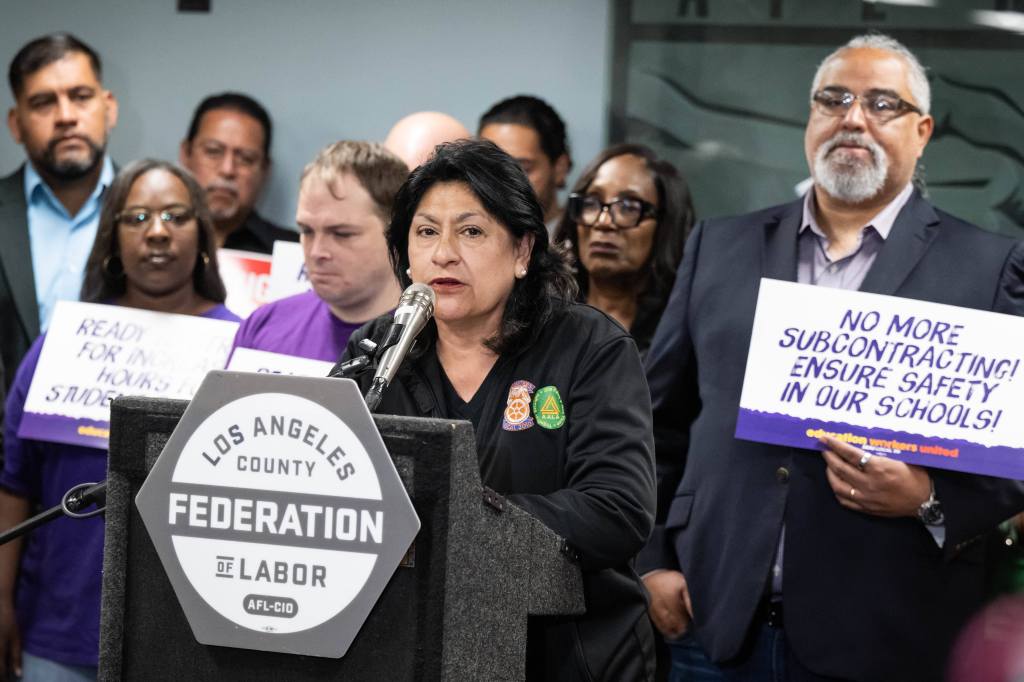
With a strike set to begin April 14, United Teachers Los Angeles is asking the public to believe that the Los Angeles Unified School District has the money to meet its demands and is simply choosing not to spend it. But that assertion warrants a strict fact-check.
UTLA’s central claim rests on the district’s $5.03 billion in unrestricted reserves, which it sees as evidence that LAUSD is hoarding money it could be spending on teacher pay and benefits. But most of that reserve is already allocated to specific purposes: workforce stabilization funds, legally required reserves for economic uncertainty, carryovers tied to categorical programs, and newly set-aside amounts for tentative agreements with Teamsters, CSEA, and the police unions.
The district’s Second Interim Financial Report for FY 2025-26, presented to the board in March, projects that after the coming three consecutive years of deficit spending – totaling $3.4 billion – the unrestricted and unassigned general fund balance will fall to just $10 million by June 30, 2028. That is not a picture of an institution sitting Scrooge McDuck-style on idle cash.
UTLA demanded a salary increase of approximately 17 percent over two years. Under the current salary table, a veteran teacher who has accumulated maximum credentials and longevity credits already earns approximately $120,000 annually, a figure that would rise to roughly $140,000 under UTLA’s proposal. The district offered 8 percent plus a 3 percent one-time bonus and estimates that its own proposals carry an ongoing cost of $901 million beyond current spending. UTLA’s demands would cost substantially more on a recurring annual basis, exacerbating a structural deficit that the district is already burning through reserves to finance. Ninety percent of LAUSD’s budget is personnel costs, meaning there is essentially no other place to cut when revenues disappoint.
The union’s credibility is also undermined by its response to the fact-finding process. When a neutral panel chair issued his recommendations on March 30, the independent report cautioned against relying on reserves or uncertain future funding to support permanent salary commitments, concluding that doing so could jeopardize the district’s long-term financial stability. UTLA immediately rejected those recommendations, characterizing them as letting the district off the hook. The union has also declined LAUSD’s offer to submit to a jointly selected independent financial review, an odd posture for an organization confident in its reading of the district’s books.
That said, UTLA is not entirely wrong that LAUSD has a history of making conservative financial forecasts. The district’s actual year-end reserves have come in above projections for the last 12 fiscal years. But some of the variances were relatively small, and far from evidence of excessive caution, slightly conservative forecasts like these are a best fiscal practice.
Future state allocations to LAUSD face some downside risks as well as one upside. Thanks to Proposition 98, LAUSD’s revenue rises and falls with state income-tax collections. The outbreak of US-Israeli military operations against Iran in late February has roiled financial markets, driven oil prices sharply higher, and depressed the technology stock indices that generate California’s capital gains tax revenue. Compounding that, the proposed 2026 Billionaire Tax Act has already driven Google co-founders Larry Page and Sergey Brin, among others, to establish residency outside California, causing a permanent loss of $3.3 to $5.8 billion of annual state income tax revenue according to a Hoover Institution analysis.
On the upside, both Anthropic and OpenAI are moving toward initial public offerings later this year. These two IPOs could generate hundreds of millions of one-time Proposition 98 funding for LAUSD. Of course, the new billionaires minted through the IPO process might then flee the state to avoid future wealth taxes.
And good budgeting does not rely on one-time revenues to paper over structural challenges. As LA and LAUSD hemorrhage residents and students respectively and the state faces fiscal uncertainty, now is the time for the district to spend prudently and for UTLA to rein in its unchecked demand for higher pay. Or they could step on the gas and drive the district toward a financial cliff – with the financial injury falling hardest on labor and students.
Marc Joffe is a Visiting Fellow at California Policy Center.