
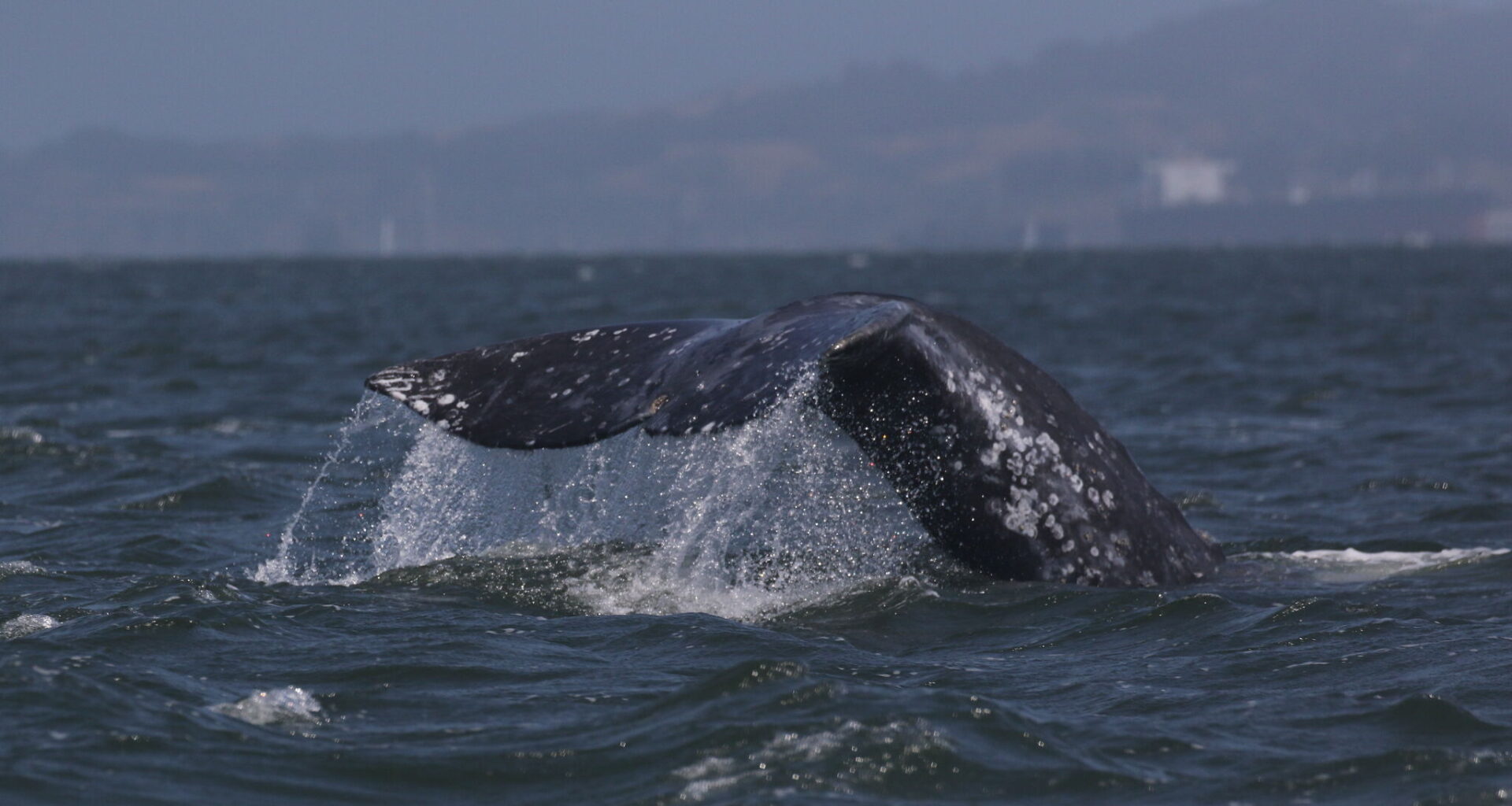
A whale named TMMC-1-66, also known as “Oreo,” is seen swimming in central San Francisco Bay on June 1, 2023.
Josephine Slaathaug/The Marine Mammal Center NOAA-NMFS Permit #26532
A whale named TMMC-1-91, also known as “Ladybug,” is seen swimming in central San Francisco Bay against the backdrop of the city skyline on May 5, 2025. This whale later died.
Josephine Slaathaug/The Marine Mammal Center NOAA-NMFS Permit #26532
The carcass of a whale named TMMC-1-91, also known as “Ladybug,” washed ashore in a rocky area near McNears Beach in San Rafael on May 31, 2025. Many carcasses such as this are inaccessible for a full examination or necropsy due to difficult terrain.
Adelle Wilkin/The Marine Mammal Center NOAA-NMFS Permit #26532
As food disappears from their feeding grounds, gray whales are swimming into San Francisco Bay — and many are dying.
At least 18% of gray whales entering the bay since 2018 have died, according to a research paper published this week in Frontiers in Marine Science. It’s unusual for gray whales to enter the bay during their nearly 12,000-mile round-trip migration from Arctic feeding grounds to breeding areas off the Mexican coast, since they typically fast along the way. But as Arctic waters warm and the whales’ primary prey — largely crustaceans and other invertebrates — declines, researchers believe they may be taking an emergency pit stop to feed.
Article continues below this ad
Many of the whales are newcomers to the bay’s waters. Scientists believe these whales, called the Bay Grays, may be establishing a new migration pattern, potentially in the search for new feeding grounds. The whales are still trying to recover from a mass die-off from 2019 to 2023 that reduced their population by close to half, driven partly by malnutrition.
The search for food has brought encounters with deadly obstacles. The study identified 114 whales that entered the bay, but at least 21 of them died between 2018 and 2025. The true toll is likely higher, since many whale carcasses sink or are swept out to sea, and skin decay can make some animals impossible to identify. Josie Slaathaug, the study’s lead researcher, estimated that upwards of 50% entering the bay could have died.
Only four of the 114 were seen years later in the bay; an unknown number presumably made it back out to the open ocean.
San Francisco Chronicle Logo
Make us a Preferred Source to get more of our news when you search.
Add Preferred Source
“One of the theories that we have as to why the number isn’t larger of returning individuals is that they have a very high mortality rate,” Slaathaug said.
Article continues below this ad
Boat strikes appear to be a leading cause of death. Among the 21 gray whales reported dead after entering the bay, roughly half are believed to have been mortally struck by ships.
To enter the bay, whales must pass through the Golden Gate Strait, a bottleneck for ship traffic headed to ports in Oakland, San Francisco and Richmond. Ferries, tour boats and recreational boats frequently cross bay waters; on April 5, for example, a ferry from Richmond to San Francisco stopped suddenly, and passengers could see a whale off the side.
Many of the dead whales studied were adult females — a big concern for a species that is nearing its lowest calf count on record.
“In any population that’s struggling with rebounding from an unusual mortality event, you really look at the breeding females and how they’re doing,” Slaathaug said. “To see adult whales and adult females of breeding age dying in the San Francisco Bay Area by vessel strikes is extremely concerning.”
Gray whales are also spending longer stretches inside the bay. In 2023, researchers photographed 17 whales, including one that stayed at least 75 days. By 2025, they observed 36 whales, with the longest stay recorded at 67 days.
Article continues below this ad
The whale who stayed in the bay for 75 days had initially been hit by a boat across its back, breaking bones, suggesting the injury kept it there. It later died after another boat struck it, and the whale hemorrhaged and suffered multiple rib fractures. Slaathaug said that the whale’s mandible was also broken.
Researchers say measures such as speed limits when whales are present or changes to shipping routes could reduce deaths. On April 22, a statewide voluntary speed reduction program will ask shipping companies to slow their vessels to 10 knots or less along the majority of the California coast.
“The slower a vessel goes, you have kind of a trifecta of risk-reducing factors that happen,” Slaathaug said. “You have more time for the captain to potentially see whales in the area. You have more time for whales to get out of the way and make their own avoidance maneuver, and you also reduce the risk of a lethal strike versus a sub-lethal strike.”