
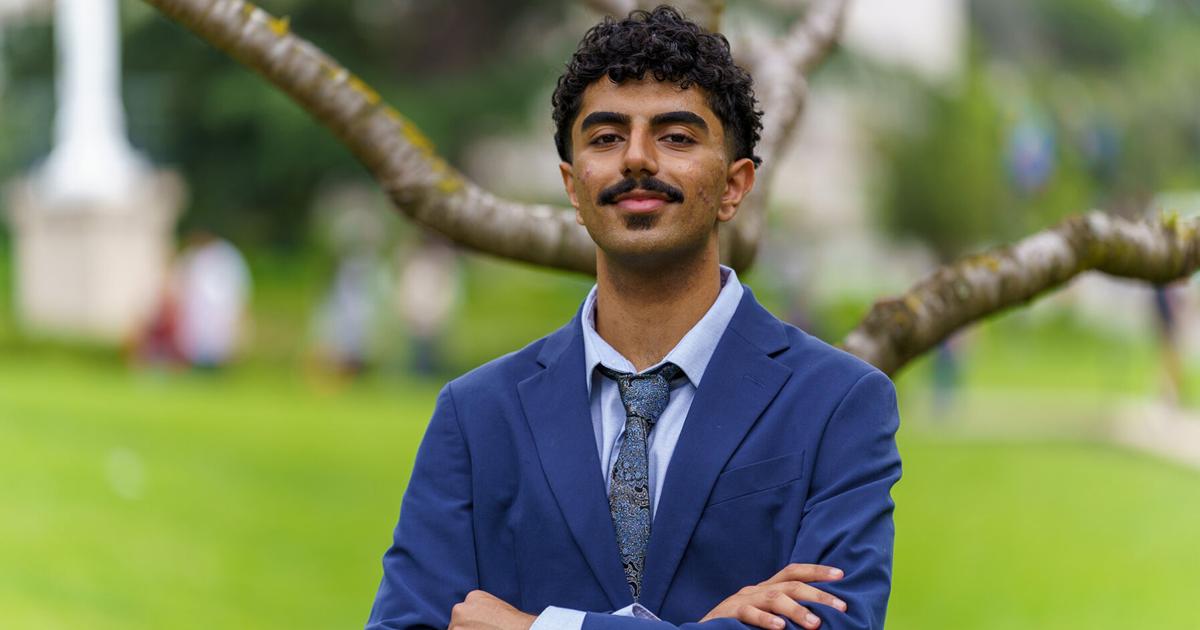
The Editorial Board is pleased to endorse Abdullah Memon for ASUC President. Memon, a junior studying political economy and Middle Eastern Languages and Cultures, is an independent, progressive candidate who understands the threats that the ASUC faces, as well as its points for growth.
Memon has his finger on the pulse of an undeniable truth: the ASUC has not achieved its political potential in publicly pushing back against campus and UC administration. His primary concern coming into office is freedom of speech on campus, an issue made all the more important under an increasingly restrictive campus administration that is all too ready to acquiesce to federal pressure. Memon’s opponents in the race also recognized this issue, but they did not acknowledge the ASUC’s shortcomings in it. Memon told us he saw the current executive slate of the ASUC often act as a “spokesperson” for campus.
All the candidates in this race have nearly identical platforms, similar backgrounds and are highly experienced. However, Memon distinguishes himself in a couple of ways. Carlos González’s platforms on free speech did not go far enough as he only promised to create a free speech conference and asked Chancellor Lyons simply to affirm students’ rights to “lawful speech.” Further, he told us that if he received pushback from campus admin, he would appeal to candidates in the gubernatorial race for relief. We do not see this as being realistic.
Both Memon and Margaret Solomon had more tangible ways to protect free speech on campus, advocating for the creation of a task force to assist with mobilizing students, as well as the use of legal defense funds for students targeted for their protest.
Solomon was a compelling choice, given her experience in organizing events like Culture on the Block for the Black community and being a primary sponsor in the resolution, “Recognition of Genocide in Sudan,” which calls upon the ASUC to boycott Blackrock among other companies invested in the ongoing genocide. But she failed to emphasize the fear of repercussions from campus or the UC regents constrained the breadth and intensity of the advocacy efforts that the ASUC could undertake. The only flaw in the current executive slate she mentioned during our interview was a lack of transparency.
Memon was the only candidate in interviews who could point out that the ASUC is not truly financially independent — in July 2025, the UC declared that student governments could not boycott Israel. An ASUC that is bound to the UC’s bidding on how they may move around their money is not a truly independent one.
Thus, it needs a leader who is willing to advocate for students beyond the narrow confines of the ASUC bylaws. In Memon, we see a candidate not afraid to step outside of Eshleman Hall and tussle with a campus administration that resists change.
By the act of stepping outside of Eshleman Hall, Memon sees the ASUC for what it is: a body with both organs that allocate funding and support student organizations, and a giant tumor — the looming judgment of the UC — that could become malignant the moment the ASUC says “Palestine.”
It is this malaise that has given birth to Memon’s desire to “radicalize the ASUC.” This is a herculean task, but in our current moment, we cannot afford to consider the alternatives. That effort, however hard, is worth trying. We believe in Memon to give it the best shot that anyone can.