
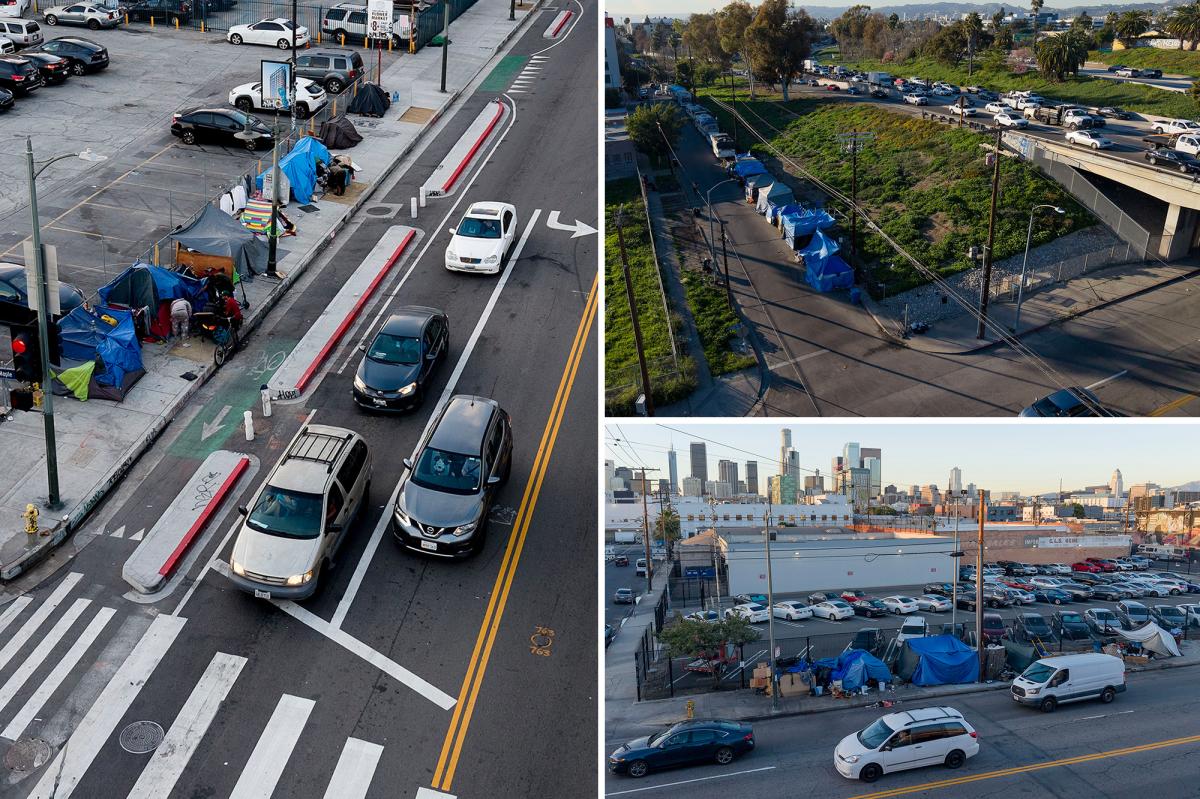
Skid Row in Los Angeles stands as a stark example of what happens when ideology overrides reality.
Spanning roughly fifty blocks, it is one of the most concentrated homeless zones in the United States, filled with people trapped in addiction and untreated, severe mental illness, often marked by psychosis — a loss of contact with reality.
For years, Los Angeles has wrapped its homelessness policies in the language of empathy and housing justice. But Skid Row reveals a harsher truth.
A homeless encampment in Downtown Los Angeles. Andy Johnstone for California Post
What exists there is not simply poverty. It is a concentration of addiction, untreated mental illness, disorder, and human collapse in one of America’s most visible zones of urban breakdown.
Los Angeles has embraced Housing First, a model that places people in permanent housing without requiring sobriety, treatment, or stability first. The goal was to remove barriers to shelter.
But housing alone is not enough for people in the depths of addiction or severe mental illness. Without structure, expectations, or consequences, Housing First too often becomes a system that manages dysfunction instead of confronting it. A key is not treatment. A voucher is not recovery. An apartment is not a cure for psychosis.
Homeless encampments along Silverlake Blvd. near the 101 Freeway Andy Johnstone for California Post
I saw this firsthand when I accompanied Jonathan Choe of Discovery Institute to interview “Egg God,” a tenant who became infamous for posting videos of himself destroying his apartment. He mocked local authorities because he knew how difficult it would be to evict him.
That was not just an outrageous episode. It was a glimpse of a system too weak to demand change and too ideological to admit when it is failing.
Jonathan and I documented what too many officials and advocates prefer to explain away.
Skid Row in Los Angeles stands as a stark example of what happens when ideology overrides reality. Andy Johnstone for California Post
The danger is immediate. Meth and crack are common, and unlike fentanyl, stimulants often fuel paranoia, volatility, and sudden violence. Add severe, untreated mental illness, compress it into a relatively small area, and the result is chaos. Many people carry knives, pipes, or other makeshift weapons, and at times the area feels governed less by law than by threat.
The violence is impossible to miss. Stand on almost any corner for a few minutes, and you are likely to hear or witness an assault. On my first day, I saw people being punched, burned, shoved, and kicked.
The abuse of animals was just as disturbing. There are hundreds of dogs on Skid Row, and in one incident, I watched a homeless man beat his dog with a metal pole and then with his fists. I approached but was threatened, so I called 911. Police arrived, but he was not arrested. Officers told me there was little they could do beyond possibly citing him later for abandonment if the dog were left alone.
Sign up for the California Morning Report newsletter
California’s top news, sports and entertainment delivered to your inbox every day.
Thanks for signing up!
I understand that police are overwhelmed and often constrained by policy and law, but watching them drive away and leave that dog behind was heartbreaking.
There is nothing compassionate about allowing people to rot in tents, animals to suffer at the hands of abusive owners, or the vulnerable to be dominated by the violent and unstable. There is nothing humane about subsidizing self-destruction and calling it mercy. That is not compassion. It is abandonment.
What Skid Row needs is not housing without expectations, but housing tied to treatment, psychiatric care, sobriety requirements where appropriate, and consequences for chronic violence, abuse, and public disorder.
The people living there do not need more slogans. They need intervention, structure, and a system willing to act before collapse hardens into permanence.
Skid Row is not proof that society has been too harsh. It is proof that society has been too afraid to tell the truth. Los Angeles did not build a humanitarian solution. It built a containment zone for human suffering and called it compassion.
Kevin Dahlgren, a contributor to Discovery Institute’s Fix Homelessness initiative, is a grassroots journalist documenting homelessness, addiction, and systemic homelessness policy failures on the West Coast.