
The San Diego city workforce has grown by 2.2% a year over the past decade and a half – more than four times the rate of the general population, according to a new report from the San Diego County Taxpayers Association.
At the same time, capital-improvement needs across the city have reached $7.8 billion and the cost of deferred maintenance is at least $1 billion, researchers said.
But the most alarming finding from the tax-conscious group may be this: The number of middle managers at San Diego City Hall has increased from 70 positions in 2011 to 393 – a 461% increase.
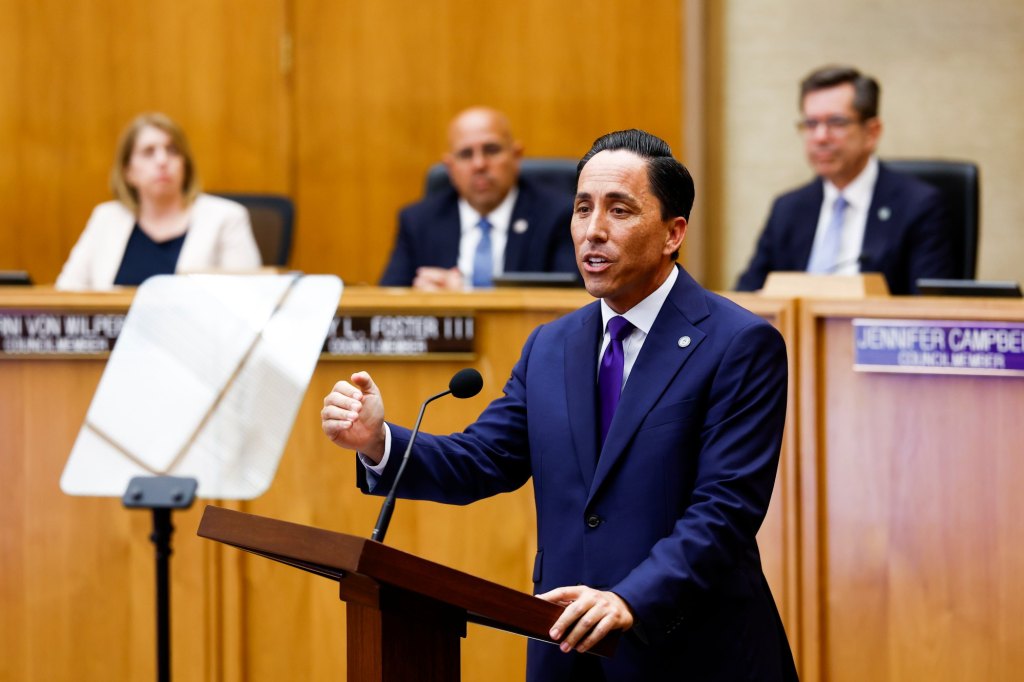
While Mayor Todd Gloria and the City Council grapple with a budget deficit of at least $120 million for the fiscal year that begins July 1, the taxpayers association is sounding the alarm over the fraught state of San Diego finances.
The 21-page analysis lays out case after case in which city officials approved new positions, new programs, salary increases and other spending with too little consideration to maintenance, capital projects and needs.
In all, the report noted, San Diego is confronting budget deficits for each of the next five years between $91.5 million and $139 million in its general fund alone. The total general fund deficit in fiscal years 2027 through 2031 is estimated at $540 million.
San Diego, which employs 12,000-plus people and will spend $6.1 billion this year, also is confronting challenges in its capital-improvement, enterprise and other funds, researchers said.
“The city of San Diego is spending more every year to grow its bureaucracy while its roads, pipes and facilities fall apart underneath it,” said Mark Kersey, the former council member who took over as association president and CEO earlier this year.
“Taxpayers are paying a higher cost per person for city services today than they did 15 years ago, and the data shows they are getting less for it,” Kersey said. “That is not a sustainable model, it is a countdown to failure.”
The study was released last week by the San Diego County Taxpayers Association, which was founded in 1945 as a non-partisan, nonprofit civic watchdog.
It is the first major initiative since Kersey was named the organization’s new leader in February, and came just over a year after the group nearly folded amid a financial collapse in the wake of former executive Haney Hong’s unexpected departure in March 2025. Over the ensuing months, a group of volunteers slashed expenses, trimmed operations and convened a new board of directors.
The analysis came in the same week the San Diego Municipal Employees Association, the union that represents thousands of the city’s white-collar workers, announced a tentative agreement on a new contract that provides members a special 8% pay bump on top of 9.5% in proposed raises.
“More good news,” the announcement is titled.
It also was published as Gloria and his top aides launched a high-profile bid to explain their hiring decisions ahead of the proposed budget due to be released this week.
“You might be hearing a lot about middle managers as we work on next year’s city budget, so let me break it down,” Gloria said in a social media post Thursday. “These are the people who help keep city services running. They schedule crews, manage contracts and make sure work gets done safely and correctly.”
The mayor said some of the positions were created in response to the COVID-19 pandemic, but that the job growth has since slowed down.
“We are not stopping there,” Gloria added. “The next budget includes about 48 fewer management jobs. So yes, we are taking a hard look at staffing but we are doing it responsibly, with transparency and with a focus on protecting the services you rely on every day.”
One day before the mayor released his video, Chief Financial Officer Rolando Charvel issued a memorandum to the council saying “much of the growth is not what it appears.” He said the city already is cutting some jobs and the criticism has been overblown.
“Unclassified positions have become a focal point of public commentary and political debate, unfairly characterized as administrative bloat or excessive management layers,” Charvel wrote.
The taxpayers’ study also raises questions about other city financial practices, including escalating overtime, unfunded pension obligations, lapses in infrastructure maintenance and a history of approving overly optimistic revenue assumptions in order to pass balanced budgets.
Overtime increased by 65% between 2019 and 2024 alone, the study said. In 2024, some 211 employees each collected more than $100,000 in overtime. Almost all of those were police and fire personnel, at a time of persistent vacancies in both departments.
“In the short term, overtime may be seen as a way to save money by leaving vacant positions unfilled,” the analysis said. “In truth, the costs associated with overtime likely outweigh any fiscal benefits.”
The San Diego payroll is outpacing overall spending, meaning it accounts for a growing share of general fund expenditures, the study said.
“Demographic projections confirm there is no way for the city to ‘grow its way out of the deficit,’ so the city must make spending cuts,” it said. “Because the city has not yet made obvious reductions in personnel, they may be underfunding other city services to meet funding requirements for personnel.”
The taxpayers’ analysis also challenged city officials to do more to address the growing gaps in maintenance spending and infrastructure development.
“The consequences are persistently increasing costs of maintaining facilities as their needs grow and conditions deteriorate, additionally risking them becoming capital improvement projects and, at worst, continuing to go unfunded,” the report said.
The result of so much short-term financial decision-making by city officials has dramatically boosted the cost of living in San Diego, the study said.
“Residents are absorbing a much higher cost of city services today than they were 15 years ago,” the report said. “In 2011, on average the city received $1,192 per taxpayer, whereas in 2025 the total climbed to $1,538 – a 29% increase.”
Over the same period, the city payroll jumped by nearly 25%, an increase from $859 per resident to $1,070, the study found.
The report concludes with a handful of recommendations aimed at addressing San Diego city finances in a more pragmatic manner.
City officials should shift from adding administrative jobs to hiring the workers needed for facility and infrastructure maintenance, it said. They should also adopt more realistic budget projections and invest more in capital projects to reduce deferred maintenance.
The mayor and the council also would benefit by using more key performance indicators to measure success department by department, and employ that feedback in developing their budgets.
The association “urges the city to act on these recommendations ahead of the Fiscal Year 2027 budget process,” it said. “Absent significant changes to spending priorities, the city will continue to increase the burden on taxpayers without providing commensurate benefits.”