
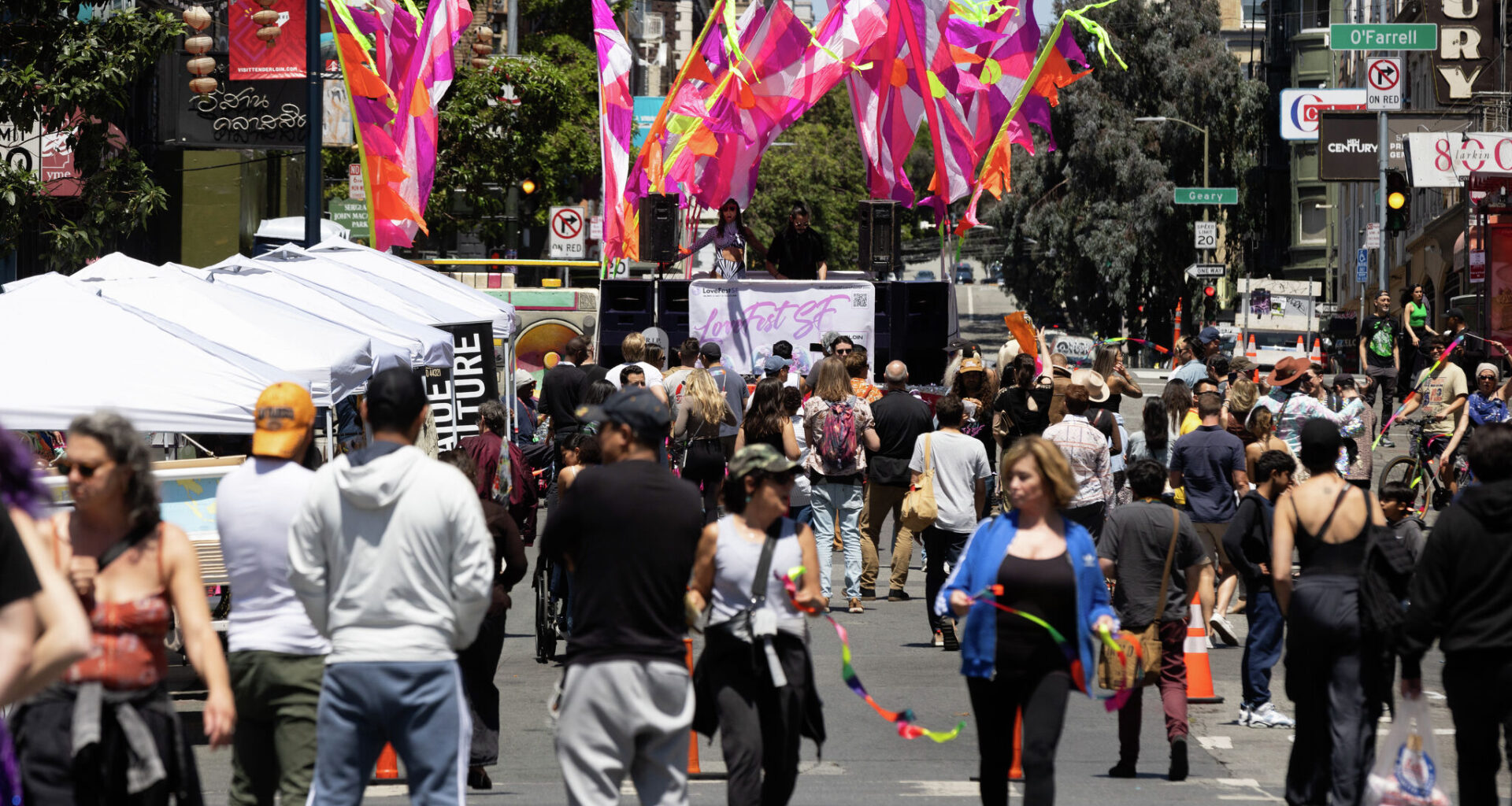
A group gathers at the Love Fest SF block party in the Tenderloin San Francisco. The neighborhood saw significant year-over-year growth in sales tax revenue in 2025, though it still lags behind its 2019 levels.
Benjamin Fanjoy/Special to the Chronicle
Roughly five years after the pandemic, most neighborhoods still had nowhere near as much economic activity last year as they did in 2019, new data on city sales shows.
That’s the bad news. But the good news is that many long-struggling neighborhoods, like the Tenderloin, are getting closer than they ever have.
Sales tax revenue, a proxy for on-the-ground spending by individuals and businesses, plunged across neighborhoods in 2020 as the city ground to a halt. Since then, recovery has been uneven and wavering, the data shows, with some neighborhoods surging ahead and others losing gains they made just a few years ago. And citywide, sales tax revenue still remains well below pre-pandemic levels.
Article continues below this ad
Still, the period between 2024 and 2025 saw faster growth in most neighborhoods than the average of the years since the pandemic, indicating that their recovery is accelerating, said Ted Egan, the city’s economist.
Sales tax data is not a perfect measure of economic activity. City data reflects when merchants paid their taxes — or got refunds — not when consumers and businesses actually bought a good or service. That can mean that, if a business overpays in taxes and later gets a refund, the data can show swings that don’t actually reflect changes in sales.
San Francisco Chronicle Logo
Make us a Preferred Source to get more of our news when you search.
Add Preferred Source
The controller’s office, which publishes the data, told the Chronicle that aggregating the numbers by year (the data is compiled quarterly) can help to mitigate some of this issue.
Article continues below this ad
Still, the data had some significant problems. Some areas were missing entire quarters of data, including the Financial District and the Inner Sunset. In those cases, the Chronicle approximated the quarterly number by averaging the quarter before and after the missing one. Others showed numbers that appeared complete but were eyebrow-raising: the Western Addition, for example, had such large changes from year to year that we excluded it from the analysis.
Even so, the data is one of the only barometers for the city’s economic recovery in terms of consumer activity in neighborhoods.
Some neighborhoods have been standouts over the last year: Japantown, Mission Bay and the Inner Sunset all had higher sales tax revenue in 2025 than in 2019. Others, including the Inner Richmond, Russian Hill and, to a lesser extent, the Sunset-Parkside, weren’t far off after adjusting for inflation. Merchants in the thriving areas have attributed the economic growth in part to people spending more time in their own neighborhoods, an uptick in events and, for Japantown specifically, a growing interest in Asian retailers fueling a boom at the mall.
Meanwhile, other areas continue to struggle: SoMa and the Financial District, for example, are still well below 2019 levels. Before the pandemic, the two neighborhoods were the largest contributors to the city’s overall sales tax revenue. Because they are still so far off from 2019 levels, so is the city overall: By the end of 2025, sales tax revenue citywide was still 27% below 2019.
That figure sets San Francisco apart from other cities: New York’s sales taxes, for example, are actually up more than 10% from 2019, according to data from the New York State Comptroller.
Article continues below this ad
But there are promising signs even among areas that are struggling. In the Tenderloin, for example, 2025 sales tax revenue was still well below that in 2019. But the neighborhood has been gaining ground each year, and saw one of the biggest jumps in recovery between 2024 and 2025.
Kate Robinson, the executive director of the Tenderloin Community Benefit District, said that seeing the increase “gave her hope,” as a longtime resident and organizer in the district, especially after the way the Tenderloin’s economic activity plunged during the pandemic.
“We lived that drop,” she said. As disorder and public drug use became the prevailing narrative about the neighborhood, she said, the area not only lost visitors — even residents became worried about leaving their apartments.
In response, “a lot of painstaking work” has gone into improving what the Tenderloin looks and feels like over the years, Robinson said. Bringing back a feeling of safety is a key part of that strategy, she explained: When people come to see the “Compton’s Cafeteria Riot” play at the Tenderloin Museum, for example, she said, they should feel comfortable walking into nearby establishments as well.
Article continues below this ad
“The food here is already great,” she said, “but people have to feel safe enough to come into the restaurant.”
The community organization’s work has been bolstered by investments from the city and public-private partnerships, she said, including a recent $5 million investment from billionaire and philanthropist Chris Larsen to revitalize Larkin Street.
“We have a lot of alignment with the city,” Robinson said. “We want the same things.”
Economic recovery has been a hallmark of Mayor Daniel Lurie’s strategy, as any scroll through his social media accounts shows. The mayor is constantly touting San Francisco as a “city on the rise” and stopping by and promoting local businesses across neighborhoods.
Article continues below this ad
While the numbers haven’t approached pre-pandemic boom levels, the mayor said in a statement that his administration has made “meaningful progress,” including through rising tax revenues in stubbornly depressed neighborhoods.