
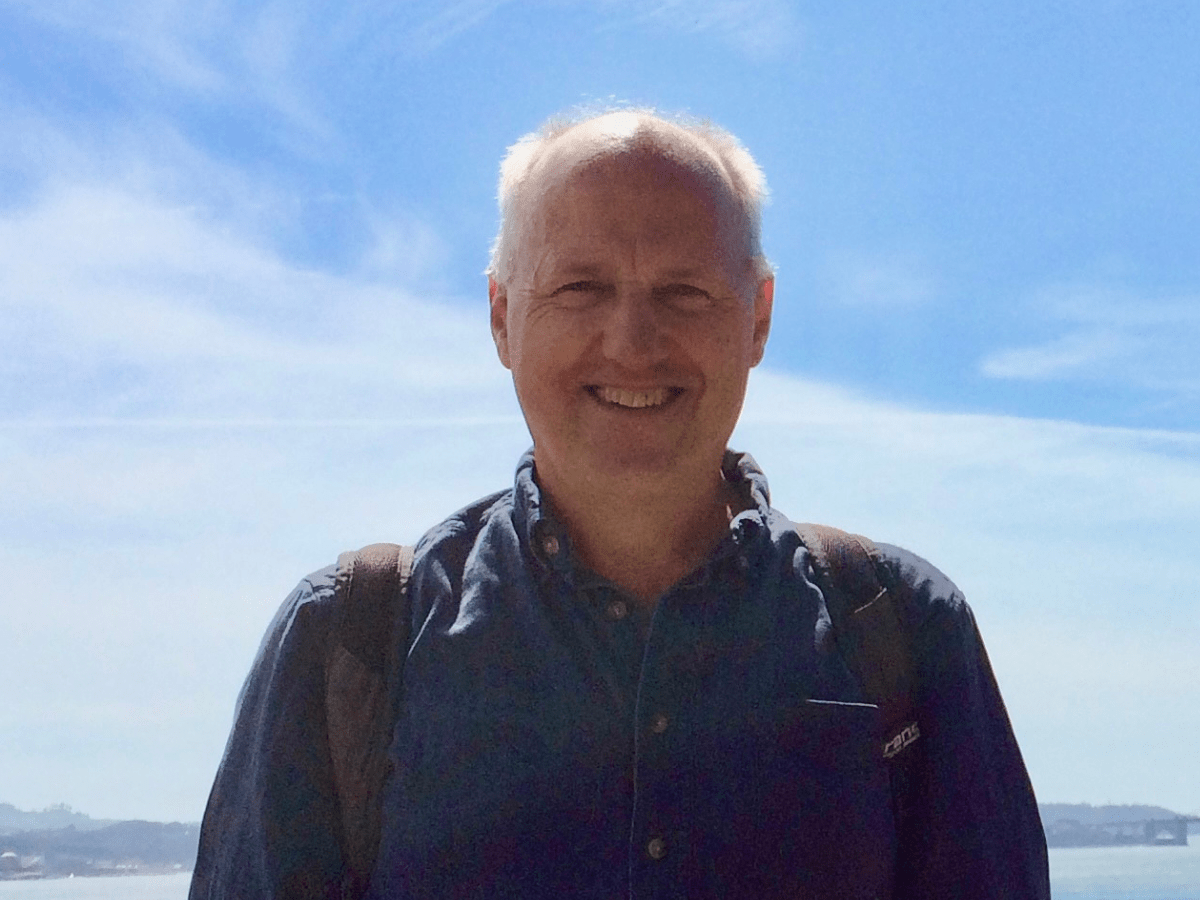
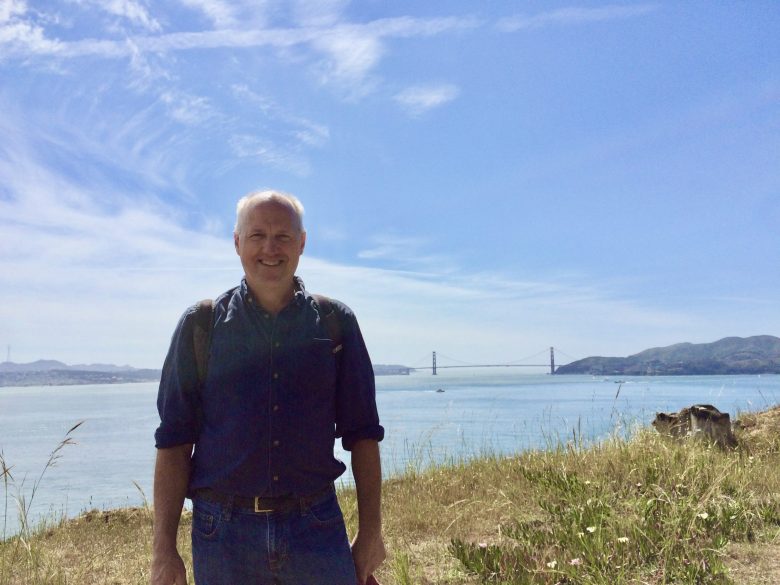
 Hiking along the San Francisco Bay, 2021. Courtesy of his family.
Thomas John Carlson, a kind and brilliant physician and botanist who creatively blended these two disciplines to educate, uplift and heal thousands of lives, passed away peacefully at home on a beautiful spring day, April 9, 2025, from corticobasal syndrome. He was 68.
Tom was born in the village of Constantine, Michigan, on Oct. 6, 1956, the seventh of nine children born to the large and loving Catholic family of Wilbert (Webb) and Joan Carlson. A curious child, he loved spending time in the woods near his home, snacking on wild edibles and making his first botanical “leave” collection at age 11.
A passion for plants and service
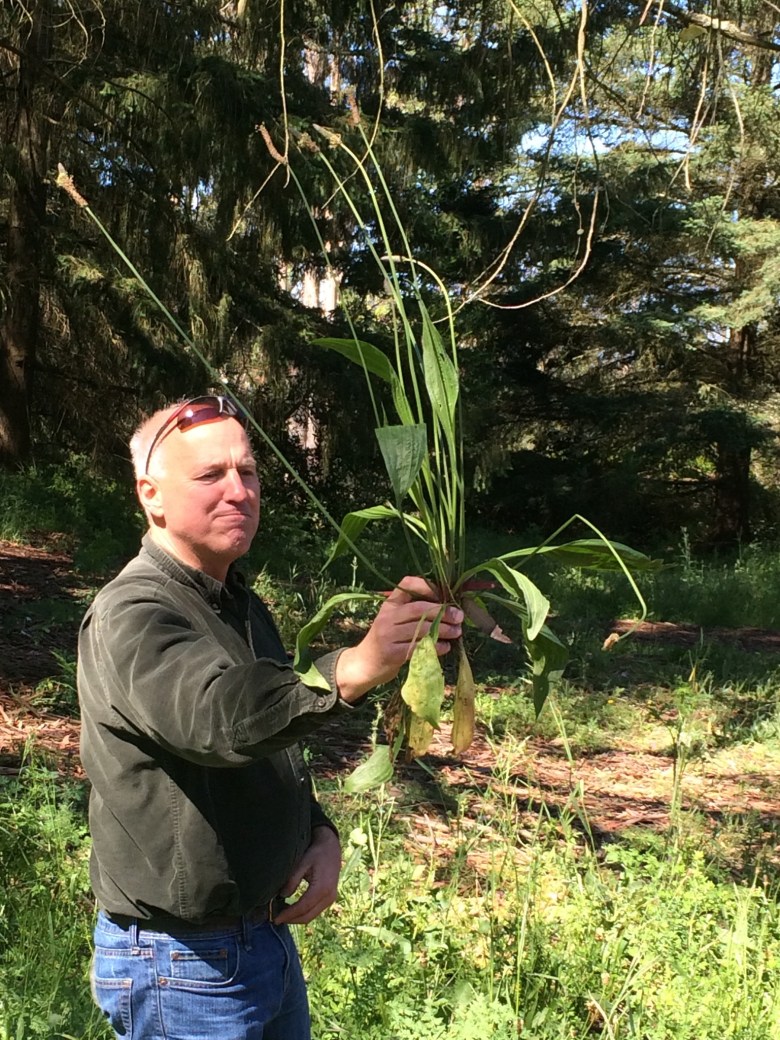 Showcasing a beautiful specimen of Plantago, a delectable edible weed, 2018. Courtesy of his family
Tom pursued his love of plants graduating with both a bachelor’s (1981) and master’s (1982) degree in botany with highest honors from the University of Michigan in Ann Arbor. He had an insatiable appetite for learning, spending most weekends out “botanizing” with his mentor Herb Wagner, and he specialized in the geographic distribution of wood ferns, Dryopteris.
Tom’s passion for botany was matched by an equally strong commitment to service. He studied Marxist agroecology in southern Mexico, helped organize a teach-in on world hunger, and later became the first SEVA Foundation volunteer at Aravind Eye Hospital in Madurai, India. There, he studied the role of household kitchen gardens in reducing Vitamin A deficiency-related blindness and remained lifelong friends with members of the SEVA family. But Tom was perhaps best known during his time at Michigan for riding a bicycle across the quad in the dead of winter wearing only a T-shirt, gleefully howling at the top of his lungs.
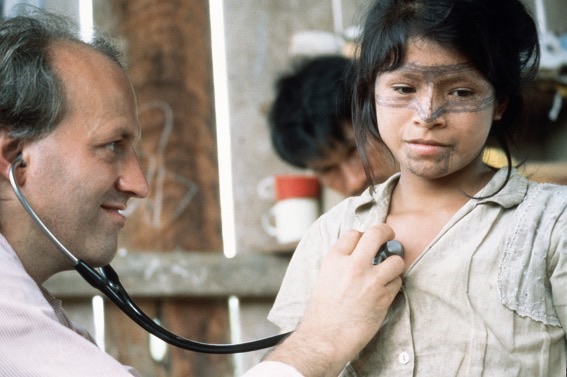 Examining a patient while conducting ethnobotanical research in the Ecuadorian Amazon, circa 1992. Courtesy of Shaman Pharmaceuticals
Tom was torn between pursuing a Ph.D. in botany, with an emphasis in ethnobotany, or an M.D., eventually choosing medicine at Michigan State’s College of Human Medicine (1987). He completed his pediatric residency at Stanford University in 1990. One professor reflected, “Tom always had a smile on his face. Even after working overnight caring for patients, he would always have a positive attitude in the morning during rounds. And best of all, his joy was contagious, making everybody’s day better.” Tom began a second residency in ophthalmology at UCSF but left after one year joking it was “too myopic.” He later returned to India several times as a medical volunteer, helping restore sight at eye camps, and providing care to residents of Mother Teresa’s Home for the Dying and Destitute. Inspired by the teachings of Sant Darshan Singh, he also lived and served as a physician at Kirpal Ashram near Delhi.
Medical ethnobotany: plants, culture and medicine
In 1992, Tom joined Shaman Pharmaceuticals, an innovative company built on the idea that ethnobotany, the study of how Indigenous cultures use plants for medicines, could advance modern drug discovery. As Vice President of Medical Ethnobotany and Clinical Development, Tom led field research teams, learning directly from Indigenous peoples about their approaches to nutrition, disease and plant-based healing. Over nearly a decade, he worked with 40 different ethno-linguistic groups in 15 different countries across Africa, Asia, Latin America and the Pacific Islands. He valued and embodied the company’s commitment to bio-cultural diversity conservation and to sharing benefits with the communities who contributed their knowledge. His work was featured in The Washington Post, Life magazine and many other publications.
Kaiser Pediatrics: Healing from the heart
As Shaman shifted direction, Tom went on to build a popular pediatric practice at Kaiser Oakland from 2002 to 2007, serving as Assistant Chief for four years and continuing part-time through 2015. He loved his patients and families and was widely sought after for his integrative approach, cultural understanding and compassionate care. One parent recalled nearly forgetting their child’s illness during a first visit, drawn into a fascinating conversation with Tom.
Family, joy and adventure
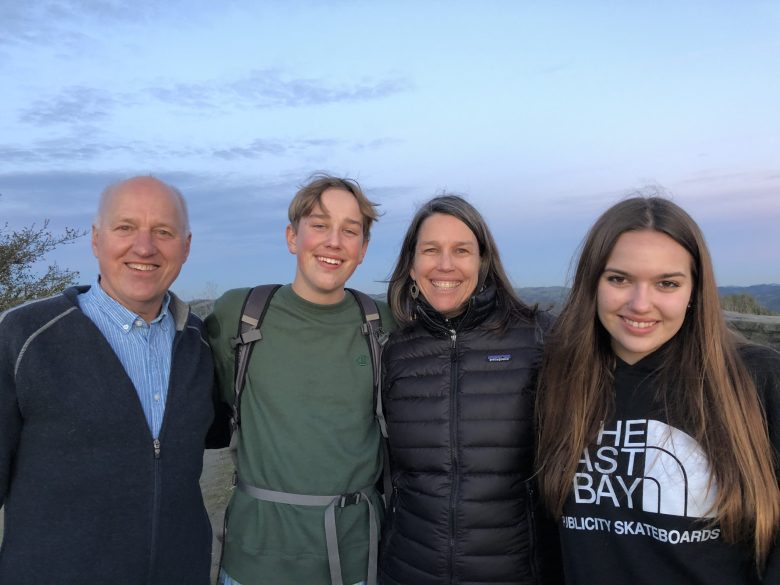 Left to right: Tom Carlson, Leif Carlson, Jennifer Sowerwine, and Indigo Carlson, 2020. Courtesy of his family
During his years with Shaman, Tom met his wife, Jennifer Sowerwine, the “love of his lifetimes,” at the Himalayan Fair. Sharing passions for ethnobotany, Eastern spirituality, and working with Indigenous communities, he proposed with a yarrow ring, and they married in 1997 on the north shore of Oahu, a place that symbolized a bridge between the East and West, and a reflection of their shared spiritual journeys.
When Tom became a father to Indigo and Leif, he never imagined how much love his heart could hold. He proudly paraded them down the halls at Kaiser when they were infants, and regaled his students with stories about their latest developments during lecture and office hours. He was their biggest cheerleader, showing up for every sporting, music and school event. Travel was now reserved for family; summers and breaks were filled with camping, road trips and international travel alongside friends, botanizing all along the way, inspiring a lifelong appreciation for all that life has to offer. A true family man, Tom created a home where his children felt safe, celebrated and profoundly loved.
UC Berkeley: A teacher who transformed lives
Tom joined UC Berkeley’s Integrative Biology Department in 2000, quickly becoming one of its most beloved and influential teachers. He created several wildly popular courses including his signature course, Medical Ethnobotany, as well as Evolutionary Medicine, and Human Reproduction; he also taught Human Anatomy. Teaching around a thousand students annually, Tom became a foundational core of the IB department.
At the heart of Tom’s teaching was a deep respect for Indigenous knowledge and botanical healing traditions. He didn’t just teach these values, he lived them: co-founding the Karuk Tribe-UC Berkeley Collaborative to support pathways to higher education and Tribal eco-cultural revitalization. In 2007, Tom was honored by the Intergovernmental Panel on Climate Change (IPCC) for his contributions on Indigenous knowledge, stewardship, and climate resilience to their work that earned the Nobel Peace Prize.
For Tom, every interaction was an opportunity for genuine connection. His office hours often had a line out the door, as students eagerly waited to hear Tom’s vivid stories about his vast ethnobotanical collections or to seek his guidance on academic, medical or personal paths. He wrote hundreds of letters of recommendation each year, opening doors for aspiring physicians, nurses, dentists, and countless others.
In their thank you notes, students consistently described Tom as a transformative mentor who went above and beyond to make them feel seen, heard, valued and capable of more than they imagined. As one student shared, “You helped me remember that I was accepted to this university for a reason and that it wasn’t a mistake … that one setback in life doesn’t dictate the leaps I can make later.”
Many credited him with shaping their paths in medicine and science, not only through his teaching but through his deep respect for diverse ways of knowing and healing. A student reflected, “I have always felt like an outsider because others would discredit my family’s choice to practice non-traditional medicine, but now I feel validated knowing those practices are not a myth.” Another shared, “You were not only an amazing teacher but a role model. … I will strive to be a culturally sensitive physician like you.”
A childlike sense of wonder: ‘Larger than life and yet so down to earth’
Tom had an infectious sense of wonder for the natural world and a boundless enthusiasm for life. Whether cooing at neighborhood cats, stopping mid-hike to crush a leaf and say, “Get a whiff of this!” or turning a walk into an impromptu lesson in edible weeds, his delight was contagious. He lived each day like it was his first, often quoting the Bob Dylan lyric, “he not busy being born is busy dying,” a reminder that continual growth is essential to true freedom.
A colleague who’d known Tom from his undergraduate days recalled that he was “the most enthusiastic student of Botany we had ever seen — and it wasn’t even close. One day he burst into my office shaking with excitement, asking if I’d ever seen anything as beautiful as the frond of Adiantum pedatum (Northern Maidenhair fern) he held in his hand.”
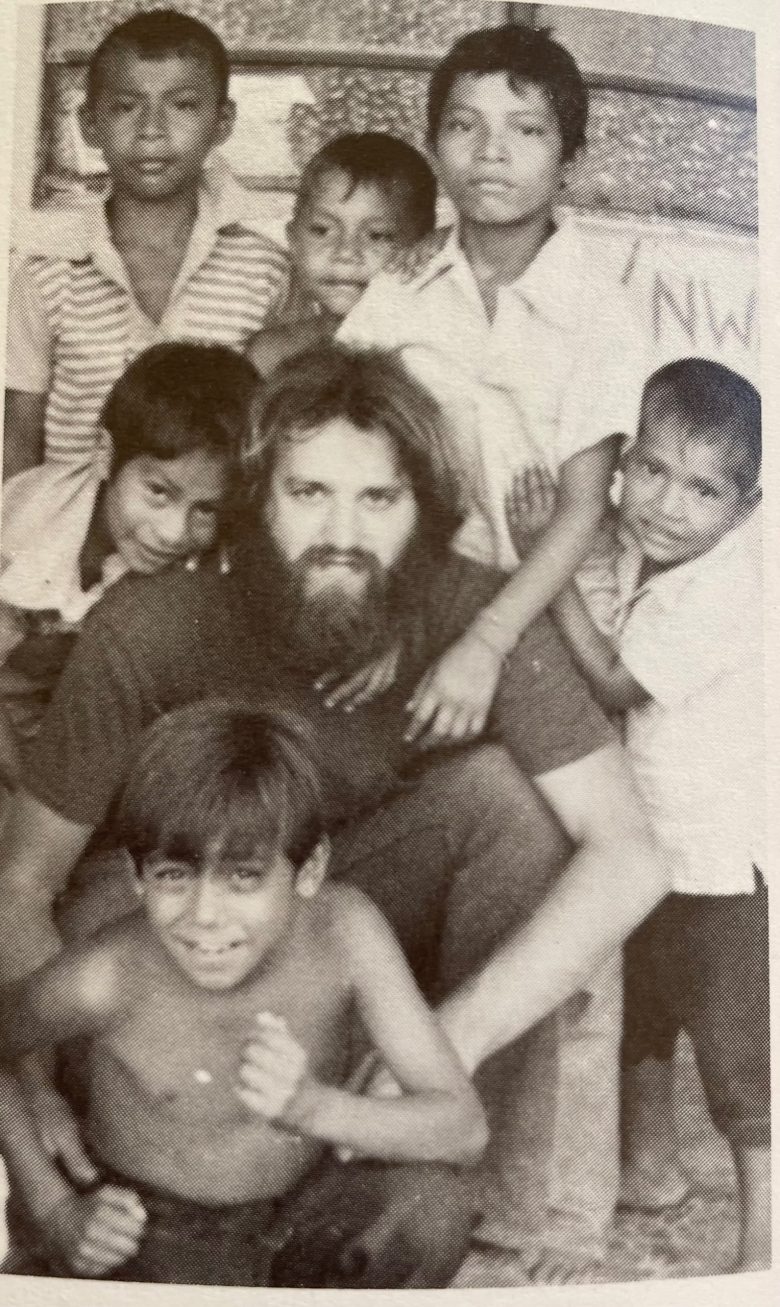 Surrounded by children who sensed a kind soul, Cardenas, Mexico. Early 1980s. Courtesy of Carlson’s collections
Always encouraging people to think and act outside the box, Tom teamed up with a colleague to explore and teach about the abundance of nutritious, edible weeds in urban ecosystems. Hikes with friends and family became tactile adventures in plant identification and foraging, sampling a Plantago here, or a Bristly Oxtongue there, where even the least interested couldn’t help but absorb some of his enthusiasm. In an episode of NPR’s Science Friday, his gift for igniting excitement about the natural world is on full display.
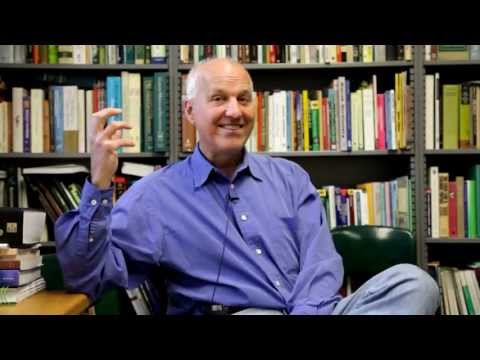
Tom was unapologetic in his joy, celebrating successes with robust high-fives and laughing in full-body waves (especially at himself). His glass was not just half full but overflowing. As one colleague noted, “He always had a kind word, a ready smile, and emanated a warmth and gentleness that is all too often missing in academia … and in the rest of the world.” Others described him as “larger than life yet so down to earth; radiating intellect, interest in everything and everyone, joie de vivre, compassion and good will.”
Another colleague reflected, “We think of our colleagues as amazing scientists, great teachers, wonderful people and outstanding humanitarians. And then there was Tom.”
Tom left his mark on nearly everyone he met, leaving them with a smile and an open heart. May we all be more present in our lives, share more love, joy, and kindness freely, and leave this world a better place, just as Tom showed us.
Carlson is survived by his wife, Jennifer; daughter Indigo; son, Leif; siblings Bill, Jim, Jan, Joyce, Dan, Tim and Joe and their families; and the thousands of students who carry his legacy forward. Donations in Tom’s memory are warmly welcomed.
• UC Berkeley Botanical Garden — to support a special tribute in Tom’s memory at the Garden, please include “In memory of Tom Carlson” in the “Additional Information – Comments” section.
• Thomas J. Carlson Scholar Award Fund – to support students in the Integrative Biology Department at UC Berkeley who demonstrate a strong scholarly record and exemplify Tom’s passion for learning.
“*” indicates required fields