
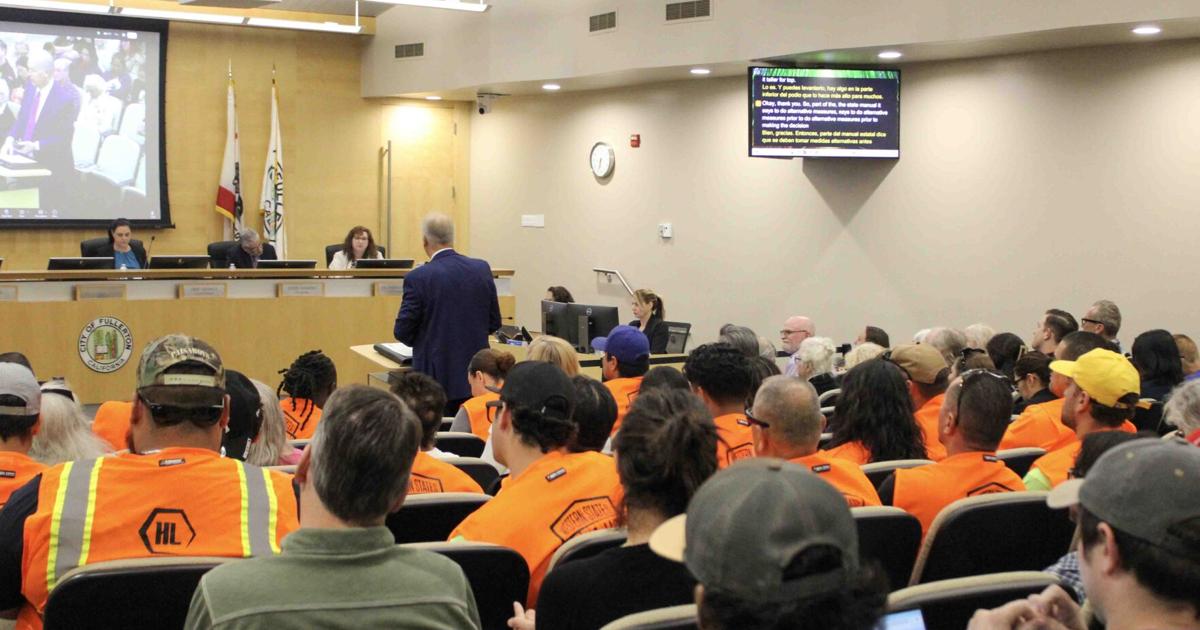
Fullerton City Council voted against installing a traffic signal at Euclid Street and Valley View Drive during the April 7 meeting.
In March 2025, the city’s transportation and circulation commission recommended the city council approve designation of a traffic signal at the intersection, due to traffic in the area.
At the time, the city council moved to return the item to the commission for further review. During Tuesday’s meeting, the contract traffic engineer and the commission stated that, upon review, installing a traffic signal remained the best course of action.
City employees also recommended the city seek grant funding from the federal government to complete this project, but the amount the project would have received was unknown.
The transportation and circulation commission discussed options to mitigate traffic with residents of the neighborhood.
City planners have previously tried a number of strategies to mitigate traffic at the intersection, including resurfacing and re-striping the road, installing speed display signs and dispatching speed enforcement to the area.
“The issue really is physical, where the roadway itself is not straight, nor is it flat,” said Traffic Engineer Dave Roseman in his presentation to the city council.
Concerns over street closures during construction and the traffic the new light will generate were brought up during the city’s presentation and public comment.
One notable concern among residents was the potential for increased traffic on residential streets due to drivers cutting through residential neighborhoods to evade the traffic signal.
Some shared that inputting a traffic signal without installing sidewalks on the street could create safety concerns.
A number of residents have been advocating for the intersection’s signalization for over three years, following an incident where a car crashed into a brick wall along Euclid Street in the city of Garden Grove.
Fullerton Mayor Fred Jung spoke during the meeting to say that the city should instead focus on enforcing speed limits throughout the city.
Other council members rejected the proposal for a signal on the basis that it would be more efficient to keep planning with city planners rather than continuing to bring the issue back to city council.
“This to me is something that staff should and can work out on their own. And I don’t think this is something that needs to go through a commission or come back,” said Councilmember Nicholas Dunlap. “I mean clearly it went back to a commission 13 months ago and what we got back was the exact same thing.”
The transportation and circulation committee is able to act in an advisory capacity to the city council. The city traffic engineer is able to determine the timing, maintenance and installation of traffic control devices, but only council members can authorize funds.
According to Councilmember Ahmad Zahra, certain costs related to approving projects, such as signalization, must be approved by the city council.
“There’s a cost involved in this, and that cost can only be appropriated — that level, it’s a significant amount of money, and that has to be appropriated by council,” Zahra said.
Ultimately, the city council moved to reject the recommendation for signalization and directed staff to search for other options on Euclid Street.
The final vote was 3-2 with Jung, Dunlap and Councilmember Jamie Valencia voting to reject the signal and Zahra and Councilmember Shana Charles voting against the rejection of the recommendation for a signal.