
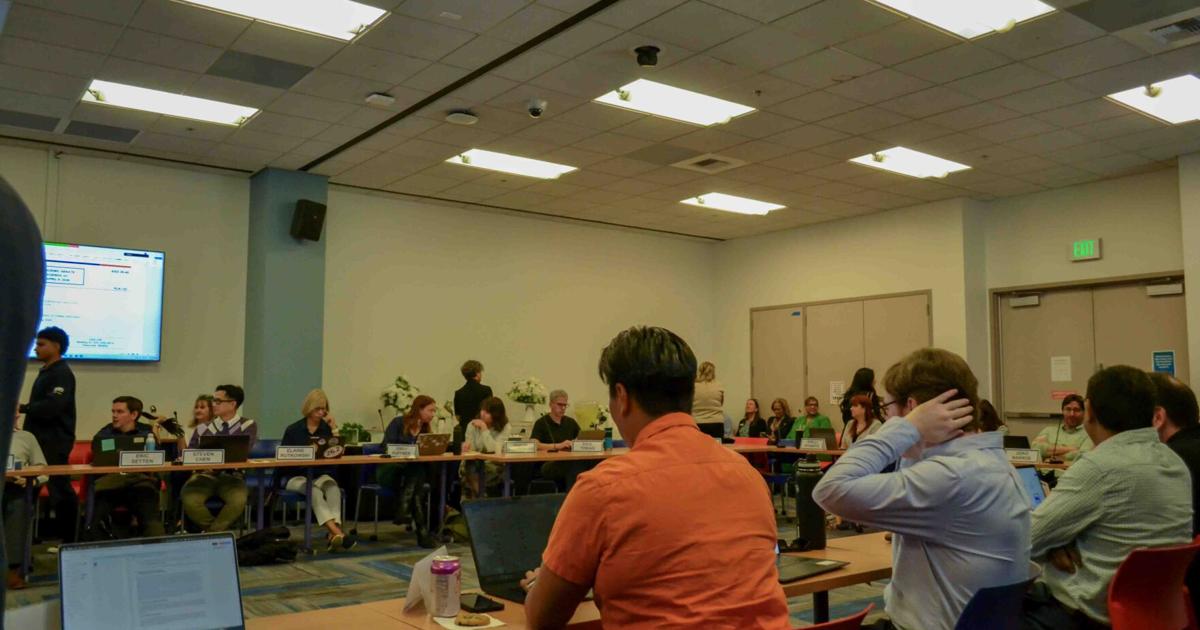
The Cal State Fullerton Academic Senate approved revisions to two University Policy Statements regarding investigating research misconduct and revising university policy statements last Thursday.
The senate also discussed making further changes to the already revised online instruction policy.
At the start of the meeting, Senator Kristi Kanel brought forth one of the two policies revised and approved to the floor as an item of urgent business.
UPS 630.000, entitled Policy for Investigating Instances of Possible Research Misconduct, establishes “policies for handling allegations for research misconduct in compliance with current federal and state regulations,” according to the document itself. The policy applies to every CSUF affiliate that is conducting research, scholarly and creative activities in any and all circumstances.
Changes were made to ensure the policy was in line with updated federal regulations issued by the U.S. Department of Health and Human Services Office of Research Integrity. The changes made include updating definitions, reorganizing policy sections and clarifying terminology and role descriptions within the policy.
If the university fails to maintain a policy not in compliance with federal research misconduct regulations, then CSUF’s eligibility for federal research funding could be put at risk.
“We want to be in full compliance and we want to continue funding uninterrupted. So this is absolutely something we need to get done immediately because I think it has to be due before our next senate meeting,” Kanel said.
The policy was passed unanimously with the revisions made by CSUF’s Faculty Research Policy Committee.
UPS 100.015, entitled Review and Revision of University Policy Statements, was brought to the senate as a matter of new business at the March 19 meeting. The Diversity, Equity and Inclusion Committee revised the policy to increase the clarity and transparency of the UPS revision process and to provide a guide that helps to assist committees when the need arises to revise policy documents.
The guidelines provided are meant to make sure that revisions are “aligned with the university’s goal for inclusive excellence,” according to a document sent to Senate Chair Matthew Jarvis.
An amendment to the revised policy was proposed Thursday, April 9 to say that a longer document will be provided to committee chairs to help members follow the new guidelines on revising other policies.
Senator Joseph Carlin explained to the senate how the DEI committee developed a longer document last year and had incorporated some of the language used in the document into the revised policy.
“What the second document does is it educates, it brings an educational tool,” said Senator Parvin Shahrestani. “So it provides some guidelines, some information of how you might actually go about, if you don’t have a background in this, how might you actually go about (revising policy) without extensive extra work.”
The original revisions presented to the senate at the March 19 meeting passed with the amendment being revised to clarify the creators of the policy guidelines.
UPS 411.104, entitled Policy on Online Instruction, was brought up for discussion to further amend the policy to create flexibility in instruction for online classes when the professor teaching the class has an emergency to attend to.
Other members of the senate raised concerns of students’ attention spans if a hybrid class were to go fully online and whether the change would honor the class’s accreditation.
“’So this week, with notice, due to an emergency, we’re gonna meet via Zoom asynchronously at the scheduled time. Save your trip to campus.’ That’s what I’m asking for,” said Senator Teresa Landeros. “That flexibility under exceptional circumstances. So we’re still honoring accreditation, but we’re also honoring the faculty emergency situation and the student.”
While it has not yet passed, the Senate voted to carry the amendment to the next scheduled Academic Senate meeting, where they will discuss the matter further.