
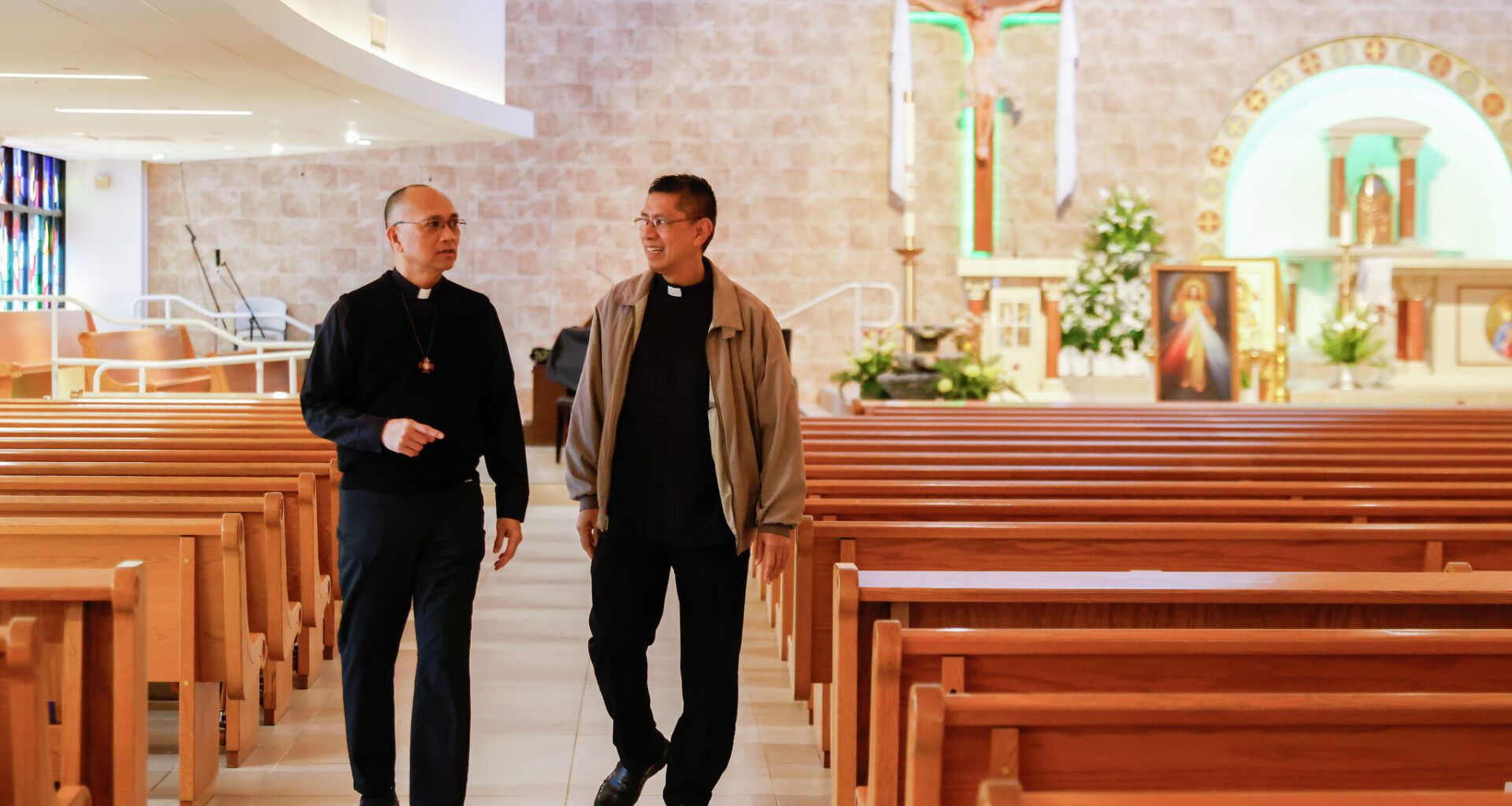
Father Raymund Reyes, left, and Father Francis Garbo walk through St. Augustine Catholic Church in South San Francisco, where Father Ray is pastor. Father Francis donated one of his kidneys to Father Ray in January.
Jessica Christian/S.F. Chronicle
Father Ray puts on his vestments at St. Augustine Catholic Church in South San Francisco before mass.
Jessica Christian/S.F. Chronicle
Father Francis leads the morning mass inside the Old Mission Dolores church in San Francisco.
Jessica Christian/S.F. Chronicle
Father Ray fixes a plate of Filipino dishes including lumpia and pancit.
Jessica Christian/S.F. Chronicle
A Catholic priest is called to serve. But for Father Ray, that call was getting harder to answer.
After seven years as pastor at St. Augustine Parish in South San Francisco, Father Raymund Reyes, 62, was in kidney failure. He was tired all the time, and dialysis three days a week wiped out what little energy he had left. He was put on a waiting list for a kidney transplant, but told it could take eight years.
About 30,000 people are added to kidney transplant waiting lists in the United States every year, but only 22,000 transplants are performed. Hundreds of people die each year waiting for an organ.
Article continues below this ad
The solution for Father Ray — and perhaps for many others — was not to wait. Instead he did what once felt impossible: he asked for help, and then accepted from a friend a gift he will never be able to repay.
Father Ray prepares for services at St. Augustine Parish in South San Francisco. Father Ray had IgA nephropathy, an autoimmune disease that causes inflammation in the kidneys and can lead to chronic disease and organ failure.
Jessica Christian/S.F. Chronicle
On Jan. 20, Father Ray received a kidney from Father Francis Garbo, pastor of Mission Dolores Basilica and Misión San Francisco de Asís in San Francisco, in what’s known as a living donor transplant. Father Ray now has three kidneys, and Father Francis, 64, just one.
San Francisco Chronicle Logo
Make us a Preferred Source to get more of our news when you search.
Add Preferred Source
Two days after Easter, both men were looking lively for lunch at Father Ray’s residence, a split-level home he shares with three other priests behind St. Augustine. Both men are trim with short graying hair and wire-rimmed glasses, and they exude a gentle calm that belies their humor.
Article continues below this ad
When Father Francis walked in, Father Ray joked that he felt lit from within — like the kidney recognized its previous owner.
“I’m just here to visit my kidney’s new parish,” Father Francis laughed in return.
The transplant was performed at Sutter Health’s California Pacific Medical Center in San Francisco, which is attempting to reinvigorate a once-thriving living donor program. At its peak in the 2010s, surgeons were doing 120 kidney transplants a year; now, CPMC performs just 30 to 40 a year.
Across the United States, kidney transplants from living donors have dropped over the past 15 years — down from roughly 37% of transplants in 2010 to about 30% in 2025. The number of transplants from deceased donors has gone up, but so has the need for donor kidneys overall. That’s due in part to medical improvements that have allowed people to live longer with kidney failure, despite high mortality risk, and therefore remain longer on the waiting list.
“I think the only pathway out of this is to push for living donors,” said Dr. Shiang-Cheng Kung, a nephrologist who was recruited to rebuild CPMC’s living donor program last year.
Article continues below this ad
Father Ray touches the place on his stomach where he received a kidney from Father Francis. He had initially been reluctant to ask for help finding a donation.
Jessica Christian/S.F. Chronicle
Studies have shown that donating a kidney is generally safe, and living with one organ does not affect kidney function in the long term. Donors have a slightly increased risk of developing high blood pressure and diabetes, but they have a normal life expectancy. They typically stay a few days in the hospital after surgery and take about six weeks to recover fully.
The reasons for the decrease in living donors aren’t entirely clear, but likely are tied somewhat to the pandemic, when hospital systems would not have had the resources to support programs that require extensive time investments, Kung said. Also, rates of obesity and diabetes have climbed significantly over the past two decades, which means more people are not considered healthy enough to donate.
But finding altruistic people who want, and are able, to donate is not actually the biggest hurdle in most cases — it’s encouraging reluctant patients like Father Ray to ask for what they need.
Maggie Jacobs, the living donor “champion” at CPMC who works with patients and families in need of a transplant, said only about 20% of the people she speaks with are willing to share their story and cast a wide net for a donor. “We live in a society where we’re conditioned to not talk about our medical problems,” Jacobs said.
Article continues below this ad
A private struggle
Father Ray and Father Francis met in San Francisco in the late 1990s, shortly after both arrived from the Philippines, and established a quick friendship. They were busy with their jobs as they transferred to parishes around the San Francisco Archdiocese, but would find time about once a month to share a meal or golf, and they would run into each other at religious and community events.
The kidney disease diagnosis came in 2019, the same year Father Ray was made pastor of St. Augustine. He got checked out after noticing blood in his urine; at the time, he knew almost nothing about kidney disease. “When I met my nephrologist, I didn’t even know that was what a kidney doctor was called,” he said.
Father Ray had IgA nephropathy, an autoimmune disease that causes inflammation in the kidneys and can lead to chronic disease and organ failure. The condition, which is more common among Asian people, is often slow-moving and can take years to develop into chronic disease. For a while Father Ray managed the condition with diet and exercise. People commented on his weight loss, but he didn’t tell anyone, at first, about the diagnosis.
Father Francis, left, and Father Ray meet for a lunch of Filipino dishes like lumpia and pancit at Father Ray’s home on the property of St. Augustine Catholic Church in South San Francisco.
Jessica Christian/S.F. Chronicle
Last year, though, symptoms of kidney failure appeared. He was short of breath and fatigued, and his legs became swollen with water retention. His doctors said he would need dialysis and eventually a transplant. Father Ray began to open up with a few close parishioners about his struggles.
Article continues below this ad
“I was very private about it because as a priest, I didn’t want to make myself a burden to the community,” he said. “As a priest, I’ve always been trained to be of service to others as much as possible.”
Father Ray started dialysis, which artificially performs the fluid-balancing and waste-removal functions normally handled by kidneys. First he was at home, but after he developed an infection he moved to hemodialysis, which required visiting a clinic three days a week; he was on it for eight months. The dialysis itself was physically draining, and though Father Ray was still able to celebrate Mass, just walking from his home to the church 20 feet across a courtyard was a challenge. He often didn’t have the stamina to visit with parishioners between medical appointments.
During that time, a parishioner who worked for Sutter recommended that Father Ray move from Stanford, where he’d been treated for several years, to CPMC, where he might be on a shorter wait list for a kidney transplant.
There, he met Jacobs, who had experience with kidney donation from both sides of the transplant. Her husband had been a recipient and in turn Jacobs, bursting with gratitude, had donated a kidney to another patient, a stranger.
Father Ray puts on his vestments inside St. Augustine Catholic Church in South San Francisco. Before his kidney transplant, he was often so tired from medical appointments he couldn’t meet with his parishioners.
Jessica Christian/S.F. Chronicle
She had learned from her own experiences how difficult it was to ask for a kidney. How could someone be so bold, to ask for such a gift? But at the same time, her husband would die without one — how could they not?
“We don’t want to be a burden. We don’t want to ask for help. We don’t want to receive help. And there are a lot of emotions wrapped up in all of it — guilt, shame, fear,” Jacobs said.
“But if you can get past that wall,” she went on, “you will get an enormous outpouring of love and support. It truly is a reflection of the lives you’ve touched, including lives you don’t even know you’ve touched.”
Jacobs convinced Father Ray to share his story. She told him that he was surrounded by a community that would surely love to support him. She told him to imagine what a privilege it might be for someone to give him a kidney and save his life.
An unlikely match
In September, Father Ray wrote an open letter to his parishioners, revealing his condition and asking for their prayers. He told them he was looking for a donor. Eventually about 40 people volunteered, including four priests.
None of the first volunteers worked out. Some weren’t healthy enough or had conditions that ruled them out. Others weren’t a good match, which could mean they didn’t have the right blood type or there was some other signal that made organ rejection a concern.
One day when Father Francis was visiting, Father Ray asked if he’d volunteered to donate, and Father Francis said he had not yet.
“I just brushed it off,” Father Francis said. “I did not see myself as a prospective donor. I did not even know my blood type. So I just continued to pray for prospective donors.”
Father Francis prepares for morning mass inside the Old Mission Dolores church in San Francisco. Father Francis did not initially expect to be a donor match for Father Ray.
Jessica Christian/S.F. Chronicle
He didn’t forget, though, and after a few weeks Father Francis pulled up the volunteer website and filled out the forms to be a donor. He got a call from Sutter a few days later, and then began a battery of tests.
Doctors made sure Father Francis and his kidneys were healthy, and that the priests’ blood types matched. They did psychological evaluations and talked Father Francis through what could happen to him, including the very small risk of death.
“They ask, ‘How will you feel if you have given the kidney and later on the patient doesn’t take care of it or something happens?’” Father Francis said. “And I said, whether it is taken for granted, I have given it to them, it is theirs.”
They told him, he said, that people would call him a hero or a saint at first, and it might be tough to experience that and then go back to being just Father Francis. “I told them I’m already just an ordinary Joe.”
Just before Christmas, Father Francis got the call that he’d passed. He would be Father Ray’s donor. Staff at Sutter insisted that Father Francis be the one to tell Father Ray, so he drove down to tell him in person.
Father Francis leads the morning mass inside the Old Mission Dolores church in San Francisco. He was back home in three days after donating his kidney, and back at work within a week.
Jessica Christian/S.F. Chronicle
“We just sat in his living room and I asked how his dialysis was, and how he was feeling,” Father Francis said. “And then after that I said, ‘I passed. I got tested and I passed and I will be your donor.’”
“Was there tears? Was there crying? There was none,” Father Francis said with a chuckle. “He just asked why I did it, and I said, because you told me.”
Easter
The transplant was performed on a Tuesday morning. The night before, Father Ray’s care team — seven parishioners who had been feeding him and shuttling him to appointments and looking after him for months — held Mass with their priest and Father Francis.
“If something happened to me, in the operating room, it would have been my last Mass,” Father Ray said. “So I was offering to the Lord, thanking him for the opportunity to be a priest for the past 30 years. And thanking Father Francis for coming forward to make this happen. That was very, very meaningful to me.”
Father Francis was back home in three days and back at work within a week. He is the same as before, he said, but with a small scar below his belly button.
Father Ray is still recuperating; he takes 21 pills a day to prevent infection and organ rejection. But physically, he said he feels great. He’s walking at least 10,000 steps a day and he’s gained about 15 pounds — not all of it from the extra organ, he jokes.
Over the past year, Father Ray said, he prayed only once in despair, doubting God’s plan. “I would ask why would God let me experience this when I could have done more for him? Why would he let me suffer and become helpless?”
He found comfort in a verse from Psalm 103: “the Lord is kind and merciful.” This time of his life, he came to understand, was meant to teach him to accept that kindness and mercy and to treasure it.
Father Francis was told just before Christmas that he was a donor match for Father Ray, and drove to tell him the news in person.
Jessica Christian/S.F. Chronicle
On Easter Sunday, Father Ray got up early to watch a pre-dawn reenactment of the emotional reunion between Jesus and Mary after the Resurrection; it’s a Filipino Catholic tradition known as Salubong, and a highlight of Easter week for his parish. One of his colleagues led the Easter service, and after, Father Ray stood at his open door, waving and smiling at his parishioners.
He’s looking forward to returning to his pulpit soon, perhaps in just a few weeks, and getting back to a life of serving others. It’s in that space that he is most comfortable, he said. But though priests are called to serve, they are also called to another purpose, said Father Ray: they are meant to bear witness.
“One day in our lives, when we can no longer do what we’re supposed to do because of age, because of illness, then we become a witness of God’s mercy,” he said. “Then you are a recipient of the goodness that comes from the people you serve.
“That’s how the mercy of God comes alive,” he said, “when you allow your vulnerabilities to shine, so people can extend their love.”