
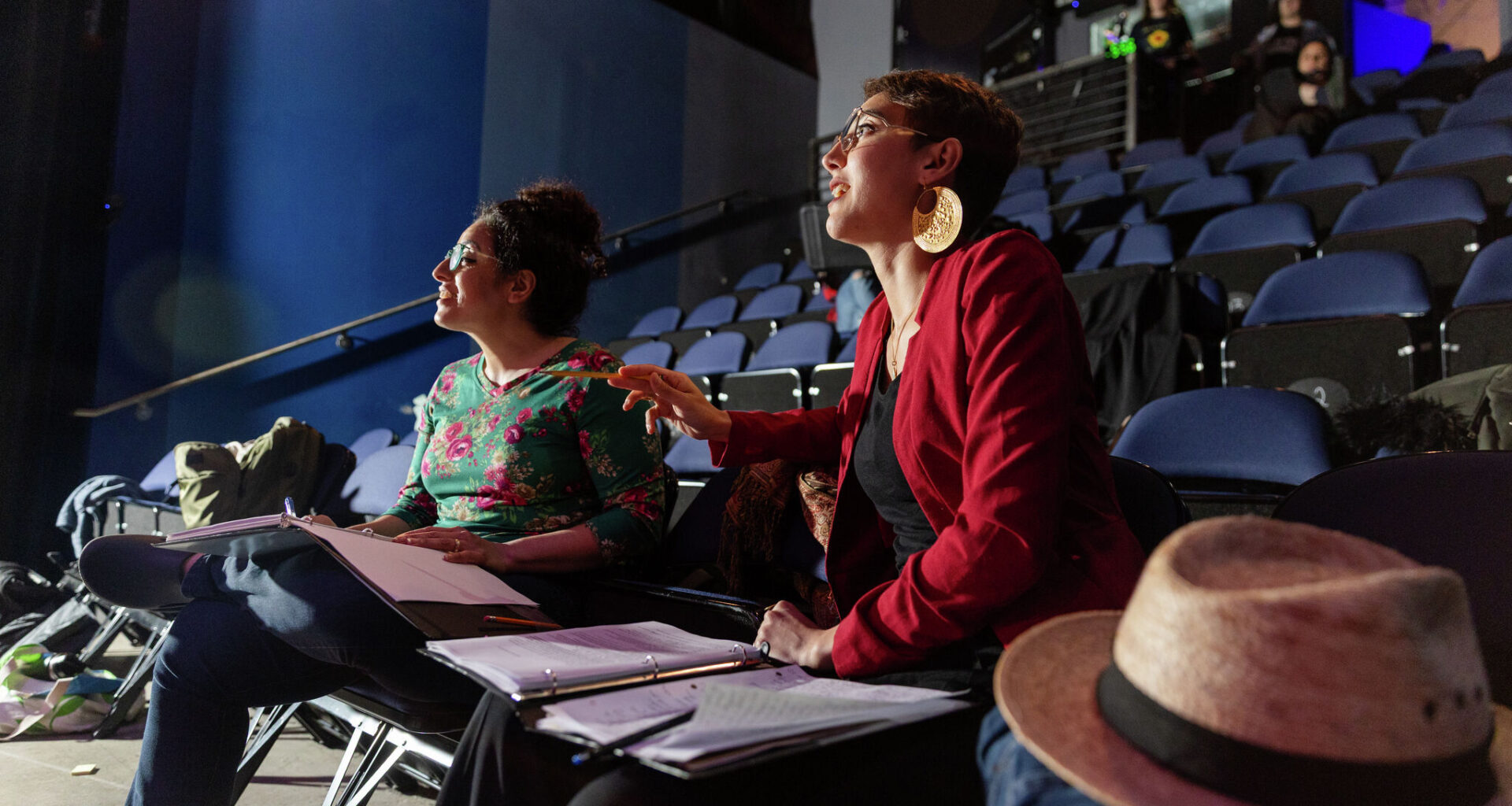
Playwright Denmo Ibrahim, left, and director Nabra Nelson give actors feedback during a Golden Thread Productions rehearsal of “A Country Made of Salt” at the Potrero Stage in San Francisco on, Friday, April 10. Golden Thread Productions is the first U.S. theater company dedicated to the Middle East.
Estefany Gonzalez/For the S.F. Chronicle
Director Nabra Nelson, right, and playwright Denmo Ibrahim work with actors during a rehearsal of “A Country Made of Salt” at the Potrero Stage.
Estefany Gonzalez/For the S.F. Chronicle
Leaders of a theater company dedicated to the Middle East probably get asked more questions about international affairs and politics than most other theater artists do.
But talk to the three women who’ve led Golden Thread Productions — Torange Yeghiazarian, who founded the company in 1996; successor Sahar Assaf, who took over in 2021 and Nabra Nelson, who came aboard in December — and they’re likely to point out that journalists should be asking those questions of every arts leader, not just the ones at the helm of identity-specific companies.
A Festival of Palestinian Art: Through Sunday, April 19. $20-$100. Potrero Stage, 1695 18th St., S.F. 415-626-4061. https://goldenthread.org
As the company was preparing to launch its Festival of Palestinian Art, which runs through April 19, the three spoke to the Chronicle — Yeghiazarian and Nelson from the Bay Area, Assaf from Saudi Arabia, to which she relocated in 2024 for family reasons.
Article continues below this ad
This conversation has been edited for length and clarity.
Q: As we speak, President Donald Trump is threatening mass destruction of Iran if it doesn’t reopen the Strait of Hormuz by tonight (Tuesday, April 7). For each of you, what is your relationship to consuming news?
San Francisco Chronicle Logo
Make us a Preferred Source to get more of our news when you search.
Add Preferred Source
Yeghiazarian: I can’t really tolerate hearing the voice of our elected officials and the language that they use, so I basically read the news. It’s self-preservation.
Nelson: Since I came back to the U.S. when I was 17, I was actually really blown away by how much propaganda is in the news and how different it was than the news I was consuming when I was in Egypt.
Article continues below this ad
Director Nabra Nelson, left, speaks with playwright Denmo Ibrahim during a Golden Thread Productions rehearsal of “A Country Made of Salt.”
Estefany Gonzalez/For the S.F. Chronicle
Assaf: I do try to take breaks, but I’m in the news. I mean, I am in the Middle East right now, with family and friends all over the impacted communities and cities and countries, so I cannot afford not to hear the news. I feel like I need to stay informed. I need to know how to be safe.
To be living in a time where the president of a 250-year-old country is threatening one of the oldest continuous civilizations with annihilation is beyond enraging.
Q: Given all that, how do we go on as artists and, speaking selfishly, those who write about them?
Assaf: I’m surprised that this is not the one topic that we’re talking about in each and every field. I mean the news today — the nuclear escalation — this is the annihilation of all of us.
Article continues below this ad
Nelson: I feel extremely lucky that I’m at a company (where) I know that if I continue to do the work, it’s moving towards justice and it’s centering communities that need to be centered right now.
I mean, how can one do work that doesn’t matter right now? I don’t understand. Like, how can you do a classic staging of “A Midsummer Night’s Dream” right now?
Golden Thread Productions Founder Torange Yeghiazarian at the theater’s Potrero Stage in San Francisco on May 19, 2021. Assaf succeeded Yeghiazarian who stepped down from her role after 25 years.
Carlos Avila Gonzalez/The Chronicle
Yeghiazarian: In the U.S., there is this sort of delusion about separation of politics from the rest of the life. Millions of people voted for these people who are running the country, and we have to take responsibility for that. We can’t be like this Berkeley mindset of, “No, we are liberal progressives that have nothing to do with what’s happening in the country.” That is not true. Everyone has enabled what is happening.
Q: At the same time, Torange, years ago you told me that “kneejerk” artistic responses to current events lead to mission drift. Do you still feel that way?
Article continues below this ad
Yeghiazarian: There are historic narratives that aren’t even part of the American psyche, that are not taught in school, that are not discussed in the media. The Middle Eastern perspective — by that I mean people who live in the Middle East — their experience is rarely shared in the U.S. The average American knows almost nothing about life in Lebanon, life in Iran, life in Palestine. Yet our leadership makes decisions that impact the lives of those people, and it’s our vote that enables that.
What’s happening between the U.S. and Iran right now — it didn’t happen February 28th. That’s not when it started. It didn’t even start in 1978 or 1979. These are stories that a company like Golden Thread has the opportunity to tell, to really dig deeper into.
When you run a theater company, when you’re programming artistic programming, that’s an opportunity. That’s a gift. What do you do with that gift?
Director Nabra Nelson, center right, leads a rehearsal of “A Country Made of Salt” at the Potrero Stage.
Estefany Gonzalez/For the S.F. Chronicle
Nelson: My background is in community engagement when it comes to theater leadership. You can only do true community engagement with the long-term in mind. You’re not coming in and saying, “You! Have a relationship with us, and tell us what you need, and let’s do that thing, and then let’s leave.” That’s how community engagement used to be. It was very tokenizing and very hit-and-run.
Article continues below this ad
(At Golden Thread), community need is integrated into our work as usual, and so we are responsive when we continue our work as usual.
Assaf: I think what Golden Thread is doing is offering a space for healing. And I’m very careful in using that word. I don’t use it lightly, but I’m only allowing myself to use it now because I recently listened to the psychologist Dalia Halabi. She’s speaking about how, when there’s dissonance between your inner world — what you’re living internally — and your surroundings, when there’s that conflict, it really breaks your nervous system.
Golden Thread is the space where our internal world and our external world align.
I want to release some of our pressure (to educate) and be like, whatever story our artists want to tell, let’s just do it.
Yeghiazaraian: That dissonance is really eating us from the inside. I remember when the U.S. invaded Iraq, during those war years, I feel like I was like one of those marionettes constantly going, “But don’t you see this? There are no weapons of mass destruction! Why can’t you see?” I was constantly trying to make people understand that the news is 90% false.
Golden Thread Productions Executive Artistic Director Sahar Assaf at the theater’s Potrero Stage in San Francisco on May 19, 2021.
Carlos Avila Gonzalez/The Chronicle
Assaf: I remember dropping my son at preschool and (being) like, “You’re just leaving your kids, and it’s just so chill, and everyone is so OK?” I was like, “I’m going crazy. I look at children, and all I see is dead bodies of children.” Then I have to go, like, run errands, and people are so oblivious, and you’re looking at images from your country and your people being annihilated.
What Golden Thread does is this attunement, this regulation of your nervous system. Everyone is feeling lighter, just because you don’t have to explain yourself.
Q: Sahar, you’ve said that when you were looking for a successor, Nabra was at the top of your list. Why?
Assaf: I felt we want someone to come in and lead with courage and love, not with fear — because we have lots of, unfortunately, leaders leading from a place of fear.
Q: Recently I was reading American Theatre’s coverage of the five-year anniversary of the “We See You, White American Theater” document that demanded concrete changes throughout the theater industry to advance racial equity. What have you seen change since then, if anything, and where you still feel we have the most work to do?
Yeghiazarian: I would say that we’ve regressed. The perceptions of people — as reflected by our leadership and the language being used politically — we can see that a lot of those gains, a lot of the points that were raised, have been undermined.
Nelson: I was so terrified that it would be the flavor of the week, and it was a longer flavor of week for predominantly white institutions, but so much of that drive dissipated.
Director Nabra Nelson makes notes during a Golden Thread Productions rehearsal of “A Country Made of Salt” at the Potrero Stage.
Estefany Gonzalez/For the S.F. Chronicle
It was so exciting to be at a large predominantly white institution devoting that energy. For a leader of color, I was like, “Yes!” It was giving me energy. But for the folks who were not leaders of color — largely white leaders, male leaders, leaders who didn’t need to think about how their identities contributed to this work on the day-to-day — it was extra work, and it made them tired and stressed.
Assaf: Mid-pandemic, I remember the weekly meetings that artistic directors in the Bay Area were having. It felt really such a communal, beautiful togetherness — until the genocide, I have to say.
I’ve listened to many of those leaders, whom I love dearly and respect, deliver impeccable land acknowledgements, but when it came to acknowledging a genocide that’s being perpetuated with your tax money right now — silence.
The fear is real, right? Cancellation is real. The pressure from the Zionist lobby is real. Losing funding is real. But that’s what makes me feel like the progress that we thought was happening is not real, because if we’re still functioning from that same place, we’re continuing to perpetuate the same systems that led to these tragic events.
Director Nabra Nelson gives actors feedback during a Golden Thread Productions rehearsal of “A Country Made of Salt” at the Potrero Stage.
Estefany Gonzalez/For the S.F. Chronicle
If you can really stand on a stage and acknowledge a genocide that happened 200 years ago, and don’t see the hypocrisy of not acknowledging a genocide that’s happening right now, I don’t know what to say about that.
I was heartbroken when I reached out to the leaders, and I was like, “This is Golden Thread’s statement. Would you like to endorse?” Nothing.
Then a few months later, I’m like, “Let’s get together and write a joint statement (advocating) ceasefire.” I don’t want you to engage in the complexity of the politics. I just want you to say, “It’s not OK to murder children, no matter what the problem is.” Nothing.
Then I was like, “I’m just going to keep going. I’m going to do the work, and when people reach out to collaborate, we’re going to collaborate.” Because it’s not time to judge each other, obviously. It’s time to (lead) with a model, with an example.