
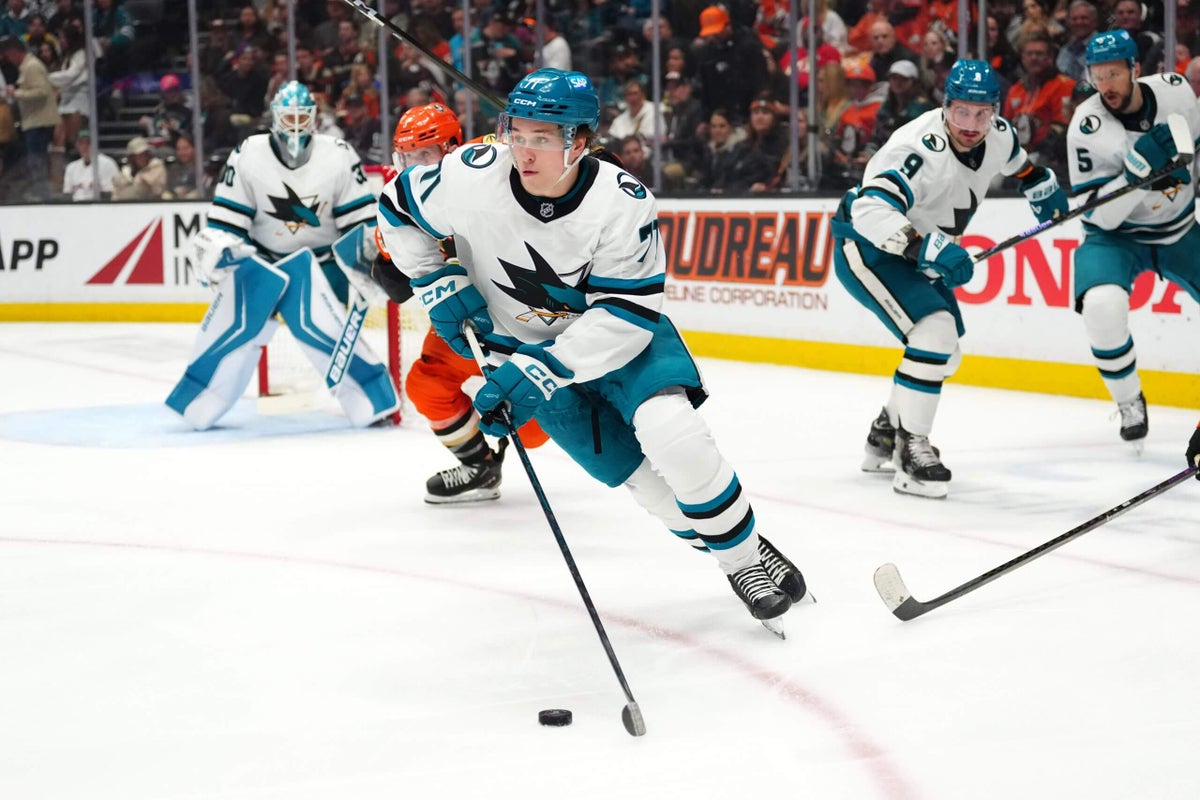
This may not have been new for Tyler Toffoli or Barclay Goodrow, Dmitry Orlov or Nick Leddy, Alexander Wennberg or John Klingberg. But it was for Sam Dickinson, Michael Misa, William Eklund, Collin Graf, Macklin Celebrini and Will Smith.
It was new even for coach Ryan Warsofsky. Heading into this season, the San Jose Sharks were not expected to be playing in games where their playoff chances were at stake. By now, they would have long been resigned to taking stock of whatever modest improvement they had made and preparing for another draft lottery. Flights to vacation locales could be booked. Tee times at favorite golf courses could be made.
Maybe the initial plan to start breathing playoff air was for 2026-27 or beyond. But instead, the Sharks circled in and out of the postseason picture throughout the second half of the season and down the stretch. Technically, they still have a mathematical chance to grasp the final spot in the Western Conference. Realistically, those dreams were dashed last week with back-to-back regulation losses to the Edmonton Oilers and Anaheim Ducks.
Add in a shootout loss to the Vancouver Canucks on Saturday, when they desperately needed two points, and you could understand why Celebrini, the Sharks’ young superstar, was ready to turn the page toward a bright future rather than lament the missed opportunity to stay in the wild-card race.
“Our whole group’s motivated,” Celebrini said. “We know what we’re capable of, and I think we showed it this year. No one expected us to be in the position we’re in, except for all of us. We all believed it from the start. We played a lot of really good hockey, and I think we just got to play more consistently. Kind of limit some of those slides.”
As they start what could be their final week of action Monday in Nashville with a must-win game against the Predators, it’s worth noting how much progress the Sharks have made, even if elimination is almost at hand. With a 37-34-8 record, San Jose has 82 points for a 30-point improvement over last season, when the team had the fewest points in the league for the second straight year.
At times this season, the Sharks held the second wild card, and the last two months weren’t about playing out the string and eyeing another high draft selection. To take part in meaningful games in the spring for the first time since the franchise’s 2019 Western Conference final run — the Sharks’ last playoff berth — is what owner Hasso Plattner wanted, not a third consecutive shot at the No. 1 overall pick.
A weak Pacific Division was certainly beneficial to the Sharks’ efforts. But their competitive improvement was enough to convince general manager Mike Grier to change their narrative. Instead of trading useful players with value as they had done throughout their rebuild in recent years, Grier went into buying mode with his January trade for Kiefer Sherwood.
Sherwood was an attractive trade candidate given his combination of production — a career-high 23 goals, including six with San Jose — and low salary while setting himself up for a large raise in unrestricted free agency. The Sharks got him from the Vancouver Canucks for two second-round picks, and then signed the winger to a five-year, $28.75-million contract extension. And as the trade deadline arrived, Grier didn’t break up the team despite having several impending UFAs.
“It makes us feel confident about what we have in the room in order to get it done,” Sharks defenseman Mario Ferraro said. “And obviously adding (Sherwood) is a big addition. He’s come in and he has done a fantastic job of just bringing some more intensity, some more leadership and energy to the room.
“Yeah, it makes us feel a sense of confidence that we can do this. The decisions that were made at the deadline make us feel good about where we’re at with the group that we have.”
Even with past Stanley Cup champions Goodrow, Toffoli, Leddy and Orlov on the roster, plus others with playoff experience, including Wennberg, Klingberg and Vincent Desharnais, the Sharks also have several young performers with less than two years of NHL experience. Or, in the case of Ferraro and Eklund, players who have been around longer but only knew losing in San Jose before this season.
Still the youngest NHL head coach at 38, Warsofsky has won at lower levels, having joined the Sharks’ staff in 2022 under David Quinn after capturing a Calder Cup championship in the American Hockey League. But this is his first time in a playoff race as an NHL head coach. That’s a new frontier, regardless of the important games he coached in the past.
“When you win, you have some experience of what it looks like, I would say,” said Warsofsky, now in his second season as San Jose’s head coach. “But it’s completely different leagues. This intensity is a lot different.”
At a time when every game carries great importance, what does Warsofsky draw on to lead his team?
“You stay true to what you believe in,” he said. “You just stay true to yourself. You keep teaching. You keep working with the guys. Keep pushing them and challenging them. Sometimes you got to put your arm around them, and sometimes you got to push them in the right direction. And sometimes, you got to teach them, whether that’s through video.
“Obviously, it’s tough with not a lot of practices, but you got to find different ways to maybe get your message across. And that’s what I’ve kind of learned from myself here and our staff.”
The Sharks will likely fall short of the playoffs this year. But they went further than almost anyone could have expected. That success will also bring heightened expectations, particularly for Warsofsky and Grier, whose coaching and roster construction will face greater scrutiny in future seasons.
Celebrini is the unquestioned leader, a 110-point player in Year 2 who will be on Hart Trophy ballots and will likely become the team’s next captain. Smith continues to improve and could be a point-per-game offensive contributor next season. Misa and fellow rookie forward Igor Chernyshov have the talent to be future staples on the Sharks’ top two lines. They’ll be surrounded by veterans Toffoli, Wennberg and Sherwood.
San Jose will need more consistent goaltending from Yaroslav Askarov and Alex Nedeljkovic. A patchwork defense corps will require an upgrade. Sam Dickinson and Shakir Mukhamadullin are still developing. It remains to be seen whether the Sharks will re-sign Ferraro or let him walk in free agency. For all their improvement in wins and points, their minus-44 goal differential is fourth-worst in the NHL.
“I think the biggest thing is we’re learning,” Warsofsky said. “We’re growing. It is not a perfect picture. We are not fully there yet, as far as how to do it consistently. So, I think it’s been some frustration at times. But I give the group a lot of credit. It feels like every time we get kind of knocked down a peg, we get back up and we fight.
“And we’re going to continue to fight to the end.”