
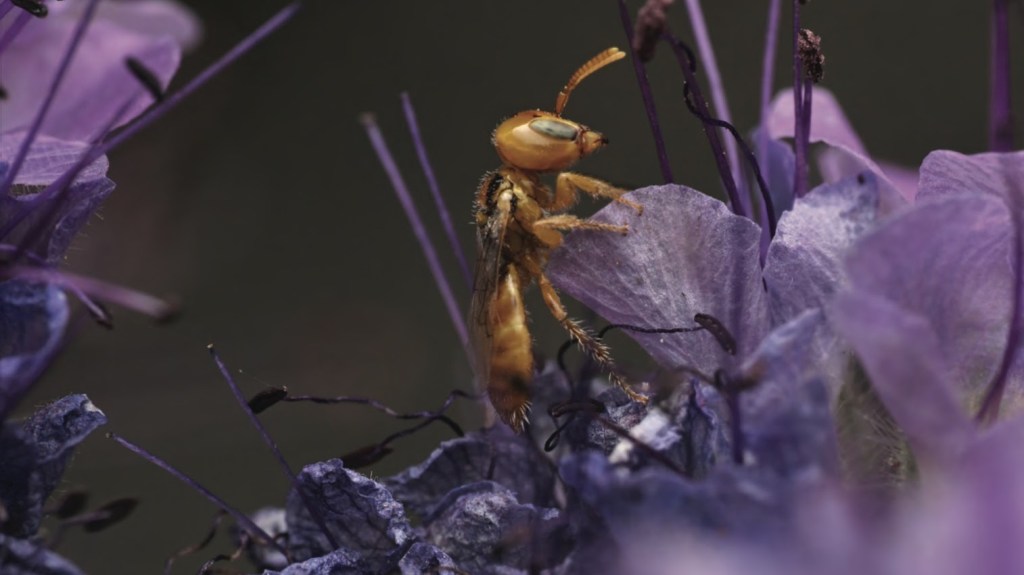
Krystle Hickman was photographing honeybees at Sepulveda Wildlife Basin when she noticed an unusual insect on a mustard plant.
She knew it was a bee, but the species was a mystery to her. The same went for the beekeepers that she asked about the creature. In an entomology group on Facebook, melittologists, scientists who focus on bees, had the answer. It was an andrena, a native mining bee that Hickman found on an invasive plant in a portion of a park better known for birthday parties than for native bee sightings.
“Honeybees have great PR, even though they don’t necessarily need it,” says Hickman. “Native bees need better PR.”
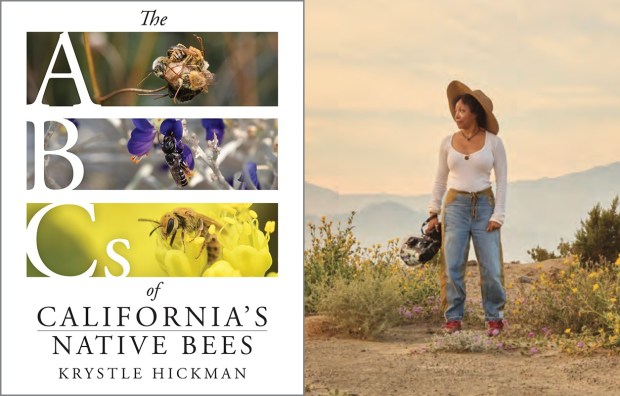 San Fernando Valley-based Krystle Hickman, a National Geographic Explorer and conservation photographer, recently published “The ABCs of California’s Native Bees,” a photo book documenting the species that she has found around the state. (Photo credit Krystle Hickman / Courtesy of Heyday Books)
So for the past few years, the San Fernando Valley-based photographer has become an advocate for the ones that call California home. A National Geographic Explorer and conservation photographer, Hickman is the author of “The ABCs of California’s Native Bees,” a photo book documenting the various species that she has found on excursions around the state.
“Native bees, they’re at risk of being endangered, threatened, extinct because they’re closely interwoven with the habitat. So, as we’re seeing habitat loss, we’re also seeing a decline in animal species, not just native bees but all animals in the habitat as well.”
Until recently, Hickman says, habitat loss was the main reason for declining bee species. Now, climate change is the top reason, with others including pesticides, herbicides and competition from honeybees.
“Honeybees basically out-compete pretty much every native pollinator in the area,” she says. “That’s definitely noticeable in drought years, when there are fewer resources. They’re also known to spread diseases to other bees, specifically bumblebees.”
Still, California has a large variety within its bee population. As Hickman points out in the book, there are 3,000 bee species native to western North America, about 1600 of which are native to California.
“California has about 8% of all bee species in the world, which I think is absolutely insane,” she says. That’s partially why Hickman was inspired to try to find a bee that corresponded with every letter in the alphabet.
At first, Hickman documented native bees solely as a fun project. While visiting a patch in the Santa Monica Mountains, where she spotted the square-headed mason bee, she noticed that fire abatement had destroyed the area where she had been observing bees.
“That inspired me to make the book because I was seeing habitat loss in real time,” she says.
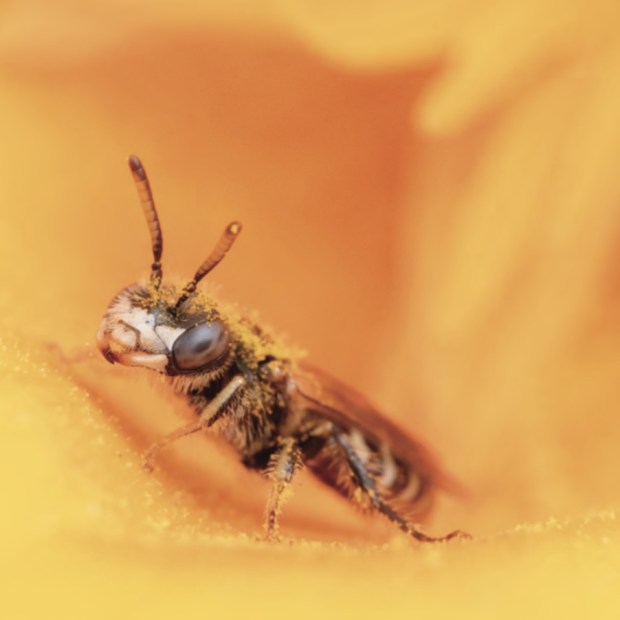 San Fernando Valley-based Krystle Hickman, a National Geographic Explorer and conservation photographer, recently published “The ABCs of California’s Native Bees,” a photo book documenting the species that she has found around the state. (Photo credit Krystle Hickman / Courtesy of Heyday Books)
The book became not only about the bees, but also about their habitats. And it’s a story that’s also about the resilience of native species, as with the California poppy fairy bee, which she found in a friend’s yard in Altadena. Last year, the home was destroyed by the Eaton Fire.
“The yard was completely burnt, but a chaparral ecosystem is supposed to come back after fires, and it did,” says Hickman. “And the bees literally rose from the ashes, so did the poppies.”
Throughout the process of making the book, Hickman learned a lot about native bees. “What’s really interesting that I’ve learned too is that a lot of native bees can’t sting people because their stingers are too small,” she says, adding that native bees tend to be solitary.
“You have to go out of your way to really bother them,” she says. “I’ve only been stung once by a native bee. It’s because I was doing close-up photography at the entrance to their hive. It was a hive of bumblebees. It took me two hours to get stung. I got stung on the finger. I really worked to earn it.”
For those looking to invite more native bees into their gardens, Hickman has advice. “Think of areas where bees and a lot of other creatures will nest. A lot of times, people don’t think of grasses,” she says. “That’s a great habitat. A lot of male bees sleep out in the open.”
Also, be mindful of how far back you trim your plants, she says, as some bees will nest in them. It’s also good to be aware of how much mulch you use in the yard, because some bees nest in bare soil.
“There are a lot of creatures that will overwinter in the ground like bumblebees, and they need to be able to breathe through it,” she explains. She points out, too, that some of the advice that applies to attracting honeybees isn’t great for bringing in native bees, like setting out water or installing a bee house.
“If you have the whole native habitat in your yard, you don’t necessarily have to do that,” she says.
And don’t fret if your yard doesn’t always look picture-perfect.
“A lot of time with gardening, a lot of people are like, it has to be pretty all the time, but native plants, they go to seed. They look dead,” Hickman says. “A lot of times, people think it’s really unsightly, but it’s part of their natural lifecycle and it’s really interesting to see what will show up at that time, different birds or different bees.”