
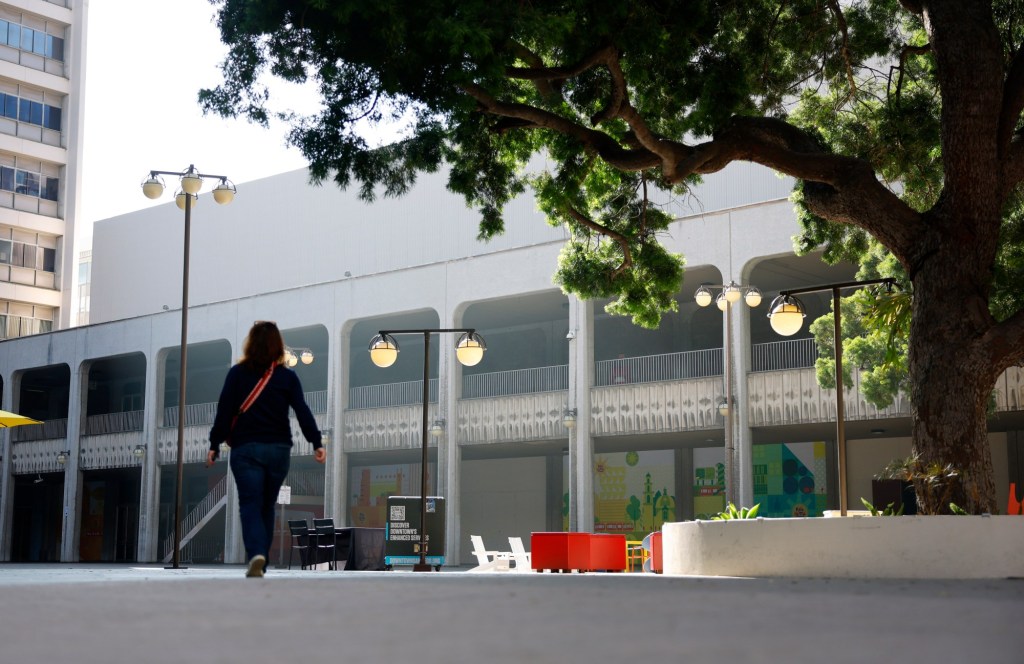
The philanthropic organization looking to architect a new era for the municipal heart of downtown San Diego is now pressing the city to adopt an action plan designed to result in a partially remade civic compound, anchored by a cultural and educational center with housing, in five years.
Tuesday, San Diego’s Prebys Foundation and the Downtown San Diego Partnership released a report that recommends the city form a joint powers authority within six months with a board of directors and its own dedicated nonprofit to more expeditiously advance redevelopment of San Diego’s Civic Center blocks.
The proposed new legal entity would include the city of San Diego, the San Diego Community College District, and potentially other public agencies, and would be able to adopt a master plan, enter into development agreements, and raise money or issue bonds.
The new report was prepared by urban planning firm U3 Advisors and is titled, “San Diego Civic Center Revitalization. Quantifying Transformative Economic Impact: Implementation Roadmap.” It builds on prior work that seeks to collectively demonstrate how San Diego can leverage the land under its decaying facilities to realize hundreds of millions dollars in cost savings and stimulate substantial economic growth across the region.
The conceptual redevelopment plan previously put forward by the partners envisions an arts and education hub with a world-class public space, thousands of apartments spread across multiple high-rises, shops and restaurants, and a hotel.
The on-paper-only vision became partially three dimensional when the community college district recently stepped forward with a proposal. The district is looking to erect a museum and educational building, and possibly hundreds of residential units for students and faculty members, on the site of Golden Hall. The city and the district are close to entering into a negotiating contract to formalize the relationship.
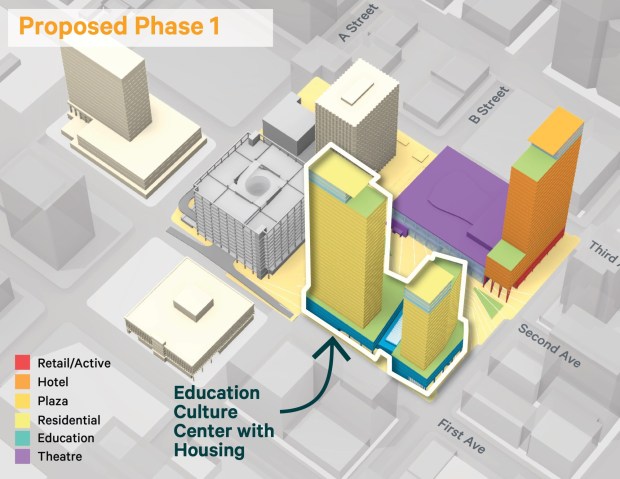 A diagram of U3 Advisor’s proposed first phase of redevelopment for San Diego’s Civic Center. The phase includes a new educational center anchored by the San Diego Community College District, an extended and enhanced public plaza, and potentially a 400-room hotel with a renovated Civic Theatre on the site of the City Administration Building. (U3 Advisors)
The formation of a joint powers authority, which would offload land control and financing decisions from the city to a nimbler independent entity, is meant to bring the entire vision to life.
“The city has an opportunity here to do something exceptional, and quickly, and that it doesn’t have the resources to do. So bringing partners to the table is a very logical next step if they want to transform downtown,” Grant Oliphant, CEO of the Prebys Foundation, told the Union-Tribune. “The joint powers agreement makes sense because it creates a very quick, decision-making apparatus for the players to move the project forward.”
The report lays out a schedule of recommended steps, starting with the formation, between now and the end of September, of the joint powers authority as the project’s governing body and the creation of a nonprofit entity to manage day-to-day duties associated with redevelopment. The timeline also calls for the city to make a formal decision before the end of the year as to whether it wants to remain at City Hall or relocate elsewhere. Then, the authority could move forward with the first phase of redevelopment, which includes the community college district’s project, an extended and enhanced public plaza, and potentially a 400-room hotel with a renovated Civic Theatre on the City Administration Building site.
“By next spring, we are going to have a big demolition party for Golden Hall,” said Omar Blaik, who is CEO of U3 Advisors and authored the report.
Construction on the initial phase could be completed by the end of 2031, according to the report.
San Diego’s Civic Center is the four-block, municipal compound bounded by A Street and C Street to the north and south, and First Avenue and Third Avenue to the east and west. The quad includes the City Administration Building (aka City Hall), the Civic Center Plaza office tower, Golden Hall, the Evan V. Jones Parkade parking garage and the Civic Theatre. The city’s real estate holdings extend across the street to a fifth block at 1222 First Ave., which is home to the City Operations Building. The sixth block, at 101 Ash St., will be leased to a development team that has agreed to convert the office tower into rent-restricted apartments.
Redevelopment has been contemplated in fits and starts for decades. The most recent push started three years ago when San Diego Mayor Todd Gloria sought to lease or sell the real estate to fund the construction or purchase of a brand-new City Hall. The two-part plan, called the Civic Center Revitalization plan, was later tabled in December 2024 because of the city’s budget woes. Gloria, however, revived the idea of redevelopment at the beginning of the year.
Amid the on-again, off-again talks of redevelopment, Prebys Foundation has, in concert with the Downtown Partnership, attempted to keep momentum going. To date, the well-heeled philanthropic organization has spent more than $1 million to fund U3’s work, which includes the conceptual redevelopment plan for the six blocks published last year, an economic impact report on the value associated with 4 million square feet of new development, and the newly released implementation report.
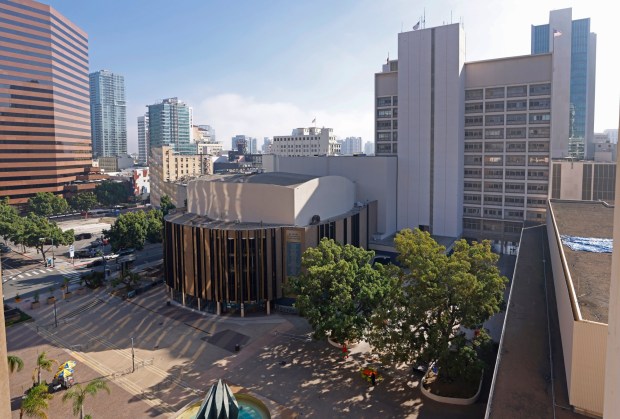 San Diego’s Civic Center, as pictured on January 20, 2026. The Civic Theatre is pictured in the center with the City Administration building, aka City Hall, in the background. Wells Fargo Plaza, which is owned by the Prebys Foundation, is pictured on the left. (K.C. Alfred / The San Diego Union-Tribune)
“We’ve made remarkable progress in very little time,” Oliphant said. “The logic was, if we had an inspiring vision that had some clear elements, then that might inspire people to want to be a part of it. Because that vision was compelling, that allowed us to start having conversations with partners who could actually make it happen. The most important (partner), clearly at this stage, aside from the city, is the community college system, and they’re important because they have a visionary chancellor, a clear need and resources to bring to the table. That has brought other partners to the table, and what they all need to know is how this is going to move forward in a timely fashion, so that they can stay at the table.”
The recommended joint powers authority would provide that surety, he said.
A joint powers authority is an independent legal entity, formed by public agencies, and governed by a board typically composed of elected officials from the member agencies.
The Civic Center redevelopment board, as proposed, would include public agency participants and private sector partners such as Prebys Foundation, the Downtown Partnership and San Diego Theatres. The consultant also recommends that the authority create a nonprofit management organization, with an executive director, to oversee project development. The nonprofit would essentially act as the land developer, coming up with a master plan, securing permits, managing financing, entering into contracts with partners and overseeing construction.
“The (joint powers authority) is a great way to go forward, because it unlocks a lot of tools in the toolbox for financing options,” said Betsy Brennan, CEO of the Downtown San Diego Partnership. “It also allows the land control to stay with the city of San Diego and other public partners, but it allows for a Civic Center redevelopment board made up of nonprofit and private sector partners, and then a project leader that wakes up every single day and will move the project forward.”
The structure works for the only real proposal on the table.
“We are comfortable with a phased approach starting with our education center, as long as we have substantial input on future development and alignment with our educational programs and activities,” Gregory Smith, the community college district’s chancellor, told the Union-Tribune. “The JPA concept, with SDCCD having a seat on the executive board, could work well to provide the influence we need as long as we maintain sufficient independence in the programs and activities we choose to conduct in our educational center.”
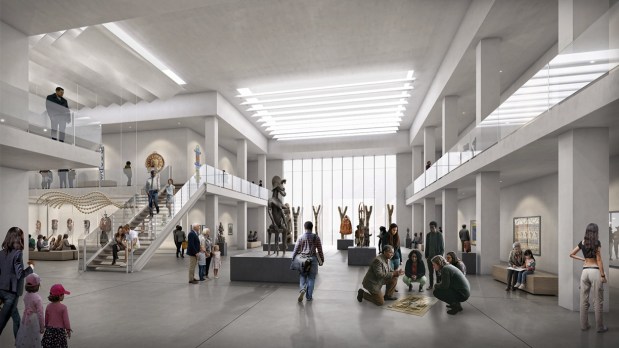 Illustrative view of the vision for San Diego Community College District’s World Art Collection Gallery. (Design Distill)
The governance structure is also the right approach for a city that would otherwise struggle to find a master developer to take on the redevelopment of the entire compound, Blaik said.
“Big, large-scale projects require some leadership and guidance. They cannot just be wished into reality without a particular structure that can push it forward,” he said. “This is a part of downtown that has been struggling for quite some time. The complexity of the infrastructure drags the numbers down for any profit margin. This is a project that requires subsidy. It’s not a project that will fly off the shelves because it is profitable.”
Civic Center is burdened by a 1960s-era central power plant, in the basement below the concourse, that keeps the lights, water and air on across the administration building, operations building, theater and event center. The single-system design would be costly to disentangle — if possible at all.
The demolition of Golden Hall would cripple the central plant and sever the connection between the plant and the other buildings, according to the implementation report and preliminary work done by engineering consultancy WSP. Additional engineering work is ongoing to find a way to redevelop the Golden Hall site while keeping the complex’s other buildings operational. Depending on the results, the community college district’s project may have to be split into two phases with the southern portion of Golden Hall left intact to start.
The power plant issue is just one of many unknowns associated with the Civic Center implementation plan, although its boosters are optimistic they have supercharged the effort to ensure that the visioning work and new reports don’t end up in a digital dustbin.
“We’ve been talking about this area for 30 years … and at this point, we do have a really wonderful, willing partner in the San Diego Community College District,” Brennan said. “It is possible to do this important Civic Center revitalization project now in 2026 and 2027. … We have a governance structure. We have an organizational structure, leadership structure, and the visionary plan, and the partners ready to do it. So we have all of the ingredients necessary to go forward.”