
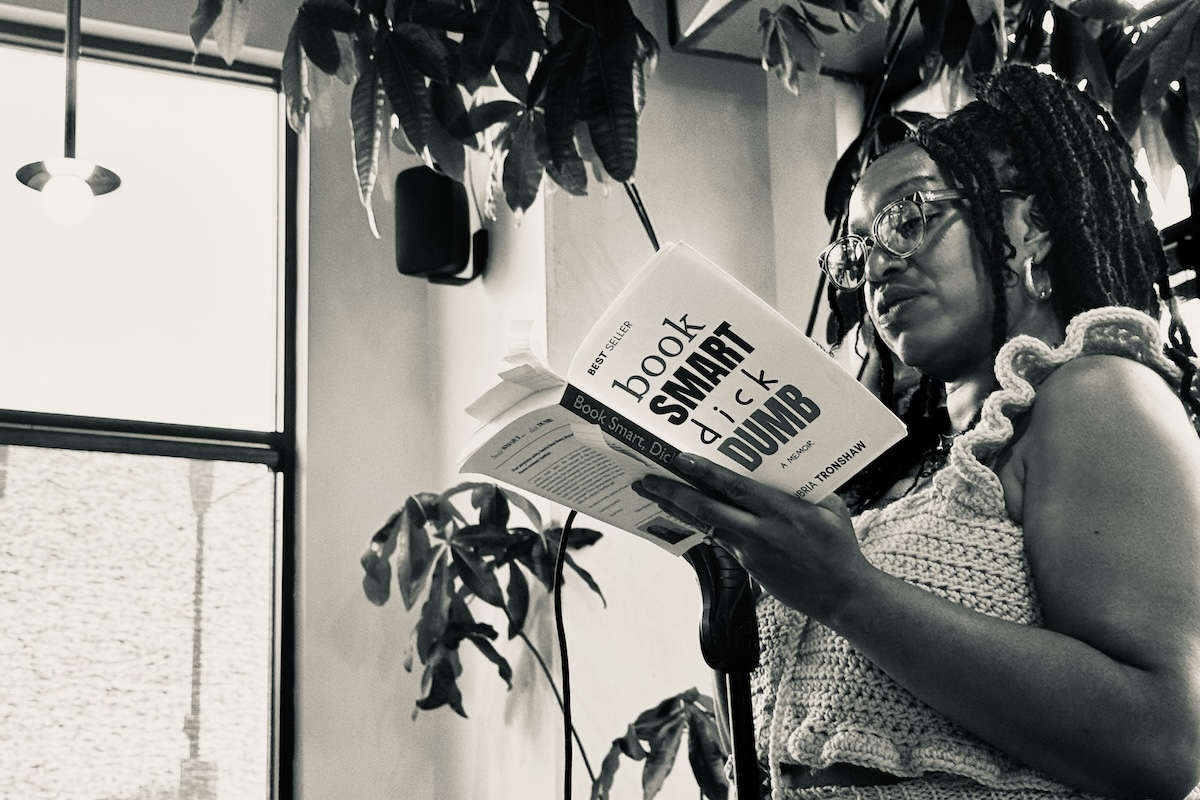
She arrives at Kinfolx Cafe in a hot-pink, crocheted two-piece—off the shoulder, hand-knitted—and the outfit tells the crowd something. Oubria Tronshaw does not show up in borrowed clothes. She makes the thing herself and wears it loud. Neither does she write in borrowed language.
“I’m not supposed to tell you this,” she whispers to the crowd, and then she tells them everything.
Tronshaw’s parents were co-workers who had an affair. “My father, his wife and their child formed a family,” she says. “My father, my mother and I formed a situation.” Custody was split like a backdoor deal: the first through the 10th with her father, his wife Gigi and her sister Tootsie Toot. The rest of the month with her mother and older sister, Sharonda.
Her father’s house was an education in hypervigilance, the terrain “a patternless minefield” for a child living in the the consequential war zone of her father’s unchecked emotions. When they heard his keys, “tinkling like a warden’s chain,” heartbeats went into space. She tucked misery under her tongue until bedtime, survived by reading her father like weather. Her intuition grew “wild like bamboo.”
That intuition became her compass. And like any compass, it showed her where she was headed—even when she went the wrong way.
Eight days after graduating from undergrad in Santa Fe and driving home to Chicago, Tronshaw met “him.” She’d told her mother: “It feels like I’m gonna meet a man and have a baby instead. It isn’t what I want, but I feel like once it happens, it’s all I want.” Her mother listened. Then it happened.
On their first date, he made his politics clear—a Black man, he told her, cannot trust a Black woman who wears the white man’s toxins instead of her own natural hair. She knew this game, and pulled a single lock past her shoulder to prove her five years of growth. He traced her bottom lip with his finger. Stared. Kissed her deeply, wrapping his fingers in her hair. The warnings were dressed beautifully, and she walked right in.
She called him the Professor—because not only did he teach her a thing or two, he thought he knew every fucking thing. Within three weeks, they’d moved in together. Within a month, she was pregnant. Five children followed, one by one—gorgeously brown, a small tribe. And eventually, because the grind is real and life breaks even the well-intentioned, Tronshaw and her husband divorced.
Book Smart Dick Dumb is not a book of pure sorrow. It’s built on a lattice of humor. “I think I just come from a funny family. If you have a lot of trauma, everybody’s funny to you,” Tronshaw says. The memoir became a place to release every smart-ass observation she’d sat on for years. “This is my book now. I can say what I was really thinking.”
She’d always wanted to write—especially about her life, which irritated her mother. Then one day, her mother said plainly: “Some things you only write when your mother’s dead.” She passed in 2017.
“I miss her terribly,” Tronshaw says, “but I don’t know if I would have the strength to be this honest if I knew she’d just pick up this book and read it.”
When she’s not writing from a café, she writes in a walk-in closet, children knocking. “All of this that I’ve done, I’ve done around motherhood,” she says. “And motherhood just always brings me back to the real world.”
She met her current husband through her Melanated Classic Tarot Deck. He ordered one, then emailed to thank her. She laughs, recounting how she tried to blow up his thumbnail to see his face, says, “We never let each other go after that original email.” Everything she makes—the deck, the memoir, all of it—lives at oubria.com.
Growing up between two households, no one place ever felt entirely hers. She always said she’d know home when she saw it. Something in Oakland’s Dimond District is settling—the neighbors, playdates, familiar faces.
“I feel more at home here,” she says, “than I have felt in a very, very long time.”
‘Book Smart, Dick Dumb,’ self-published by Oubria Tronshaw, released March 12; oubria.com.