
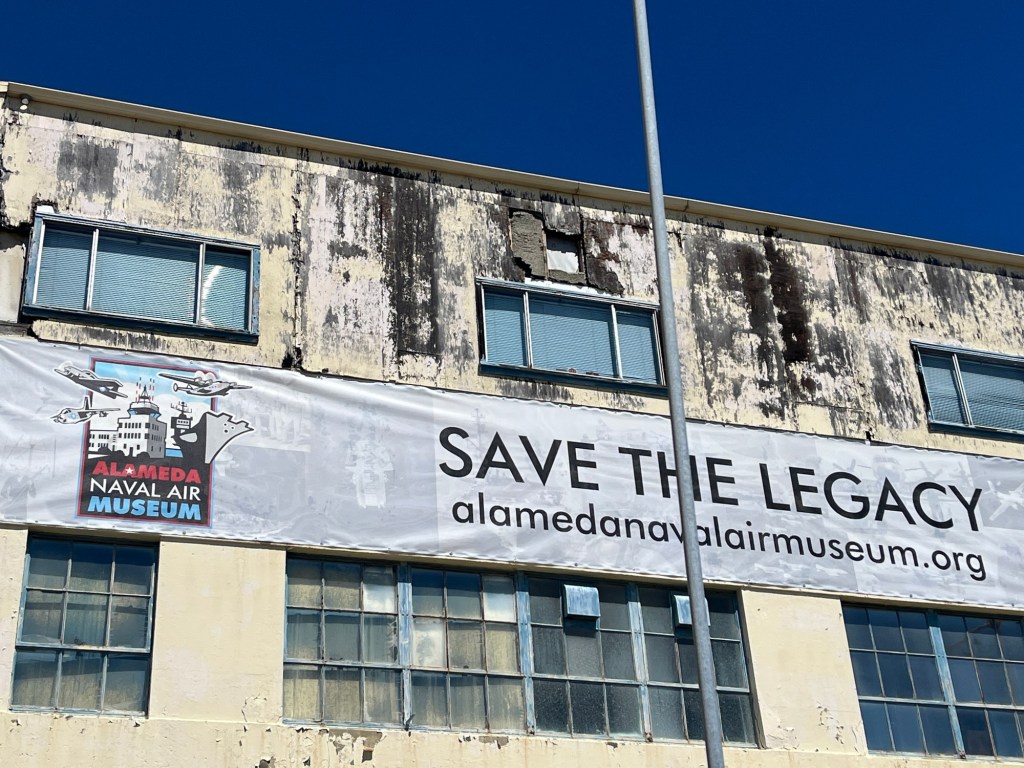
Since Naval Air Station Alameda’s closure in 1997, the buildings that made up the base have been turned into thriving breweries, distilleries, a bakery and even a pickle ball emporium. However, one of the few sites linked to the base’s military past, the Alameda Naval Air Museum, is on life support.
Closed since November, the museum at the former air station’s old Building 77, is a treasure trove of World War II naval aviation artifacts, books and other items collected since the base shut down. After its first stint from 1995 to 1997 in Hangar 41, the museum closed for several years before reopening from 2004 until last fall.
That’s when, due to a massive increase in the facility’s insurance that they couldn’t afford (from about $915 a month to about $3,170), the all-volunteer staff who operate the museum were forced to shut down. A short walk from the USS Hornet Sea, Air & Space Museum, Building 77 is owned by the city of Alameda, to which the volunteer staff pays insurance and maintenance fees.
“The age of the building is a problem. It has some issues, especially the front, the face of the building,” says Larry Pirack, the president of the Alameda Naval Air Museum’s Board of Directors. “So they upped our insurance from $11,000 a year to $38,000 a year, which is an enormous increase.”
One reported problem with the building, built in 1942, is that lead paint — now known to be toxic — was used on the exterior.
“That might be some of it, but it’s just the age of the building and the condition of some of the areas inside,” says Pirack. “Water leaks. There is some deterioration of the concrete. The building’s a very strong building. But it’s a concrete building that has got issues. If you look around the windows, you’ll see some of the issues there. I would say the building is probably earthquake-proof the way it’s built, but it needs a lot of sprucing up.”
As to exactly what’s wrong with the building, Pirack says all the insurance company would say was that it’s “too old. The city put a value of $8 million on it. It does need work, and we can’t afford to do it.”
An email sent to Alameda Mayor Marilyn Ashcraft’s office on whether the city would help the museum pay the increased insurance bill went unanswered. As far as the building’s track record on insurance claims, there has only been one.
“That was because of a sprinkler head on the ground floor. It was in a closet underneath the stairway. But that’s the only claim we ever had, and we had a $5,000 deductible, which we took care of. But insurance is hard to get nowadays,” says Pirack, 85, a longtime Alamedan and military history buff.
In a fundraising letter sent out to Alameda Naval Air Museum members, Pirack said the organization is “continuing to search for alternative sources of insurance. We need donations from our membership and other concerned folks to continue operations. Our work is necessary and invaluable as a resource and living museum.” Pirack did not mention how much money they’ve raised so far.
Founded by two longtime former base employees, Marilyn York and Barbara Baack, the museum features exhibits and archive materials on the rich aviation history at Alameda Point, as the former base is known today — even before it became a Navy base in 1940. For example, an exhibit explains how the site was the starting point for the first trans-Pacific flight from the U.S. West Coast to the Philippines by Pan Am’s China Clipper in 1935.
The museum also houses exhibits on World War II events such as Doolittle’s Raid on Tokyo and the Battle of Midway. Among the many photos are ones of President John F. Kennedy, who landed at the airport in 1962 on his way to give a speech at UC Berkeley’s Memorial Stadium. Other presidents who have passed through include George H. W. Bush and Bill Clinton.
A popular feature of the building is the third-floor, wood-paneled “Crow’s Nest” dining area featuring a bar and small stage with stunning views of San Francisco Bay. The museum rented it out when it was open and would like to attract a restaurant interested in renovating it.
Museum docent Bob Caturegli, 67, who like Pirack knows his military history, calls the museum “a hidden gem. It’s unknown by a lot of the people. I think it’s important to keep some of the old and bring in the new and develop this into a modern playground, but at the same time, respect its history.
“And frankly, it’s a tribute to the thousands and thousands of service men and civilians who either came through here during the time that the base was open or worked here and had their livelihood here.”
A fundraiser will be held May 23 at the museum to support its reopening. For more information on donating to the Alameda Naval Air Museum’s fundraising effort to reopen, visit alamedanavalairmuseum.org.
Paul Kilduff is a San Francisco-based writer who also draws cartoons. He can be reached at pkilduff350@gmail.com.