

A newly proposed bill would limit the salary of all CSU administrators, managers, contractors or employees who are not represented by an employee organization to 125% of the California governor’s salary. California District 26 Assemblymember Patrick Ahrens introduced Assembly Bill 1831 on Feb. 11, 2026 and the bill currently sits in the Committee on Appropriations.
The governor of California currently earns $245,929 per year, meaning that CSU administrators and managers could not make more than $307,031 annually. This would also increase with the governor’s salary.
For Sacramento State President Luke Wood, this would result in a pay decrease of $197,767, as he currently earns $504,799 per year. In comparison, California Polytechnic State University San Luis Obispo President Jeffrey Armstrong earns $611,203 per year, making him the highest paid president in the CSU system. The president of the United States earns $400,000 per year.
In a statement on Dec. 1, 2025, Ahrens explained the CSU’s proposal to raise student tuition over five years. Tuition would increase 6% for five consecutive years for undergraduate students taking at least 6.1 units per academic year starting in 2023.
RELATED: Students gather across campus to protest 34% tuition increase
“Administrators already being paid more than the President of the United States is a moral outrage and breach of the public’s trust,” Ahrens said. “This outrage is amplified by the CSU policy to annually raise student tuition.”
CSU employees would be impacted by the bill, according to the Assembly Bill Policy Committee Analysis. 6,635 administrators, managers and contractors, of whom 155 make more than $307,411 per year, would not be eligible for a salary increase from Jan. 1, 2027 until fall 2029.
The CSU Office of the Chancellor has formally opposed the bill. The system said in a statement to The State Hornet that a comprehensive market analysis created concern that hiring CSU presidents would no longer be competitive if salaries were capped.
“AB 1831 would impose a fixed salary cap and prohibit compensation adjustments for all non-represented CSU employees, impacting thousands of employees including those who directly support students every day,” according to the statement.
Non-represented employees include any CSU employee that are not affiliated or represented by a labor union.
Daniel Smith, a sophomore political science major, said that the bill raises the concern of union strikes. Smith said the issues like strikes are happening at Sac State with the recent Teamsters strike.
“You need to raise the pay of union workers and contractors before you ever raise the pay of the admin, [which] I feel like is a way to prevent strikes in the future,” Smith said.
The bill also prohibits the trustees from increasing administrator compensation for a fiscal year in which student tuition also increases. Smith said this is positive because students will see that they’re paying for tangible results, not their university president’s salary.
“I think this is wonderful because it ensures that the money being added to the CSU through raising the tuition dollars isn’t going to the top and it’s actually going to the systems to help campuses and students as a whole thrive,” Smith said.
Concerns around competitive hiring were raised in the California Assembly Bill Policy Committee Analysis by Ellen Cesaretti-Monroy, the senior consultant of California State Assembly’s Committee on Higher Education. Cesaretti-Monroy’s analysis report said that the University of California Board of Regents also raised tuition and salary, but no equivalent bill for the UC system has been written to cap this, nor does AB 1831 cover it.
RELATED: BREAKING: President Luke Wood to receive 6% salary increase
The California Faculty Association has signed on as the bill’s sponsor. CFA president Margarita Berta-Ávila addressed the chair of the California Assembly Higher Education Committee, Mike Fong and committee members in a written testimony on March 17, 2026.
“We talk about the growing gap between the rich and the poor. We are literally watching this happen in the CSU,” Berta-Ávila said. “The lowest-paid full-time lecturer makes just over $66,000 a year, but most lecturers are not full-time and make less than half that amount.”
The CSU Employees Union, California Federation of Teachers, California School Employees Association, Teamsters California, UAW Local 4123 and UAW Region 6 are also supporting the bill.
David Selby is a professor and lecturer in the liberal studies department at Sac State. Selby said that he supports the bill, but he does not think it will pass.
“In general in legislative processes, it’s a lot easier to play defense, meaning it’s easier to kill things that you don’t like rather than it is to pass things you really do like,” Selby said.
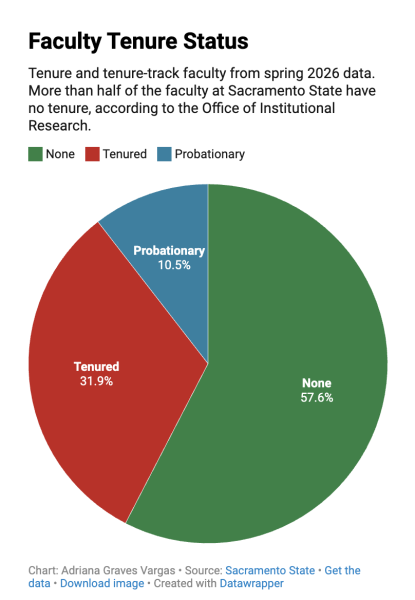
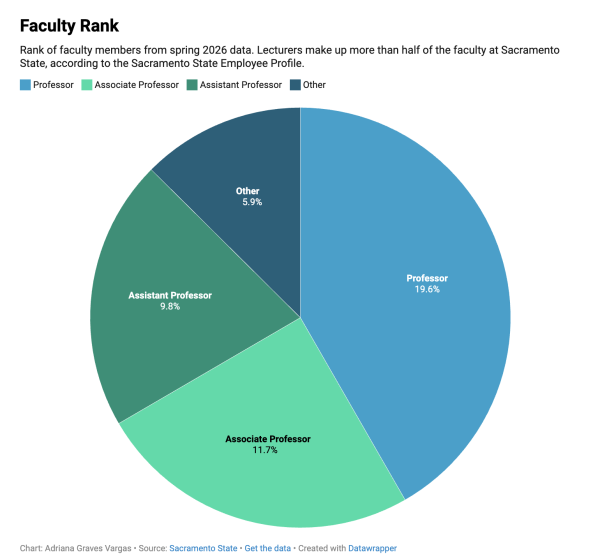
Selby said he was in favor of the bill because he often gets the last pick of classes as a contingent faculty member. He said that 50% of Sac State courses are taught by contingent faculty members and have the highest rates of enrollment.
Contingent faculty members have no long-term position commitment from their institution. These include full-time and part-time positions that are not tenure-track and are paid by the course.
“Hiring more administrators, more administrator salary, all of that, it’s a really long-term problem in higher ed,” Selby said. “It seems to be a big part of the attempt to turn higher education into a marketable commodity.”
Selby said the mission of a higher education university should be to teach. As a contingent faculty member, Selby said this is personal.
“We’re an educational institution, so money should go to education,” Selby said. “Why is that so hard?”
After being heard by the Committee on Appropriations Wednesday, April 15, the bill will go to the Senate or Assembly Rules Committee for policy committee assignment.
The State Hornet reached out to Sac State for comment but did not receive a response by press time.