
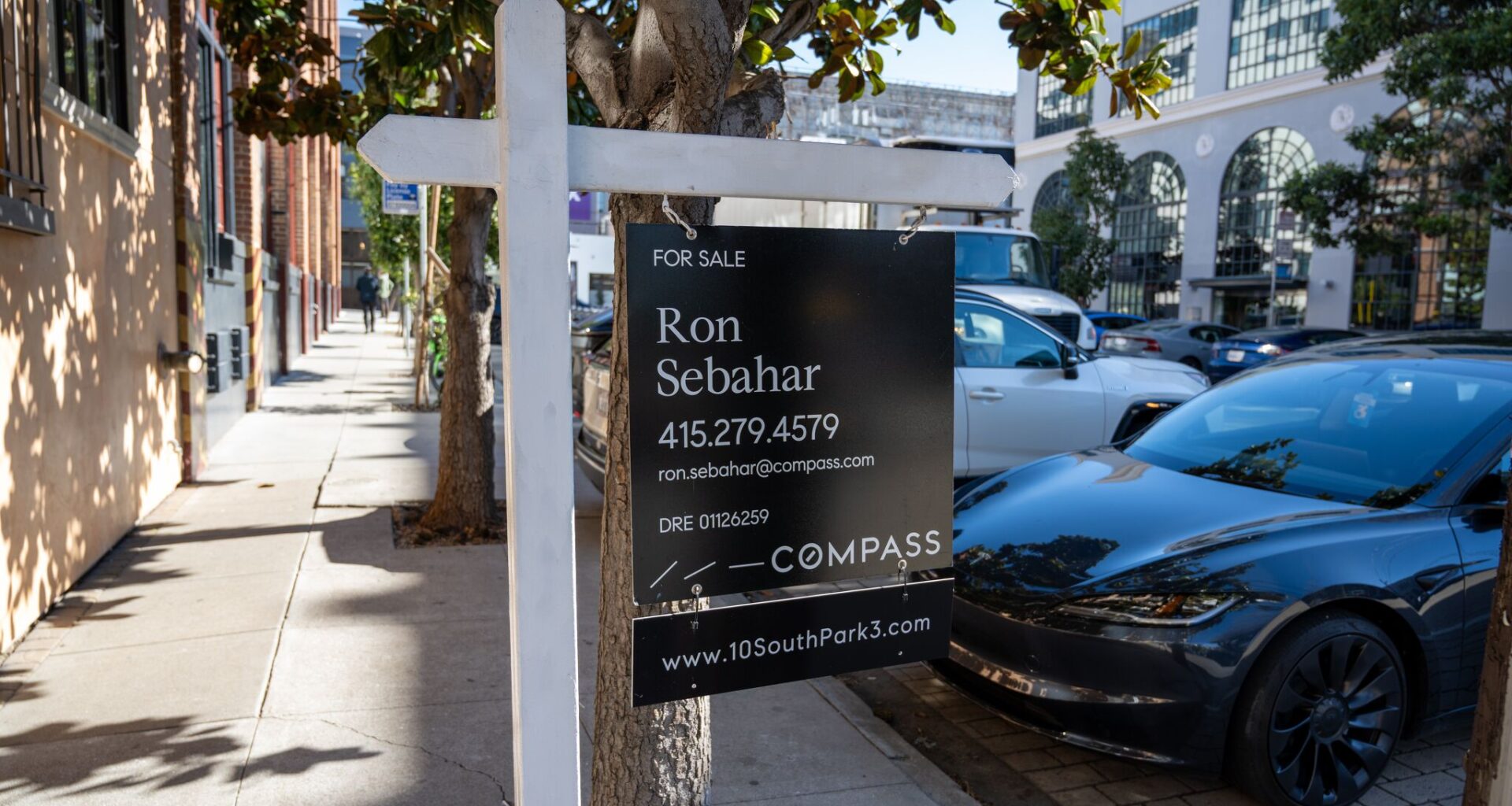
A home with a “for sale” sign is shown last month in San Francisco, where rising prices and borrowing costs continue to reshape what buyers can afford.
Smith Collection/Gado/Gado via Getty Images
In America, a $200,000 salary is pretty good.
In the U.S., the average annual salary in 2026 is $64,505 per Forbes; it’s $79,900 here in California.
A $200K salary puts you well above twice that average. Still, in the Bay Area, it won’t go far when you’re shopping for a house.
Article continues below this ad
It’s a topic that recently came up in a popular post on the Bay Area subreddit titled “What a $200K salary really buys in 10 Bay Area cities (2026).”
The Reddit poster calculated post-tax monthly income on a $200K salary and used that to create a chart listing 10 major Bay Area cities and corresponding median home prices — ranging from a low of $800,000 in Oakland to a high of $3 million-plus in Palo Alto, with San Francisco near the top at $1.3 million to $1.5 million. The chart showed what the monthly payments would be for mortgages at current rates on those homes and determined the “affordability level” based on that.
San Francisco Chronicle Logo
Make us a Preferred Source to get more of our news when you search.
Add Preferred Source
The analysis oversimplified several elements of the home-buying equation, but it raised a good question: What kind of house can you buy with a $200K salary in the Bay Area? Where can you find something affordable, and what areas are totally out of reach? And how should you think about building a home-buying budget, at any salary?
How much house can you buy with a $200K salary?
The chart posted on Reddit used post-tax income to determine a home-buying budget. But that’s not the right place to start, said Jeff Ostrowski, a housing market analyst for financial comparison platform Bankrate. Mortgage underwriting — the process lenders use to determine how much they’ll loan you to buy a house — is based on pretax income, also known as gross income.
Article continues below this ad
“$200,000 in household income is in most parts of the country a lot, it’s plenty to live comfortably,” Ostrowski said. “But that’s not really the case in the Bay Area. … The rule of thumb that might make sense in Atlanta or Dallas or Indianapolis might not be OK in San Francisco or Oakland.”
Three times that total gross household income is the baseline many mortgage lenders use to determine how much house you can afford, said Paul Barbagelata, a real estate broker who specializes in San Francisco and the Bay Area. But there are a lot more variables at play beyond the number on your paycheck. He said brokers want to know things like your planned down payment, what will be left in the bank after the purchase, and whether there are HOA dues or other fees to factor into the monthly payment. You’ll also want to factor in things like long-term maintenance, especially for older homes.
Nadia Evangelou, a principal economist for the National Association of Realtors, said the typical industry standard for figuring out what monthly payment is doable involves 25% of your gross income going toward your mortgage payment — principal and interest — with another 5% allotted for the rest of your recurring monthly housing costs, like taxes, insurance and any fees like HOA dues. She said it’s important to build a big-picture budget that takes into account your retirement savings, child care costs, debt payments and other real-life expenses.
So how much house does that work out to? Evangelou said that on a $200,000 salary, she’d recommend a house budget between $650,000 to $800,000, which would put monthly payments between $4,000 and $5,000, depending on your down payment. Ostrowski said that at current mortgage rates (around 6.5% for the average 30-year loan as of this week), he would aim for a budget of around $730,000, though with more flexible Federal Housing Administration loans, the upper limit could be as high as $925,000. Barbagelata said given higher housing costs in the Bay Area, he’d advise clients to look in the $1.2 million range, though again, it would depend heavily on their planned down payment.
Article continues below this ad
Where in the Bay Area can a $200K salary buy you a house?
When you’re looking for a house within a certain budget, you’ll likely have to make compromises across three dimensions, Evangelou said. There’s the type of home you buy: a condo or townhome versus a single-family home. There’s the location, particularly the distance from job centers. And there’s the age and condition of the house.
In San Francisco, the South Bay and the Peninsula, you’ll have to make a lot of those compromises to achieve your price point.
The explosion of AI companies has drastically altered San Francisco’s real estate landscape.
“The AI market in San Francisco is really hot,” which has pushed up housing costs considerably, Barbagelata said. “You have entry-level positions paying $350K for just the bottom tier.” When it comes to housing, he said, “San Francisco and San Mateo are really very untouchable right now for that price range” outside the condo market.
Article continues below this ad
Within San Francisco, Barbagelata said he’d advise clients looking for single-family homes with a $200K salary to look at the Portola, Visitacion Valley, Excelsior, Outer Mission and Bayview districts. He said you’d likely find some options in the $900K to $1.2 million range, though they would be “still quite competitive.”
Outside San Francisco, he’d recommend Concord, Richmond, Martinez or Benicia — “beyond Oakland and Berkeley, because that’s very unaffordable right now.”
In Marin County, he advised looking in places to the north like Terra Linda and Novato, though “it’s going to be very few and far between.” Most of Napa and Sonoma proper would be out of reach, but you could look in Sebastopol and the Russian River area.
Evangelou said she’d advise buyers to look for townhomes and condos in the East Bay and Alameda, and entry-level single-family homes in Contra Costa, the North Bay, Napa, Sonoma and Solano County.
“The Bay Area is not one market,” she said. “An income buys very different housing outcomes depending on where you look.”
Article continues below this ad
What if you can’t find a house in your price range in the Bay Area?
The combination of high mortgage rates, widespread tech layoffs and broad economic uncertainty has slowed the usual spring flurry of buying and selling. Though home prices continue to increase nationally, the National Association of Realtors revised its annual forecast this month to predict fewer home sales this year.
If you can’t find something in your budget in the area where you want to live, step back and reconsider whether buying right now is really the right move, said Annamaria Lusardi, the faculty director of the Initiative for Financial Decision-Making at Stanford University. Though renting doesn’t build equity, saving money on housing means more can go toward retirement savings and investing, which are more liquid than a house. Rent prices have grown more slowly here in California compared to other parts of the country.
“In California, to me, it’s not always obvious that buying is the best choice,” Lusardi said, noting the state’s high property taxes and housing prices. “It’s tricky to have too much of your wealth just in one asset.”