
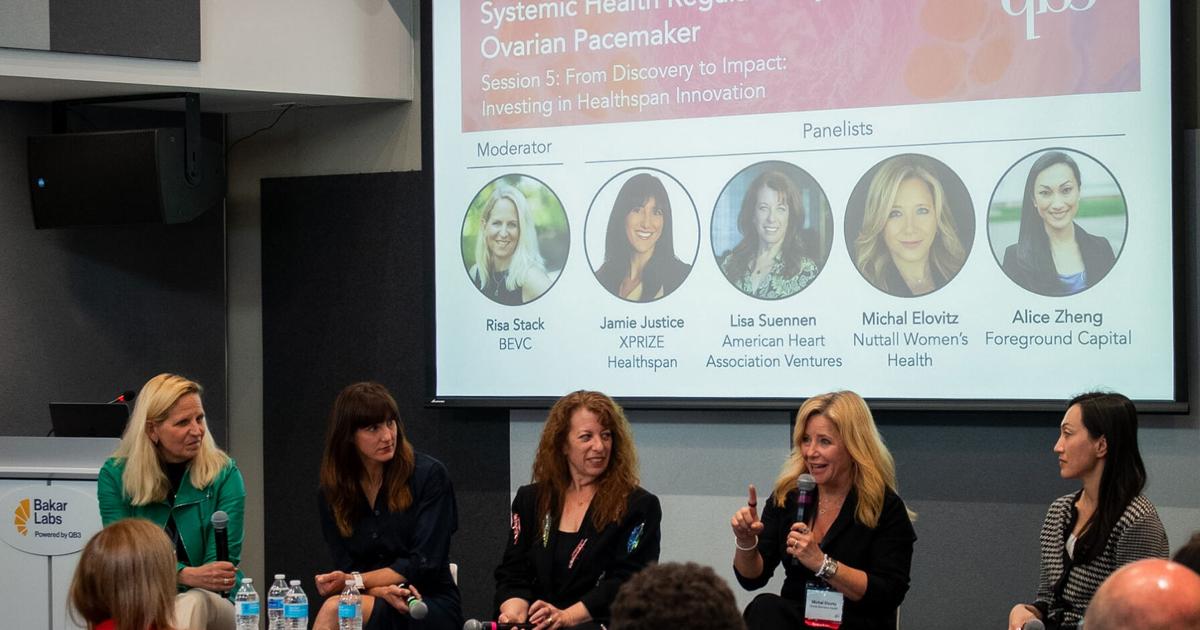
QB3 hosted its annual symposium Tuesday at Bakar Bio Labs, focused on ovarian health and aging and the broader impacts they have on women’s health.
Panelists shared research on ovarian aging, diseases and whole-body impacts. Panelists also discussed more clinically based developments in ovarian health and advancements in technology and therapies to address issues in women’s health.
QB3, or the California Institute for Quantitative Biosciences, hosts annual symposiums with the aim of sharing new research and projects emerging from academia and industries in California and beyond. It also helps to connect researchers and businesses working on similar issues, according to Katarina Klett, the director of research translation at QB3.
Lise Barbé, the grants coordinator at QB3, said the symposium focuses on women’s and ovarian health largely because it is underrepresented in research. She hopes that “collaborations will spark” at the symposium and that gathering people from diverse backgrounds will encourage investments into women’s health solutions.
She said that after the symposium she helps host follow-up events to support researchers to further refine specific project ideas and apply for funding.
“This is really the beginning of the whole pipeline where we start having people interact (and) figure out what they want to do,” Barbé said.
The panel topics included the impact ovaries has on lifespan and cognition, its impact on cardiovascular risk, AI tools being used to assess menopause symptoms in hospital charts and more.
Emily Jacobs, one of the panelists and a current professor at UC Santa Barbara, began focusing on women’s health as a Ph.D. student at UC Berkeley. While doing research on estrogen in the brain, she realized that while more than 50,000 brain imaging articles have been published, less than 1% of them focused specifically on women’s health factors.
She said this represented both a “historical negligence” and an “incredible opportunity to make major discoveries.”
During the panel, Jacobs discussed how the ovaries have an impact on the brain and nervous system in women, and specifically how “endocrine transitions” including pregnancy, the menstrual cycle and menopause impact the brain throughout a woman’s life.
She shared research that found many of the changes that occur in women’s brains during “endocrine transitions” can also leave them more vulnerable to adverse factors such as depression.
Jacobs also said there is a lot of “low-hanging fruit” yet to be discovered about ovarian impacts on the body due to how understudied it is.
“I think the best is yet to come,” Jacobs said. “I think that women’s health has been having a moment. We have to turn it into a movement.”