
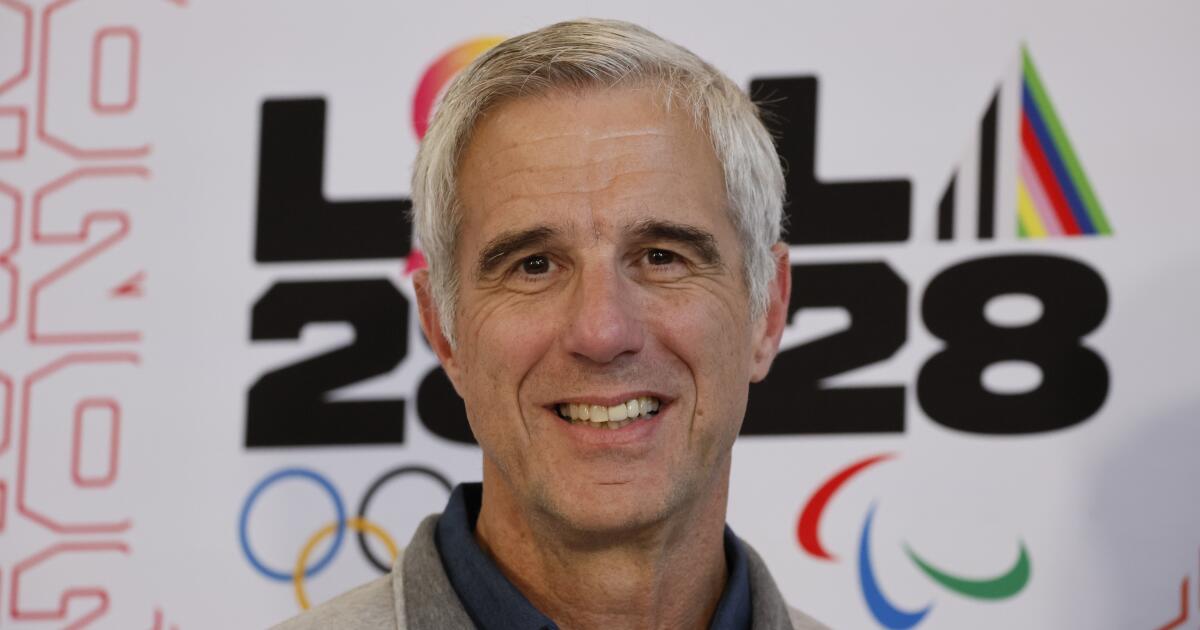
With the 2028 Olympics approaching, Los Angeles city officials are pushing hard to make sure local and small businesses within the city get a big share of the massive contracts generated by the Games.
You’re reading the Essential California newsletter
Sign up to start every day with California’s most important stories.
By continuing, you agree to our Terms of Service, which include arbitration and a class action waiver. You agree that we and our third-party vendors may collect and use your information, including through cookies, pixels and similar technologies, for the purposes set forth in our Privacy Policy such as personalizing your experience and ads.
But Olympic officials say they worry that limiting the contracts to firms within the city limits could hurt competition and end up making the Games more expensive.
The friction between the two sides erupted in public Tuesday when L.A. City Council committee members interrogated LA28 Chief Executive Reynold Hoover about “procurement” plans for the monthlong Olympics and Paralympics.
The chief executive of the host committee says he’ll do his darndest to make sure L.A. businesses get their fair share of the contracts, but not if it means driving up costs so much that the Games bust their $7.1-billion budget, leaving L.A. taxpayers on the hook for cost overruns.
How much money is at stake
At stake is an estimated $4 billion in contracts, with roughly $1 billion expected to go to small businesses. Local companies will provide food at Olympic venues, install fences and portable toilets, and build an equestrian cross-country course, among many other projects.
LA28’s plans call for 75% of that work to be done by local companies, which the nonprofit organization defines as those based anywhere in Los Angeles, Ventura, Orange, Riverside and San Bernardino counties.
But council members told Hoover they believed his organization should be doing more to prioritize businesses within the city of Los Angeles, considering L.A. will be the epicenter of the Games and the government is taking the greatest financial risk if the Games don’t make money.
If the event costs more than it brings in, L.A. will be liable for the first $270 million in cost overruns, with the state of California on the hook for the next $270 million and the city liable for any unpaid expenses over $540 million.
“When the city of Los Angeles is the first on the hook for the financial shortfalls in producing these Games, our businesses in the City of Los Angeles should be … first in line” for contracts, said Councilmember Monica Rodriguez.
L.A. council members push for more local contracts
Council President Marqueece Harris-Dawson said L.A.’s greater level of regulation (including those that assure fair wages and worker protections) means its businesses might submit higher bids than those in places like Barstow and the Inland Empire. He also noted the historic spending L.A. has made on venues such as the Coliseum. Harris-Dawson said LA28’s plan “misses the mark” by not giving the city special consideration compared with “people included in the five-county area that have a lot less at stake.”
Councilmember Hugo Soto-Martinez said he didn’t trust the LA28 board. “We have to go to our constituents,” he said, “and say that we are fighting for them to make sure that they’re going to get as much business as they can out of this event.”
City officials demanded that LA28 commit to a more specific dollar “spend” on L.A. business contracts and adopt a program for certifying that L.A. companies are truly based in the city (to assure, among other things, that out-of-town outfits don’t merely use an L.A. P.O. box.)
The ‘General’ promises to be fair
Hoover gave no indication that LA28 would adhere to those requests, but he pledged to return to the council with more specific information. The Olympic chief — an Army veteran whom council members addressed as “General” — said he was doing everything he could to bring opportunities to the city.
“We’re actively going out to all the council districts and all of the communities around to talk to business leaders and community leaders about procurement … so that they can participate,” Hoover said.
But he also emphasized that he had to keep his eye on the bottom line and did not want to have to hire L.A. businesses that charged LA28 “premium Olympic prices.”
“If I focus solely, first and foremost, on the city of L.A., for … small business, then I am artificially reducing the pool of competition,” Hoover said, “placing greater risk on city taxpayers and placing greater risk on the [financial] backstop of the city of L.A., because prices will go up when there is no competition.”
Today’s top stories 
Lonna Drewes, left, shown with attorney Lisa Bloom, on Tuesday alleged that Rep. Eric Swalwell (D-Dublin) assaulted her in 2018.
(Myung J Chun / Los Angeles Times)
More Swalwell assault allegationsAnother woman accused Rep. Eric Swalwell of drugging and raping her in 2018 while she was a model in Beverly Hills, saying she became incapacitated after a single glass of wine.The news came after Swalwell announced Monday he would resign from Congress after multiple women came forward with sexual misconduct accusations.Unions win big at LAUSDThree unions won major victories including double-digit raises for teachers and 24% for lower-paid service workers, averting a strike that nearly shut down schools.But the price of union peace will be nearly $1.2 billion in annual contract costs, and questions remain about whether the district can afford it.L.A.’s housing marketMortgage rate increases triggered by Iran war tensions deepened L.A.’s housing market freeze, rendering more first-time homebuyers unable to afford starter homes.But the ceasefire deal in April has sparked activity, according to one agent, who says new escrows are up in L.A. County, though sales data have yet to reflect this momentum.Trump administration’s ‘gold standard science’Across the Trump administration, agencies have committed to a supposed “gold standard” of science.Critics, however, say it’s being selectively applied to prioritize desired outcomes over inconvenient evidence.What else is going onCommentary and opinionsThis morning’s must-readAnother must-readFor your downtime 
BagelFest founder Sam Silverman at the inaugural BagelFest West at the Wilshire Boulevard Temple’s Audrey Irmas Pavilion in Los Angeles. Silverman founded the original New York-based BagelFest in 2019 as a celebration of bagel culture.
(Angela Osorio / Los Angeles Times )
Going outFestivals: A New York bagel fest rolls into L.A. to show the best of West Coast innovation. Theater: Legendary South African actor John Kani arrives at the Geffen Playhouse to reprise a role he first performed more than 40 years ago.Staying inA question for you: Are you planning on leaving California for another state? If so, tell us why.
Rachel says, “No, I was born here, and here is where I will stay. Where can you find weather like ours? There’s just about nothing you can’t do here in California. There’s always something happening, something going on, and something to do. No, I’m staying.”
Email us at essentialcalifornia@latimes.com, and your response might appear in the newsletter this week.
And finally … your photo of the day 
Brandon Shahniani’s Los Angeles town home is full of specific time-capsule moments that bring him joy, such as his 1950s-style diner.
(Myung J. Chun / Los Angeles Times)
Today’s great photo is from Times photographer Myung J. Chun at the theme park-style home of a Disney enthusiast, who designed each room using theme park techniques to create spaces that make him feel safe, expressed and happy amid generational anxiety.
Have a great day, from the Essential California team
Jim Rainey, staff reporter
Hugo Martín, assistant editor, fast break desk
Kevinisha Walker, multiplatform editor
Andrew Campa, weekend writer
Karim Doumar, head of newsletters
How can we make this newsletter more useful? Send comments to essentialcalifornia@latimes.com. Check our top stories, topics and the latest articles on latimes.com.