
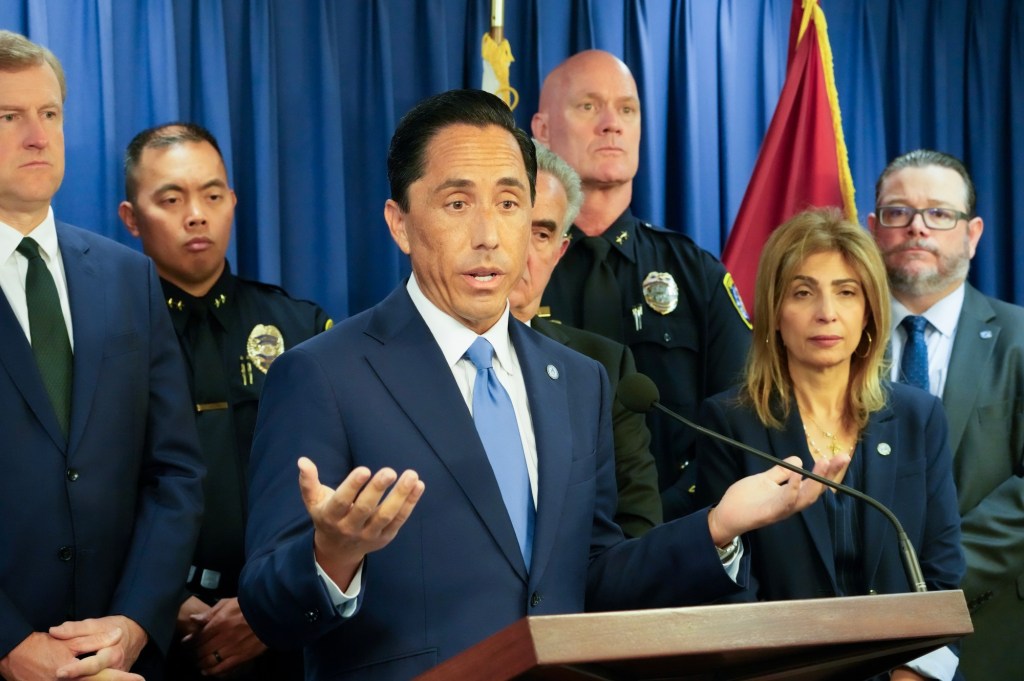
A budget proposal for the new fiscal year unveiled Wednesday morning by San Diego Mayor Todd Gloria looks to close a projected $146 million deficit by eliminating all arts funding that directly help local arts and culture organizations, dealing what some are calling a “catastrophic” blow to a sector that has not yet fully recovered from the pandemic.
The mayor, who will release his fiscal year 2027 budget plan in its entirety at noon Wednesday, said the proposed cuts “are not going to be easy” and “every department made reductions. No area of city government was exempt, including my office.”
The plan, which will be reviewed and debated by the City Council between now and June 9, proposes deep cuts for some areas, such as libraries and recreation. But it sharply cuts funding for the arts, taking it from $13.8 million to just about $2 million, eliminating all funds under the city’s two grant-making arms: the Organizational Support Program and Creative Communities San Diego. Monies received from those two programs go directly to arts groups, which use the funds to drive matching grants they apply for from the private philanthropic sector.
The remaining $2 million will essentially keep open the city’s Cultural Affairs Department, whose staff oversee the public art program and grant-making process. The department is expected to continue working with individual artists and incubator programs “because those come from state funding,” said Alessandra Moctezuma, the chair of the city’s mayor-appointed Commission for Arts & Culture.
“But the bulk of the budget — $11.8 million — is what supports most of our arts nonprofits,” she said Tuesday ahead of the mayor’s announcement. “That’s a devastating loss to the community.”
The proposed cuts threaten groups and arts programs across a large swath of the region, everything from Dia de los Muertos celebrations and powwows to specific events like the Asian American Dance Festival and Ocean Beach Street Fair & Chili Cook-Off, which this fiscal year received $15,052 from the city. Under the proposed cuts, San Diego Pride would lose $376,564, the amount it received for fiscal year 2026. Some of the city’s largest arts organizations would not escape unscathed: Using figures they received for fiscal year 2026, the Old Globe Theatre would lose $382,057 in city funding and the San Diego Opera $270,293.
 Bob Lehman, executive director of the advocacy group San Diego ART Matters, talks to the media after San Diego Mayor Todd Gloria unveiled his proposed budget at City Hall on Wednesday morning. (Nelvin C. Cepeda / The San Diego Union-Tribune)
After the mayor’s briefing Wednesday morning, Bob Lehman, executive director of San Diego ART Matters, the region’s largest arts advocacy organization, said he was dismayed by what he heard.
“My biggest takeaway from it was two statements, one from the CFO (Rolando Charvel), who said we can no longer afford to fund arts and culture grants. That sounds permanent. … There were no qualifiers in there. In the mayor’s statement, he said it’s hopefully temporary, which means it’s open to discussion, but the cuts are there in the proposed budget. The only other place in this country where this type of arts cuts are happening is in the Trump budget.”
Word of the cuts spread through San Diego’s creative community Monday, and by Tuesday afternoon, a hastily organized Zoom virtual meeting — with the subject line “URGENT: Arts & Culture Emergency Virtual Town Hall” — had attracted 100 arts leaders from across San Diego, from the San Diego Symphony’s Martha Gilmer to Space 4 Art’s Jennifer de Poyen. Many could not join the call, organized by San Diego ART Matters, because the call had reached capacity.
Another emergency virtual town hall has been organized and planned for 11 a.m. Wednesday.
Lauren Lockhart, the executive director of La Jolla Historical Society, was locked out of the meeting because of capacity, but she didn’t mince words Tuesday night about the proposed cuts, calling it “catastrophic.”
“Eliminating arts and culture funding will have a catastrophic impact on San Diego’s cultural infrastructure that serves residents and visitors to the region,” said Lockhart, whose nonprofit organization received $111,578 this fiscal year. “For La Jolla Historical Society, this funding is vital to ensure that our exhibitions and programs remain accessible to all and that we can preserve and activate our historic campus.”
Megan Pogue, executive director of the always-free Timken Museum Art in Balboa Park, said: “Cuts to city funding for the arts present real challenges for organizations like the Timken and the community we serve. As a free museum welcoming over 250,000 visitors annually, this support has ensured broad public access to exhibitions and educational programs. City funding represents nearly 10% of our annual budget. Combined with reduced federal support and a more constrained philanthropic environment, replacing these funds will be extremely difficult.”
The Timken received $188,499 this fiscal year as part of the Organizational Support Program, which uses an algorithm — some say an outdated one — that provides funding dollars based on an organization’s operating budget.
De Poyen, executive director of Space 4 Art and a highly vocal and visible visual arts advocate, said: “It is absolutely devastating for organizations to lose city funding which supports so much essential cultural activity and also encourages private donors and philanthropists to support our programs. … Ideally and in practice, the city provides essential seed money that allows organizations to stabilize and grow programs and services that no government or private entity provides.”
In fiscal year 2026, the city awarded nearly $9.6 million to 119 arts organizations under the Organization Support Program, which “provides general operating support to tax-exempt, nonprofit, arts and culture organizations, for delivery of activities and programming that positively impact San Diego’s quality of life and tourism.”
Under the Creative Communities San Diego program, the city doled out just a little more than $1.7 million to 70 arts groups to provide “project support for nonprofit organizations to deliver dynamic projects in San Diego neighborhoods.” This funding is directly tied to an arts organization’s project and must be used toward that effort.
“The mayor’s proposed funding cuts will drastically impact the artists of San Diego as well as potentially eliminate a culturally important arts event that represents and serves a large swath of San Diego’s population — the entire AAPI diasporic communities,” said Joyce Lien Kushner, founder and director of TILTshift Dance, which organizes the Asian American Dance Festival, which this fiscal year received $5,000 from the city.
Arts commissioner and consultant Kamaal Martin, who works with Catalyst of San Diego & Imperial Counties, said the proposed cuts is virtually “dismantling a $10.8 billion economic engine.”
“San Diego’s creative industries generate a total economic impact of $10.8 billion and support nearly 170,000 jobs across the region,” he said, citing a 2024 city of San Diego report on creative industries. “Cutting city arts grants, the anchor investment that catalyzes private and philanthropic dollars, threatens the foundation of this entire ecosystem, not just the nonprofits receiving direct support.”
Martin said the repercussions of the proposed cuts will be felt beyond the arts sector.
“Tourism revenue is at stake, and the arts are a primary driver,” he said. “The city’s entire arts grant program is financed by the Transient Occupancy Tax, meaning arts investment is explicitly linked to visitor spending. The city’s arts funding programs are designed to improve quality of life for San Diegans, generate employment opportunities and boost tourism. Defunding these programs risks a downward spiral where fewer cultural attractions generate less TOT revenue, producing future deficits that dwarf today’s savings.”