
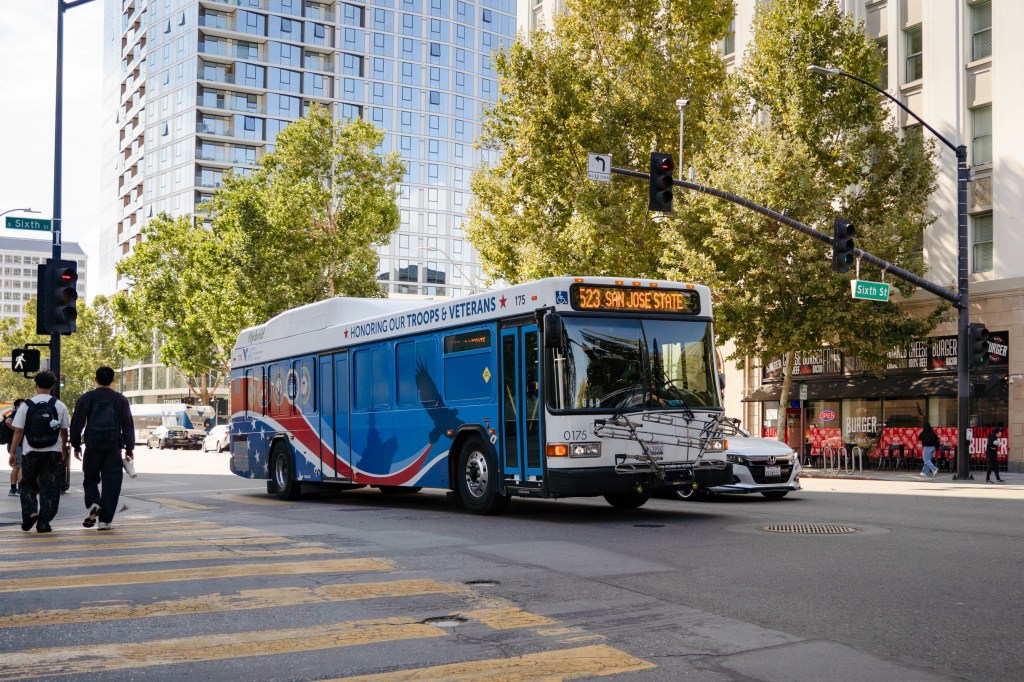
As Bay Area transit agencies face the threat of major service cuts, San Jose is staking out its funding priorities for the Valley Transportation Authority ahead of a November 2026 regional ballot measure.
The plan — approved unanimously by the San Jose City Council Tuesday — recommends directing $264 million in projected annual revenue authorized under Senate Bill 63 into three key areas: service improvements, major construction projects and repairing bus-heavy roads.
Last October, Gov. Gavin Newsom signed Senate Bill 63, authorizing a regional transit sales tax measure on the November 2026 ballot.
If approved, the measure would fund Caltrain, BART, Muni, AC Transit and other systems across Alameda, Contra Costa, San Francisco, San Mateo and Santa Clara counties. It would levy a half-cent sales tax in most counties and a full cent in San Francisco. The Metropolitan Transportation Commission estimates the measure could generate about $1 billion annually over 14 years.
Like most Bay Area transit agencies, the VTA – although reporting a rebound in ridership – is projecting multi-million dollar deficits in the coming years, a hangover from pandemic-era ridership losses.
Across the region, agencies including BART and Caltrain have warned of potential station closures and steep cuts to service frequency without new revenue. The VTA has avoided cuts for now, but joined the regional ballot measure effort last year to stave off deeper reductions down the line.
The city wants to direct the largest share — 50% — to target day-to-day service improvements: upgraded transit stations, cleaner and safer vehicles, more frequent routes, signal technology that gives buses priority at green lights, and discounted or free transit passes for young riders.
Councilmember Pamela Campos said transit infrastructure in her district remains inadequate.
“In my district, which Monterey Highway runs along, there’s a bus stop that does not have shelter and very little sidewalk,” she said. “And I have seen people waiting on the Caltrain train tracks to get some shade as they wait for the bus.”
Another 30% would fund major construction projects, including the redevelopment of Diridon Station, a new rail link to Mineta San José International Airport, and upgrades to the light rail and Caltrain systems.
The smallest slice, 20%, would go toward repaving streets that carry heavy bus traffic. Officials say buses wear down roads far faster than cars, and current road repair funding is set to expire in 2028.
The priorities are recommendations only and, although made by San Jose, cover the full VTA service area across Santa Clara County. The agency plans to consult other local governments in the coming months before any funding framework is finalized. The VTA board draws its members from cities and across Santa Clara County, with San Jose holding at least five of 12 voting seats.
Councilmember Peter Ortiz, who represents East San Jose, said his district is the most transit-dependent in the county and should “see the greatest benefit” from any new funding.
“These dollars can go further, supporting more activity along our corridors, strengthening our small business community and making our neighborhoods more connected,” Ortiz said. “When we invest in transit for the communities that rely on it the most, we’re investing in workforce access — local small businesses gain access to customers, to workers, and to the overall vitality of these neighborhoods.”
But Ortiz also raised pointed concerns about whether VTA could win over voters, criticizing the agency’s outreach in his district as “unsatisfactory.”
He alleged that VTA has canceled public meetings, that his office has struggled to get basic updates from the agency, and that construction along the Capitol Expressway corridor — happening overnight, he said, with inadequate dust mitigation — has frustrated residents.
“It’s hot in District 5. They’re not able to close their windows because of the heat, and there’s not proper dust mitigation,” Ortiz said. “I have to practically yell and cc everybody and the VTA board to get updates, and that’s not acceptable.”
Ortiz warned the friction could cost the measure votes.
“Good luck getting votes from District 5 residents — good luck — because they’re unhappy with VTA,” he said.
VTA defended its work in East San Jose, saying in a statement that the agency is committed to the communities it serves and is working to deliver the Eastridge to BART Regional Connector project on schedule.
“We take neighbors’ concerns seriously and are finalizing an improved program to address impacts, similar to the support provided to local businesses, ensuring community voices are reflected as the project moves forward,” a spokesperson told this news organization in an email Wednesday.
A coalition of transit and advocacy groups — including Seamless Bay Area, the Transbay Coalition, and Public Advocates — urged the City Council to direct at least 80% of the funding toward service improvements and transit priority investments. In a letter submitted the day before the vote, the groups noted that VTA runs far less service per resident — just 1.1 service hours per year — than almost any comparable transit agency in the country.
Adina Levin, Seamless Bay Area’s executive director, said the gap was exactly why the council should direct even more than 50% toward service improvements.
“It’s a unique opportunity for increasing ridership,” Levin said. “Over time there are a lot of different funding sources for capital, and it is historically more difficult to fund basic service.”
She credited VTA’s recent strategic planning work, but said the agency’s own data shows service levels have barely budged since 2001.
“We admire VTA’s work in recent years in developing those valuable and important strategies,” she said.
Monica Mallon, a San Jose-based advocate who has tracked public transit issues for about a decade, supported the plan and called its emphasis on service spending a significant shift — a sign of how much attitudes toward public transportation have changed in recent years.
“It is just incredible to see how attitudes have changed on service and how our leaders are prioritizing investments that will impact riders and residents right now,” Mallon said. “Not having flexibility has hurt us quite a lot. We should learn from our past mistakes and do better.”