
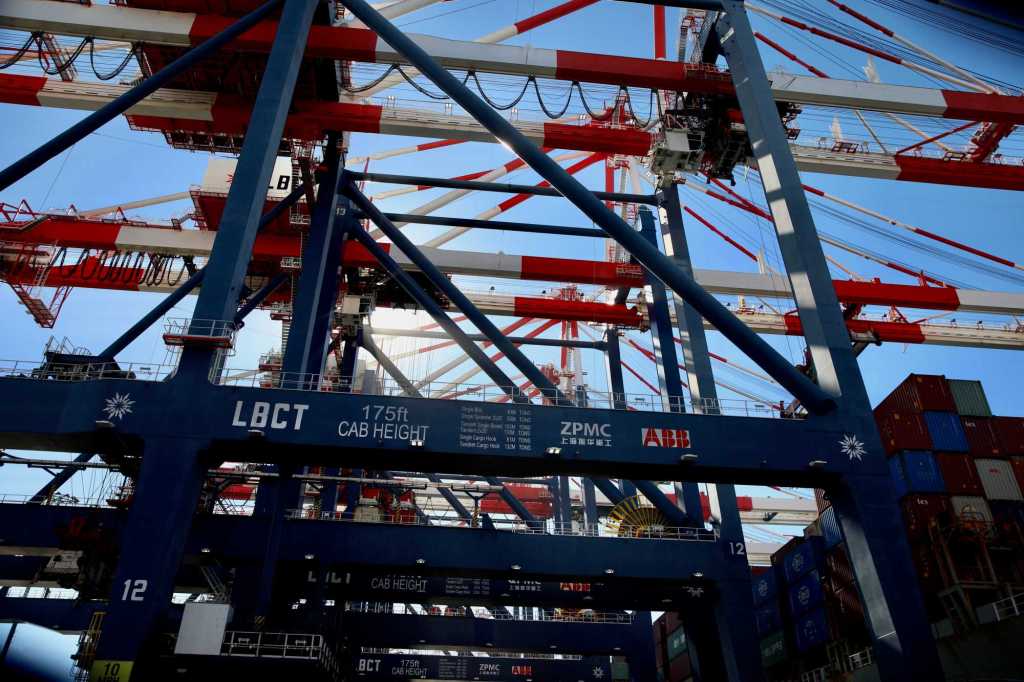
The Port of Long Beach landed bragging rights — again — to top cargo numbers for both the month of March and for the first quarter overall.
Port CEO Noel Hacegaba, leading off a virtual news briefing with the latest statistics on Wednesday morning, April 15, said Long Beach dockworkers and terminal operators handled 774,935 twenty-foot equivalent units of cargo last month, 5.2% fewer containers than the same time in 2025, which was a record year for cargo movement at the port.
It was the most cargo in North America in March and through the first quarter of 2026, he said.
But much of the rest of the 30-minute briefing — with guest Jonathan Gold, vice president of Supply Chain and Customs Policy for the National Retail Federation — centered around the continued unpredictability of the supply chain because of tariffs, shipping challenges in the Middle East and other economic concerns.
Impacts from hostilities in the Middle East, including blocked vessel traffic in the Strait of Hormuz, have not manifested in Long Beach, Hacegaba said.
“Despite these global pressures,” he said, “the conflict has not yet reduced cargo volumes at the Port of Long Beach.
“What we’re seeing instead,” he added, “is the impact of tariffs and timing and the comparison to a strong baseline the year before.”
Gold said rising fuel costs and other challenges are being felt.
“Unfortunately, as we’ve seen in previous supply chain disruptions,” Gold said, “it’s not easy to quickly pivot, to have to look for rerouting cargo, which takes time and money.”.
Small retailers who make up the bulk of the retail community, Gold said, are feeling a disproportionate impact and more challenges in being able to quickly respond.
“They’re already operating on a slim margin,” he said, “so they don’t have the ability to absorb cost increases and they have to pass those along to the end consumer.”
Now the nation is seeing the start of the holiday shipping season, Gold said, which is now starting in May and June.
“Over the years, retailers have spread out the holiday peak season,” he said. “Consumers are buying holiday merchandise earlier and earlier so they want to make sure they’re ready and goods are on the store shelves.”
A breakdown of the March cargo numbers indicates that imports declined 1.6% to 374,412 TEUs, while exports showed a 0.5% uptick to 104,554 TEUs when compared to March 2025. Empty containers moving through the port dropped 11.1% to 295,970 TEUs.
Through the first quarter of this year, the Port of Long Beach processed 2,390,225 TEUs, more than any seaport in the nation, Hacegaba said. Cargo volumes for the first quarter of 2026 were down 5.7% from the first quarter of the port’s record year of 2025.
“Thanks to the efforts of our ILWU workforce and terminal operators, the Port of Long Beach led the nation as the busiest container port for the month of March,” Hacegaba told reporters during his virtual media briefing. “While not our strongest month on record, we handled nearly 775,000 TEUs, making us the busiest gateway in North America.”
Hacegaba, however, also warned that war in the Middle East is creating uncertainty for global supply chains, even with a ceasefire in place.
“When ships are being rerouted to avoid conflict zones, it sets off a chain reaction,” Hacegaba said. “Cargo has to move differently. Routes get longer. Costs go up. And ultimately, consumers pay more.”
The supply chain is already reacting to rising fuel costs by implementing new surcharges and other cost-saving measures, Hacegaba said.
“Here’s the bottom line: what happens in the supply chain doesn’t stay in the supply chain,” Hacegaba said. “It shows up in the prices people pay every day. Not just higher price tags — but fewer discounts, higher free-shipping thresholds and slower delivery times.”
Rising fuel costs, meanwhile, are accelerating the case for renewable energy and domestic energy independence, Hacegaba said, two major issues in the port’s outlook.
“This is a pivotal moment for energy,” Hacegaba said. “At the Port of Long Beach, we’re not waiting.”
At the media briefing, Hacegaba also highlighted the four-year anniversary of the Clean Truck Fund Rate, which was created to fund zero-emissions trucks and infrastructure with container fees collected from cargo owners. Since its inception in 2022, more than $62 million has been reinvested toward transitioning trucks serving the Port into a zero-emissions fleet.
“This is how we turn policy into progress,” Hacegaba said.
The port is also investing in zero-emissions equipment, clean shipping corridors and offshore wind infrastructure such as the Port’s proposed Pier Wind terminal, Hacegaba said.