
 Courtesy graphic
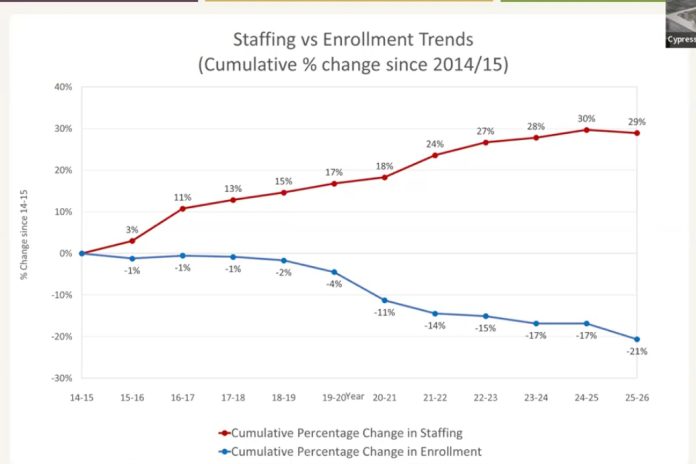
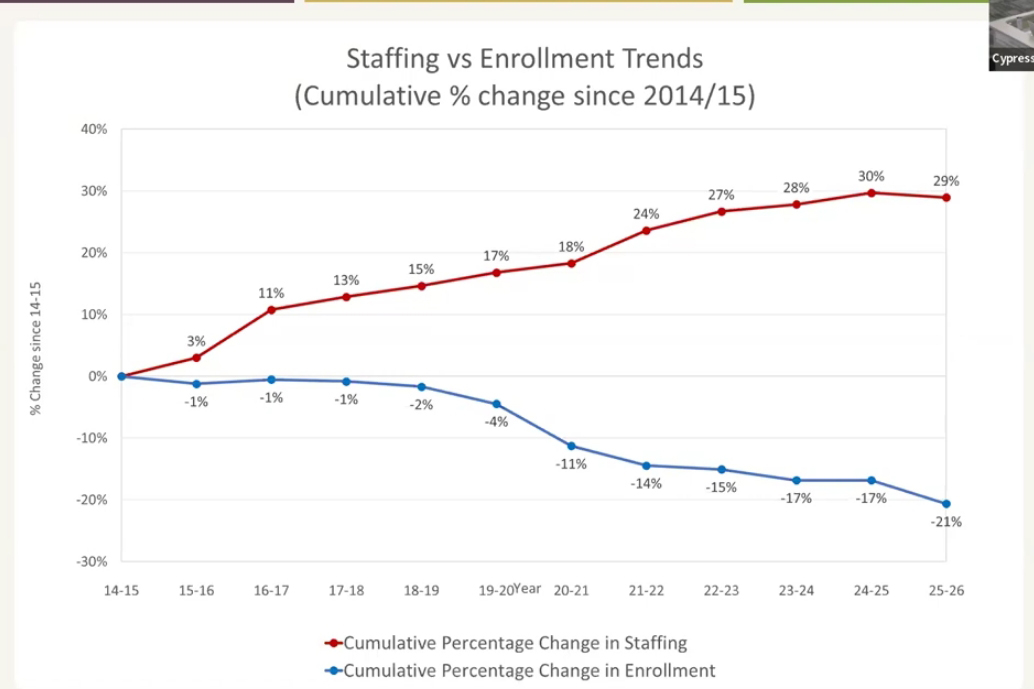
“So, the chart in red, is the thing we spend money on and the chart in blue is the thing that generates the funding. And they’re going in opposite directions and that’s going to lead to the challenge we are seeing today,” Ferchaw told the board.
Not only is its current budget more than $3 million in arrears, but trustees of the Cypress Elementary School District also learned at its regular meeting Thursday that without hard decisions, the system faces even more red ink in the future.
“This isn’t just a Cypress thing,” said Interim Supt. Dr. Timothy McLellan, adding that “this is what a lot of California school districts are experiencing.”
While the financial picture was less than rosy during what turned into a five-hour marathon workshop that laid bare the district’s dwindling finances, the Board of Trustees did manage to get a detailed analysis of the system’s financial structure, including Fund 40.
Fund 40 is where the district’s investments into private apartment complexes are kept and spent, as the board spent nearly two hours hearing an explanation.
Cypress, like other districts, is experiencing declining enrollment. Two decades ago, the board apparently formed a committee to deal with underutilized sites, meaning sites that had been closed then for declining enrollment.
The district then had six surplus sites, which included MacKay Elementary, which had already been closed for years, and Dickerson Elementary, which had been closed in 2009.
The Board then agreed to sell both surplus school properties for more than $30 million, and they in turn, signed an “exchange” for the real estate.
The Cypress School District acquired two SoCal multifamily properties totaling 81 units in a deal valued at $26.7 mil, or about $330k/unit. The revenue from this investment was expected to support local educational programming for students of the Cypress School District.
One of the properties is Coast Apartments, a 65-unit multifamily property located at 400 Merrimac Way in Costa Mesa, which was acquired for $20.05 mil ($308k/unit). The other purchase was for Azure Apartments, a 16-unit building located at 2704 Vanderbilt Lane in Redondo Beach. That acquisition went for $6.65 mil ($416k/unit).
In the analysis requested by the board at the last meeting, Assistant Supt. for Business Affairs, Dr. Larry Ferchaw told the Trustees that the larger complex produced approximately $415,000 in profit last year for the system, while the smaller complex produced $261,000 in rents, etc.
He said Fund 40 has a balance of over $11 million and noted that the board was using transfers from the fund to “stay solvent.”
Ferchaw and Interim Supt. McLellan took the board through a masterclass in restricted vs unrestricted funding, reserves, etc. and noted that following the pandemic, “students’ needs have increased.”
The district, with a budget of more than $55 million, is running a deficit this year of more than $3 million. “The question,” asked Ferchaw, “is where did all the money go?”
“I think the answer is it went to provide services and support to students,” said Ferchaw. “Every dollar we spend goes toward staff,” he said, noting that the district “is in the business of educating students. It’s what we do, we employ people to provide services to students.”
In short, Ferchaw pointed out in one of the many charts shown to the board that since 2015, district staff has grown 29% (denoted by a red line) while, at the same time, the board has experienced a 21% (denoted by a blue line) decrease in students.
“So, the chart in red, is the thing we spend money on and the chart in blue is the thing that generates the funding. And they’re going in opposite directions and that’s going to lead to the challenge we are seeing today,” said Ferchaw.
“We cannot continue to increase or maintain this level of staffing,” he said.
Ferchaw introduced Greg Magnuson, a financial analyst provided to the district by the county education department to assist in helping the district better understand its financial situation.
Magnuson said most districts had staffed up because of the pandemic and are having similar problems. He said during the first year of COVID, “everybody was taking a hard hit and the state was trying to figure out how to make ends meet,” he said.
He explained the state’s funding formulas in detail and explained that the state has even gone to an “averaging” formula for daily attendance that allows school districts to reach back into years when attendance was higher to “average” out numbers to submit for funding.
School districts each get about $11,000 per student, although there are numerous exceptions and special formulas for special ed, etc. Nevertheless, Magnuson said as a result, Cypress School District was paid for 458 students in 21/22 “that were not in the district.”
Even with the averaging, he said Cypress is “losing 100 students a year you didn’t have.”
He said the state has been provided “one-time” funding to districts as they try to wean themselves from the COVID ramp up, coupled with dropping attendance.
Moreover, he said that if Cypress takes no action, they could end up with a $5 million structural deficit by the 28/29 school year.
The county education executive said it is understandable that “this squeeze hurts any school district that has an operating structure that, because we support kids, nobody wants to take away from it so there’s got to be some affirmative action to try and resize as this kind of phenomenon occurs.”
The Cypress School District demanded the full workshop on finance at their last regular meeting as they grapple with ways of dealing with the inevitable.
The board continues to circle the Fund 40 balance of $11 million, which could alleviate some pain this year.
Ferchaw explained the fund also provides for maintenance and other issues but said there is likely more Fund 40 can do to help.
“We’ve had a good discussion,” said Ferchaw.
“With Mr. Magnuson and the county’s continued support, looking at short and long-term ways of addressing the district’s deficit, continuing to look at utilization of Fund 40…we’ll come back with an identifiable, sustainable amount of funds from Fund 40 that we can use to prop up the general fund on an ongoing basis,” he promised the board.
In other action, the board approved a contract for McLellan, paying him a daily rate of $1118.45 per day, based on a 225-day year, until a new Superintendent is in place.
According to a schedule presented by McLellan to the board, given recruiting process and approvals from stakeholders involved, it could take until August or September to seat a new Superintenent for the system.
Also, on Thursday, the board voted 4-1 to censure Trustee Meghna Parikh for unspecified actions last year for which she took full accountability.
The action will not hinder her position nor affect her representation in any way, board officials said.
The Board praised the presentation of the Arnold Elementary Debate team, as Parikh, an attorney, said “my heart is filled with joy” watching them and suggested they consider a mock-trial as a next step.