
A block away from the summit of San Francisco’s Nob Hill, the Stanford Court Hotel has a certain historical ambiance and a few tasteful references to the past — including a grand stained-glass dome and a mural of galloping horses, a subtle homage to a groundbreaking photographer. But the majority of guests checking in to the landmark property, which itself is more than a 100 years old, don’t have a particular reason to think about the scale of what happened here, before the earthquake and before the fire.

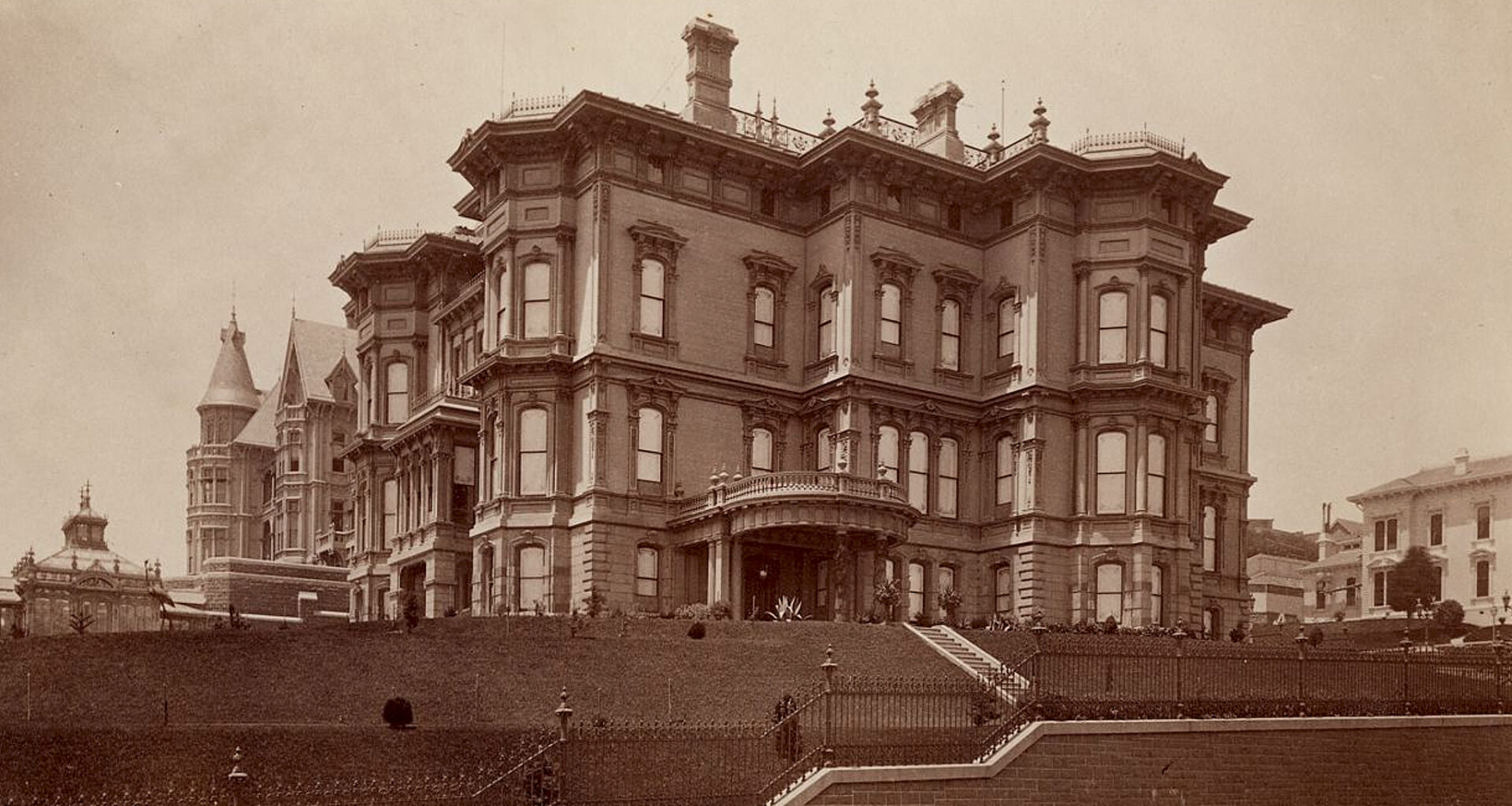
For roughly three decades at the end of the 19th century, 905 California St. was the address of the grandest private residence in the entire state: the Nob Hill mansion of Leland Stanford, a man who amassed one of the largest fortunes of the era.
Most people associate the Stanford name with the prestigious university on the Peninsula. But the hotel bearing the family’s name is the only remnant from a Gold Rush railroad empire and what was once the largest private residence in California.
Article continues below this ad
East view of Leland Stanford’s house in San Francisco built in 1876, photographed in 1878.
Eadweard Muybridge/San Francisco Public Library
View looking south and west from the windows of Leland Stanford’s home in San Francisco, photographed in 1878.
Eadweard Muybridge/San Francisco Public Library
The railroad baron arrives
Leland Stanford came to California in 1852 during the Gold Rush. A decade later, he was one of the four Sacramento businessmen — along with Collis Huntington, Mark Hopkins and Charles Crocker — who established the Central Pacific Railroad, the western half of the first transcontinental line. Stanford became president of the company in 1861, and that same year, he was elected governor of California, taking office in January 1862.
Article continues below this ad
Stanford made a fortune from the railroad and “was chosen to drive in the symbolic last spike, colloquially known as the ‘Golden Spike,’” according to American Rails.
Leland Stanford (1824-1893), American industrialist, politician and founder of Stanford University, Washington, DC, 1890.
C.M BellUniversal History Archive/Getty Images
In 1874, Stanford moved his family from Sacramento to San Francisco and began looking for a place to build. He found the location of his future mansion at the corner of California and Powell streets, on the steep hill that required a cable car to scale it. At the time, the hill was empty. Stanford was essentially creating a neighborhood identity from scratch.
Article continues below this ad
Make SFGATE a preferred source so your search results prioritize writing by actual people, not AI.
Add Preferred Source
He was first. The rest of the “Big Four” followed.
A palace on California Street
The mansion at 905 California St. was designed by Samuel C. Bugbee & Son, an esteemed firm also responsible for Mills College and later, Charles Crocker’s Nob Hill residence. According to an 1875 San Francisco Chronicle article, Stanford hired 100 workers to prepare the foundation for the massive building — the paper called it “the largest private residence in the state.”
Article continues below this ad
The lot ran roughly 412 by 275 feet. Inside were 50 rooms spread across a staggering 41,000 square feet. No expenses were spared in the design of the interior and exterior of the home, which was clad in limestone with copper accents, including a copper roof. The front of the home on California Street featured a 50-foot-wide porch supported by 16 Corinthian columns, with marble steps and marble buttresses.
The billiard room, with dark blue leather, in the Leland Stanford mansion in San Francisco, photographed in 1878.
Eadweard Muybridge/San Francisco Public Library
Jane Stanford’s room, with light blue and pink satin, photographed in 1878.
Eadweard Muybridge/San Francisco Public Library
Opulence continued past the front doors. The entrance hall was 100 feet in length and widened to showcase a central rotunda, which was ringed by another set of Corinthian columns rising to the roof. Mirrors were strategically placed throughout the house to make the larger rooms feel even larger than they were. The dining room could seat 60, had its own indoor fountain and featured a hand-stenciled ceiling. In the art gallery, walls were covered with paintings by significant European artists.
Article continues below this ad
On the second floor, the ceiling was decorated with murals meant to represent every continent. Even guest rooms were glamorous, with features like marble fireplaces.
The view from the hilltop, which Stanford had selected intentionally, showed Alcatraz to the north and San Jose to the south. “The depots and offices of the Central Pacific Railroad are in full view from the south windows,” wrote the Chronicle, which was presumably not an accident.
Devastation in 1884
Leland DeWitt Stanford, the Stanford’s only child, died in Florence on March 13, 1884, at age 15 as a result of typhoid fever.
Article continues below this ad
After the funeral, the grief-stricken Stanfords emptied their mansion of nearly everything. Every painting came down from the gallery walls. Every room was stripped, aside from the boy’s room, which was left exactly as it was and never touched again. Stanford and his wife Jane moved to Menlo Park and would only return to their former California Street residence to mourn.
The Stanford Court Hotel is seen on Monday, Aug. 27, 2018, in San Francisco.
SF Chronicle/Getty Images
To have the memory of their son live on, the Stanfords used their vast resources to build a university — “the children of California shall be our children,” said Leland to his wife, according to the New York Times.
Leland Stanford Junior University, simply known better as Stanford, opened its doors in 1891.
Article continues below this ad
A street transformed
The mansion stood almost vacant until the morning of April 18, 1906, when the earthquake arrived and fires burned for the three following days. The Stanford mansion and everything else atop the hill was brought down to its foundation. Later in 1912, a developer named Lucien H. Sly purchased the lot and built a large apartment complex called the Stanford Court Apartments. Eventually, the apartments were converted into the hotel that stands there today.
In 1877, Eadweard Muybridge helped Leland Stanford win a wager regarding whether all four legs of a horse come off the ground while galloping by devising a series of cameras with fast shutter speeds. June 19, 1878.
Eadweard Muybridge/Library of Congress/Corbis//Getty Images
Inklings of the past can be found inside the hotel. The mural spanning the lobby wall is an homage to photographer Eadweard Muybridge’s “Sallie Gardner at a Gallop,” a sequence of 24 images shot in rapid succession in 1878. The now-iconic work was commissioned to settle a bet.
Article continues below this ad
Stanford believed that a galloping horse went fully airborne at some points in its stride, and Muybridge’s camera proved him right. Beyond the bet, the photos laid the groundwork for the future of motion pictures.
Today, there is no plaque for the mansion itself. Nothing marks what was here before the hotel, the apartments and the fire. All that’s left is the hill, the views that Stanford selected, and the horse frozen mid-gallop on a wall, a remnant of a man who once lived here.