
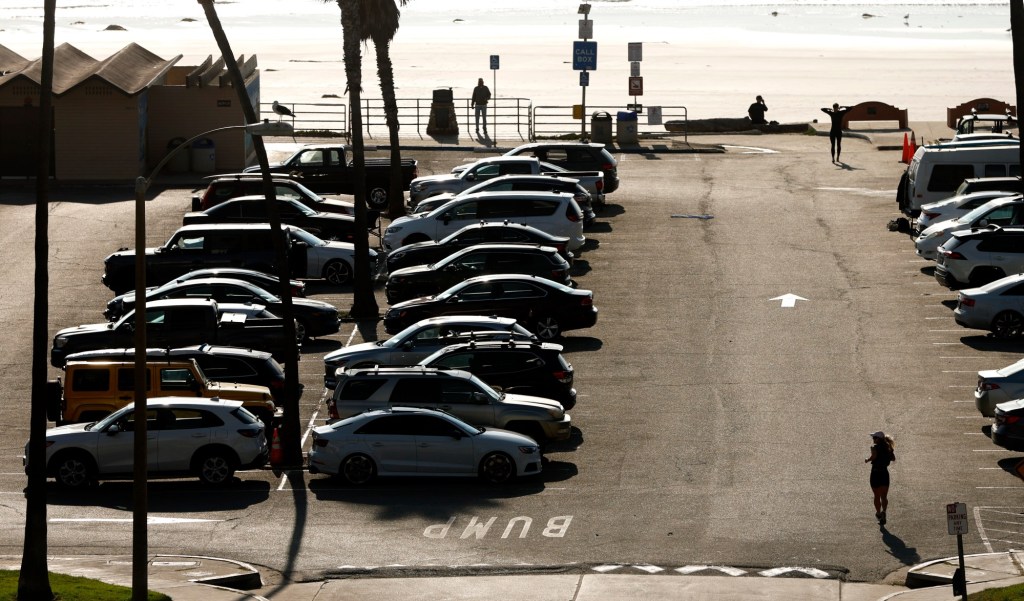
A San Diego City Council committee voted last month to consider permanently banning priced parking at the city’s beaches and bays. The stated reason is that the city botched paid parking at Balboa Park. The lesson drawn is that the city can’t be trusted with this tool, so we should take it away for good. That conclusion is wrong, and our beaches will pay for it.
A functioning beach requires maintained bathrooms, staffed lifeguard towers and a parking space when you arrive. None of those are free, and San Diego has no dedicated source of money for any of them. Beach maintenance competes every year in the general fund against other parks, and in a larger sense against police overtime and road repair. Against this, beach funding consistently loses. Last year, facing a budget shortfall, the city considered closing 13 of its 28 restrooms in Mission Bay Park. A council member warned that it would risk conditions similar to those that preceded the 2017 Hepatitis A outbreak, a crisis that infected 588 people and killed 20, driven largely by years of deferred investment in basic sanitation. Parking fees, dedicated for beach operations, are the most direct way to close that gap. This measure would make collecting them illegal.
Also, consider free parking doesn’t mean more people get in. It just means the lot fills up earlier and stays full. Parking researcher Donald Shoup found that about 30% of cars in congested areas near underpriced parking are circling for a space, burning time and fuel while blocking traffic. A free lot that fills by 9 a.m. isn’t accessible to a family that feeds their young kids breakfast and arrives at 10 a.m. Free beach parking is a lottery of first-come-first-served for people with flexible schedules, which means it advantages people who can leave when they want over people who can’t. A modest fee set to keep a handful of spaces open at all times means that family gets in. That’s a better outcome for access.
Free parking is also not free. The cost of providing and maintaining a free lot is distributed across all taxpayers, including the roughly 30% of residents without reliable car access that would rarely use the lots. Meanwhile, the benefit flows almost entirely to people with the flexibility to arrive before the lot fills. Those certainly aren’t working people with strict schedules or who rely on public transit. In fact, the one group who benefits the most are tourists.
To be clear, Balboa Park’s paid parking was badly designed: Prices were arbitrary, and the revenue closed a budget hole instead of bringing new funding to the park. Those are real problems. But the answer to a bad rollout is better rules — mandatory additional and dedicated funding, clear accountability — not a permanent ban on the mechanism itself. Every city that runs beach parking well does so because those guardrails are in place.
Cities up the coast have been doing this for years. Del Mar generates $1.35 million annually from beach parking. Every dollar is dedicated directly to lifeguard operations, trash collection and beach maintenance. Oceanside charges residents $100 a year for a beach parking permit, under $2 a week, while keeping select lots free just three blocks from the pier. Both cities manage the same coastline and face the same if not smaller, maintenance demands. San Diego’s beaches — the most visited in the county — have no comparable funding model and show it.
Those who support this measure believe they’re defending beach access for people who can’t afford to pay. That instinct is right even if the conclusion is wrong. When San Diego’s structural deficit — already in nine figures — forces another round of cuts, the options without parking revenue are bathroom closures, lifeguard reductions and deferred maintenance. Models that work are already operating up the coast. What’s missing is the willingness to use them.
Rea, a San Diego native, is the strategy and mobilization lead for Strong Towns San Diego. Asad is an advocate for livable cities.