
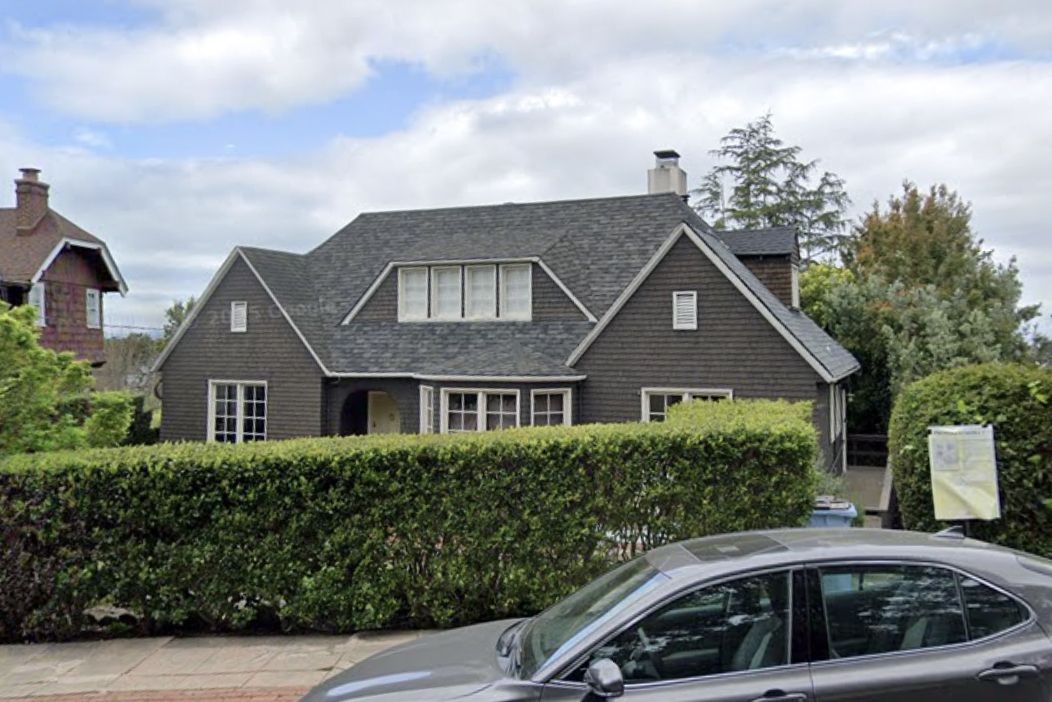
The owners of this home at 910 Indian Rock Ave. in Berkeley wanted to demolish it and build a new home. But neighbors filed a petition with the Landmarks Preservation Commission. While the home wasn’t given landmark status, the homeowners ultimately abandoned the plans to tear down the home and sold it.
Google Street View
The Borg Building at 2146 San Pablo Ave. in Berkeley was designated as a landmark in 2020 after a developer submitted plans to replace it with a mixed-use housing complex. Built in 1923, it was seen as characteristic of the architecture of the time.
Google Street View
This Bennington Apartments building at 2508 Ridge Road in Berkeley was designated as a historic landmark in 2016. The building was created in 1915 by joining two 19th-century single-family homes.
Google Street View
In 2020, neighbors attempted to designate this three-unit, two-story home at 1915 Berryman St. in North Berkeley to keep it from being developed into 10 townhouses. The Landmarks Preservation Commission decided that the property wasn’t historic enough to merit landmark status.
Google Street View
In 2020, neighbors got wind of a proposal to replace a 130-year-old North Berkeley brown shingle home with a 10-unit residential project. The reaction was swift: within two weeks of the developer’s construction application, 65 neighbors had signed a petition to designate the property a historical landmark.
To housing advocates, it was a clear example of how Berkeley’s landmarking policy has been weaponized to slow development. City leaders, facing pressure to build more homes and improve affordability, are starting to agree.
On Tuesday, the City Council passed legislation to raise the number of petition signatures necessary to trigger the landmarking process to 200 from 50.
Article continues below this ad
“Landmark preservation should be about broadly shared public benefits, not the preferences of a narrow group or purely for the sake of the buildings themselves,” said Council Member Mark Humbert, one of the measure’s sponsors, during the meeting.
Preservationists, though, are concerned that the change could sideline residents at a moment that Berkeley is undergoing rapid urban change. They worry that if the bar is set too high, citizens could lose a crucial tool in protecting the city’s history.
San Francisco Chronicle Logo
Make us a Preferred Source to get more of our news when you search.
Add Preferred Source
“This could effectively eliminate the ability for community members to initiate landmark applications altogether,” said Berkeley Landmarks Preservation Commission Chairperson Denise Hall Montgomery.
The council’s vote — eight in favor, one abstention — was a compromise between the commission, which advocated for the threshold to be set at 100 signatures, and more adamant pro-housing council members who wanted to see the number raised to 400.
Article continues below this ad
In San Francisco and Oakland, any member of the public may bring forward an application, but the historic status must be approved by the Board of Supervisors and City Council, respectively, whereas in Berkeley, the Landmark Preservation Commission has authority to approve a new landmark itself, though the council can overturn its decisions.
For some housing advocates, preservation has become synonymous with NIMBYism, morphing from a tool to recognize cultural heritage to an anti-development tactic. The examples extend well beyond Berkeley: In San Mateo, San Francisco and Los Angeles, residents tried to designate entire neighborhoods as historic districts to sidestep state laws like SB9, which allows greater density in areas once reserved for single-family homes.
In Berkeley, the list of landmarks includes over 300 sites. They range from The Greek Theatre to a former Japanese laundry now operating as a smoke shop. In 2025, the Landmarks Preservation Commission approved six new landmarks. A typical year sees two or three.
After submitting their petition, applicants must also conduct a historical review of the property demonstrating its architectural merit or cultural significance. Once they’re deemed a ‘landmark,’ these properties require additional levels of city scrutiny to be redeveloped or demolished — creating months or years of delays, if not shutting the project down entirely.
In 2020, neighbors filed to protect the Borg Building at 2136 San Pablo Ave., a 1923 one-story commercial building after a developer filed permits to redevelop it as a six-story mixed use building. The project still hasn’t moved forward.
Article continues below this ad
The landmarking process helped save sites like the West Berkeley Shellmound. After a housing project was proposed at Fourth and Hearst Streets, indigenous activists rallied to landmark the site, which they said was the site of one of the earliest known Ohlone settlements. After a protracted legal battle, the city helped the transfer the site to Indigenous people.
In recent years, though, landmark designation has come under more scrutiny. After a year and a half of debate over the brown shingle home in North Berkeley, the preservation commission decided that the property wasn’t historic enough to merit landmark status. Despite an appeal, the City Council agreed, allowing the project to move forward.
The council has also blocked the commission from designating two Colonial-style properties on Durant Avenue near the UC Berkeley campus as historic, after an architect filed plans for a 20-story building there. The commission also shut down an application from Berkeley Hills residents looking to prevent a neighbor from demolishing their home.
To some council members, the episodes were examples of how preservation can be used in ways that undermine its intent.
“It cheapens the entire concept of landmarking,” Humbert said.
Article continues below this ad
But preservationists argue that at its best, landmarking isn’t about stopping projects. It’s about recognizing the layers of history contained even in ordinary places.
“Berkeley is a special place,” said Kelly Hammargren. “It’s important we not erase the history that started here.”