
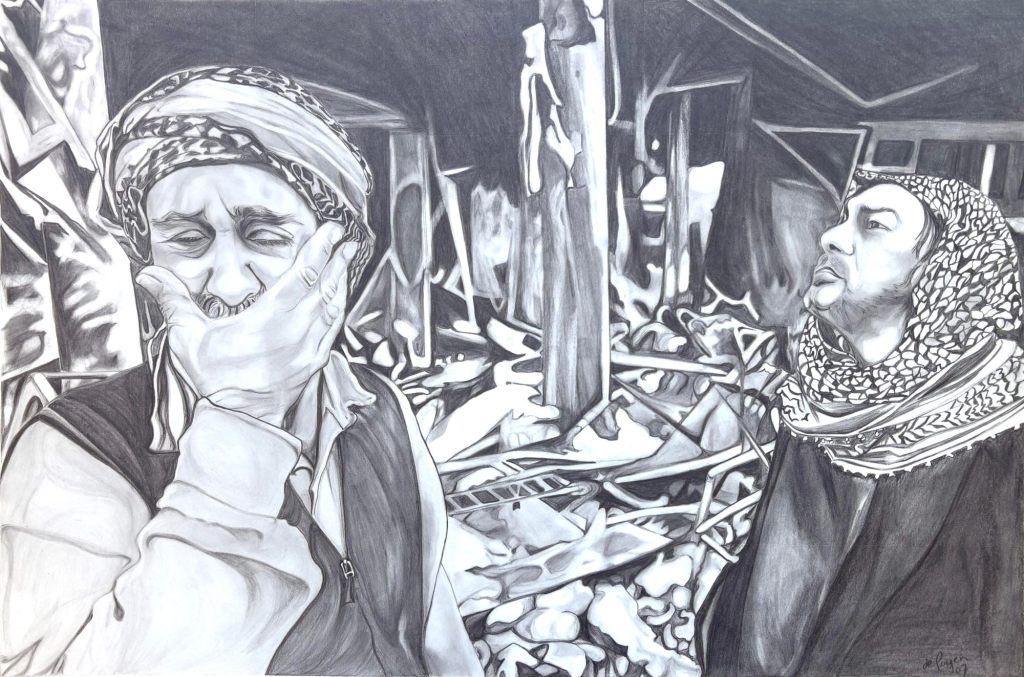
Putting together the “Instructions for Unrest: Art Against Complacency” exhibition has been an opportunity to speak up, speak out, and give other people the chance to do the same.
“Being in a position to be able to create an environment where a dialog about what’s going on can take place, that can help create community, create hope, create some kind of stamina to get through what we’re going through. I think it’s just so important for people to be able to show up as themselves in their work. Not everyone’s an artist, but everyone can go march in a protest. Not everyone is a writer, but everyone can say, ‘This is not OK.’ So, just giving people voice, in general, is important to me, to encourage people to speak out about what’s going on in this world,” said Jennifer de Poyen, executive director of Space 4 Art, a San Diego nonprofit that supports artists through studio space, exhibitions, and public programs. She is also one of the artists featured in this show. “There’s no reason to be afraid. Having the courage to take a stand is important, and if we don’t do it as small-L leaders in this community, then how do we encourage other people to do so? That’s kind of where we were coming from.”
This group exhibition is the third in a series of shows at Art Produce Gallery in North Park, presented by Space 4 Art, and curated by Alessandra Moctezuma, professor of museum studies and gallery director at San Diego Mesa College. Opening with a reception from 4 to 7 p.m. Saturday, and continuing through May 14, it features various works from a group of artists who see “art as a tool to disrupt and to sound an alert” during a time of increasing tension politically and socially. Moctezuma and de Poyen took some time to talk about this latest show, and their own participation in a long, historical tradition of art as a means of protest and resistance.
Q: How did the idea for this exhibition, with this specific focus, come together?
Moctezuma: We are living in a very difficult time, and we are experiencing attacks. A lot of our communities are under siege, whether it’s our immigrant communities being affected by the unlawful actions of ICE agents, or whether it’s women’s rights or LGBTQ rights or our environmental protections are being stripped away. So, I think we are living in a very turbulent time due to the current political regime, and I’ve been participating in protests. I’ve been creating political posters and I feel that that’s a way that I can communicate my outrage in a creative way, and also providing, maybe, some hope through that action. So, I wanted to do this show, and reach out to other artists who are doing the same, whose work is grounded in this kind of response to what’s happening. I feel that it’s difficult because so many times we feel impotent, we feel like we have no power, but when you go to a protest, you’re with people and they’re speaking out, they’re being present, they’re coalescing to try to bring attention and bring change. I was really inspired by those actions, and I wanted to do an exhibit that centered on that. Historically, that’s something that I’ve been passionate about as a curator, as an artist. There are many approaches to art making, but there’s definitely an important thread of artists that use their work to bring attention and to bring about change, starting with the Chicano artists that I learned from when I was a young person. It’s kind of following something that is very dear to me and very important for me, so with this exhibit, I reached out to many artists who are approaching different issues; some of their work might be more subtle, and some of the work might be more in-your-face, but I think it all is about trying to inform and trying to make us feel that we can impact change.I think that, also right now, there’s been a lot of attacks on the arts, and there’s been a lot of changing how history is told, and removing works from museums like the Smithsonian. So, a lot of places and institutions and museums are feeling this pressure of changing what they’re saying, or being afraid of commenting. I feel very lucky to be able to curate in spaces like our college gallery, or in spaces with Space 4 Art and Art Produce where we don’t have to be afraid of speaking up about what’s happening. We’re not going to be subject to any kind of censorship or limitations.
de Poyen: Looking around for the last year and a quarter for who’s going to stand up, and it hasn’t been the politicians. It hasn’t been the big-L leaders in our society-it’s been the people. And, we stand with the people. We may work for organizations that represent institutions, but what are institutions for but to help represent people and diffuse ideas that advance the cause of the people in our community. I think that it’s just a fundamental orientation, where we stand, and we’re lucky that we’re not dependent on federal funding and that Trump’s not paying any attention. Even if he did, I think you go through that calculus in your head like I think we all do, of ‘Should I post this on Facebook? Should I say this in public?’ Increasingly, as you look around and see the failure of our institutions writ large to respond to what’s actually happening, at some point you have to say, ‘OK, I’m either going to be silent and complicit, or I’m going to say something. And, even if no one’s listening, even if no one cares, even if I get in trouble, I’m going to do it.’
Q: As you were thinking about artists whose work you wanted to include, what was coming to mind for you? What were you looking for?
Moctezuma: I was looking at kind of a range of approaches to political response. I collect art also, and political art is an important part of the art that I like to purchase from artists. I have a piece by Marcos Ramirez ERRE, which has a quote by the Russian anarchist (Mikhail) Bakunin, which talks about people basically being against authoritarian regimes. That was kind of the first work that I thought about because I have it hanging above my mantelpiece and I see it every day. It’s like a call for action and a way to think of collective action.
Also, I have been noticing and following other artists who’ve been doing things, like Katie Ruiz. Besides being an artist, she was volunteering a few years ago to bring food and water to refugees who had just crossed the border. Her work right now is really grounded in bringing attention to the violence that ICE is perpetrating against communities, so I have seen some of the work that she was doing recently using the phrase “Let’s Melt the ICE” and I really loved how she was responding to the moment.
Then, there’s the collective Electronic Disturbance Theater, which was actually creating an internet tool that people could use to track where ICE was coming into communities. They saw this as part of their art practice, but it’s definitely something that people can actually utilize to help them in this moment. There are also other artists, like Patricia Frischer, who has been doing a series of images about the #MeToo movement and women’s rights, which are also under attack at the moment. She’s an artist who’s seen the changes of the rights of the feminist movement, and now seeing the backlash of that, and I think her work is responding to all of that.
I also was very struck by the fact that that Jennifer has done these drawings about the war in Iraq. She had shown them to me, and you’re looking at those images and thinking of the violence that’s happening right now. They are drawings about Iraq, but now we’re seeing this happening in Iran, so there was this thread of imperialism and the violence in the Middle East. I also asked Doris Bittar, who’s also an activist, so many of the artists I included, I would call them artist-activist. Doris has a large piece that is about the war on Gaza. It’s almost like a memorial to everybody who’s died, so the pieces also touch upon their reflections of the human cost of all of these different political acts. That was also important for me.
Q: Can you talk about the pieces you’ve contributed to this show?
de Poyen: There are two. One is called “Rubble” and the other one is called “Rapture.” “Rubble” is a picture of a man and his friend in a home that has just been decimated. One of the men in the picture is the homeowner, whose house has just been obliterated, and the other one is his friend, and it’s just their faces and the rubble that is behind them. “Rapture” is a protest march in Lebanon, which is somewhat timely, unfortunately, with the cedar flags and men and women and children marching in protest of the bombing of their country, and other Muslim nations in the name of whatever, the War on Terror.
Just to take a step back, I was so incensed by the terror in the era of George W. Bush because it was clear, even at the time, that the war was predicated on lies and misinformation and disinformation and just a willingness and desire to go in there and just stomp on people to take what we thought was rightfully ours, which is the resources. I was actually collecting a series of photojournalistic images from the New York Times, and these images really struck me and I just started interpreting them through drawing, basically. So, they’re drawings done in graphite in 2007. It was a kind of way for me to process what was happening because reading your morning news at the time, I would think, ‘I can’t believe what I’m looking at, I can’t believe what these people are going through and I’m just sitting here with my coffee.’ It was a way for me to enter empathically into the lives of the people who were under this attack. That’s pretty much what it’s about. For me, as an artist, drawing these images allowed me to slow down and really, imaginatively, enter into the situation that these people were in. All the work in the show, it allows you to have some space and to take a breath and to absorb what’s happening in our world. To enter the lives of people who, maybe, you don’t know and can’t directly imagine, but there they are and you’re able to interact with the work, with the issues, with the people who are involved.
Q: There are so many examples of protest art and works that incite collective action and influence policy changes. Some of those that come to mind, for me, writing by Audre Lorde or Octavia Butler, music by Nina Simone or Billie Holiday, or Jean-Michel Basquiat’s “Defacement” painting. What are some examples of protest art you’ve come across over the years that has made a lasting impact?
Moctezuma: There are really so many artists that I could think of that have been important for me, but I would say that there’s a couple of different approaches of artists trying to create change. Of course, because I’m a visual artist, I always appreciate all the history of political posters, going back to Mexico’s Taller de Grafica Popular, the Chicano artists who use silkscreen posters. Self Help Graphics up in LA; that has always been a really important part of the tradition that I was taught in because my master’s was in printmaking, and so that’s something that I really enjoy and I tried to put into practice. It’s not only in Mexico, but obviously Cuba. You go back to European political posters of the Spanish Civil War, and also in Germany during the Weimar, so there’s a lot of historical tradition of these political posters. The other thing that I was really always inspired by is community engaged art, which basically is artists that, in a sense, dream big and create change by leveraging connections and community. An example here is Chicano Park. People came together and they transformed this place. That act of creating a park underneath the bridge is, I think, one of the most beautiful examples of a political action in art. There are also artists I admire, who are friends, who are doing political art that is more conceptual. Marcos Ramirez ERRE is a good friend and he always uses language to bring attention to different issues. He uses language and symbols, and he alters them. He might do a chess game where the pieces are actually bombs, and it’s actually talking about war and conflict. So, he’s one of the artists that I really appreciate the way that he approaches it. There’s really so much, I would have a very long list.
de Poyen: Very early on, I would say Albert Camus and Jean Paul Sartre and Simone de Beauvoir were really important in getting me to start thinking about what it means to be a human living in a largely absurd world, and the absurdity often comes from the fact that the people making decisions make terrible decisions that affect everyone. That was sort of my philosophical or literary grounding. In terms of visual art, Manet’s work on the Mexican Revolution, “The Execution of Maximilian,” which is really about the way the French and the Mexicans engaged in war in his time. Picasso’s “Guernica” is the crowning example of a great work, but about the Spanish Civil War. The great antiwar art movements- Dadaism and German Expressionism – which were as politically engaged as they were artistically daring/innovative.
Like you, I’m a huge fan of protest music, like Nina Simone; it’s totally my jam. Bob Dylan has been really important to me, even Neil Young and “Ohio” (a song written in response to the 1970 Kent State University shootings) and his railing against American thuggery, the government attacking students, that kind of thing. There are so many examples.
Moctezuma: The other important group would be the Guerilla Girls (an anonymous feminist art collective). They’ve been working on bringing attention to inequities in the arts, but they do it in a way that is very engaging, using performance. Using billboards and actions, so I also really admire that. I think that’s a very cool way to bring attention to what’s going on.
Q: Are there ways that you can think of in your own life where either creating art, or engaging with art, has instructed your own unrest?
Moctezuma: I have to say that I really only make art to express my unhappiness about certain things. I love going to protests; for me, that action is really important. I’ve been going to protests, I think the first one I went to was in the late ’80s for AIDS, to bring attention to ACT UP (AIDS Coalition to Unleash Power). That was my first protest when I was like 18, and we did performance pieces and we did posters. This last year, I’ve been getting together with a group of printmakers. We’ve organized under Chris Lahti, who’s a master printer, under the name Protest Ink San Diego-PISSED. We’ve been working with students at Mesa College, Grossmont, and Mira Costa, with artists and professors, and we’ve gotten together and made political posters. Each of us made 50 posters that we brought protests, and we passed them out, gave them out to people. That was just a very exciting and very direct way of creating art that comes for the moment, that can be used and can be shared with people.
de Poyen: I think, one thing to say about that is allowing yourself to look at what’s going on and to engage with what’s happening in the world. It gives me the confidence to express myself and to connect. A lot of my work is not directly political; I did a whole series on grief and much more personal stuff, but I think the process of making political art, which I do love to do, helps me to see a path toward a better future with other people because art is something we can share. Not everything that you make is going to be for the ages. It’s for the moment and that’s good. I think, a lot of times, people are looking at the idea of what can I do that’s going to be more significant than doing nothing? Sometimes it’s hard to answer that question because you think, who am I? Little me, who am I to say or do anything? But, when you engage in the process, you realize the joy and the purpose and the fulfillment that you get from it is really its own reward. You can see when you create, like Alessandra and her collective making posters for the last protest, and seeing how people respond because you’ve said something that resonates with them, either visually or with words. You can share that, and it’s exciting and emboldening and empowering for people. That’s what really brings me satisfaction in making art.