
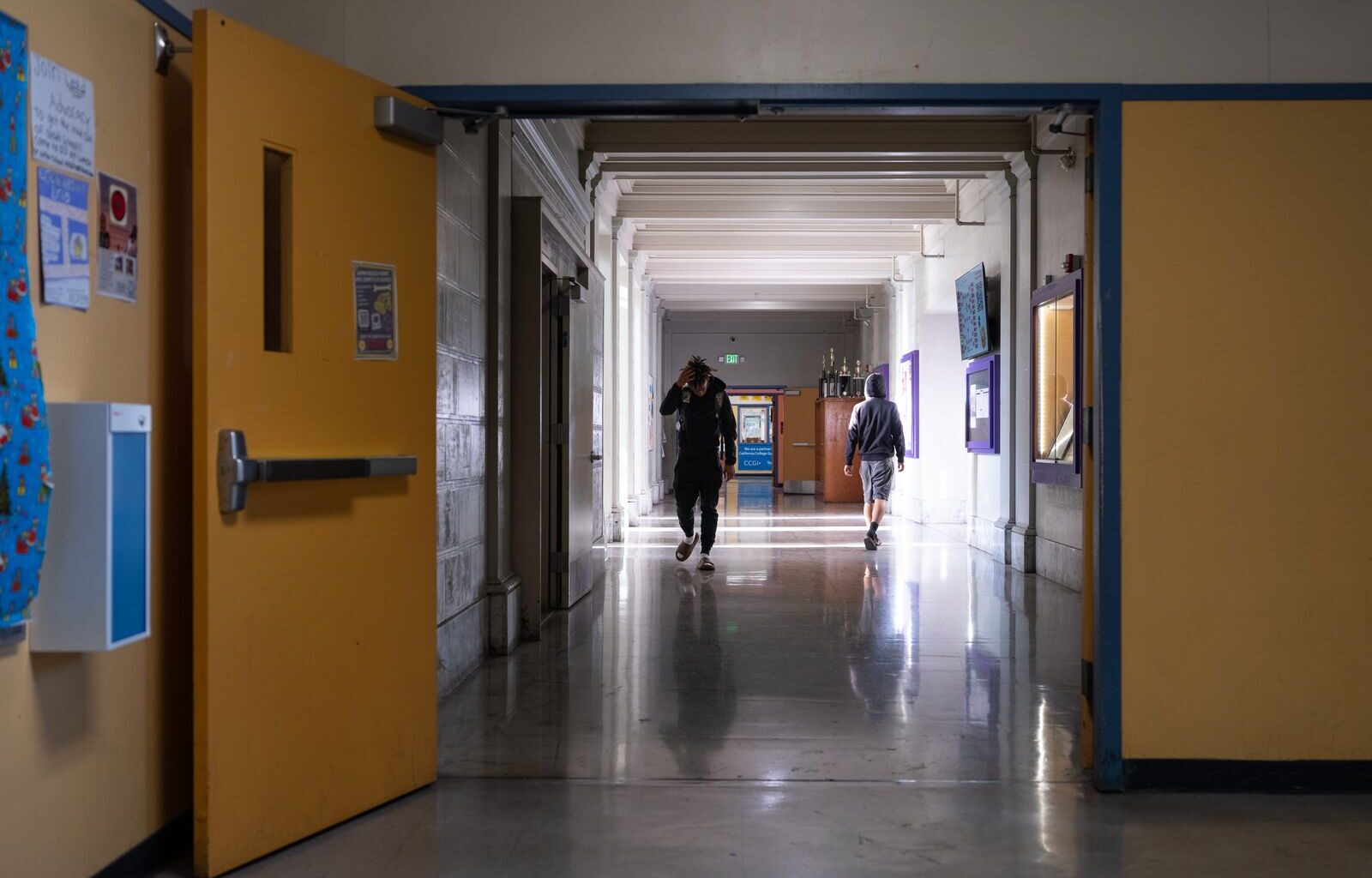
As temperatures spiked in March, parents at many OUSD schools were confronted with the fact that thousands of classrooms in the district lack cooling systems of any kind. Parents at Sequoia Elementary School took things into their own hands, fundraising for portable AC units, thermometers and window films to alleviate sweltering classrooms.
This week, thanks in part to their advocacy, the public got a look at OUSD’s first districtwide plan for cooler classrooms.
This summer, the district’s facilities team will focus on implementing more low-cost, short-term improvements at elementary schools, including installing protective window films, adding blinds, installing external window canopies, and planting more trees. By the end of the summer, every Oakland classroom will also get a temperature sensor, which district officials will then use to direct future investments, including major HVAC upgrades.
The plan was presented at Thursday night’s facilities committee meeting, after months of pressure from parents and teachers organizing to demand OUSD take action to cool off its classrooms. Most school buildings in OUSD don’t have air conditioning, and heat waves during warmer months can cause classroom temperatures to soar above 80 degrees, making it more difficult for students to learn and teachers to teach. In the last five years, those heat waves have become hotter and more frequent, making matters more urgent.
 OUSD’s heat mitigation plan examined how temperatures have shifted in recent years. Credit: Screenshot from OUSD’s air quality and thermal comfort plan
This summer’s improvements will be funded with $8 million from the district’s Measure Y facilities bond that the school board had designated for heat mitigation. OUSD is applying to the U.S. Environmental Protection Agency and the state for additional grant money.
“The overall facilities approach to shift towards more active cooling is going to take a significant amount of time and a significant amount of dollars,” said Preston Thomas, OUSD’s chief systems and services officer. “It’s going to require additional funding through future bonds and a long-term strategy that’s going to be potentially a decade long to address these issues. While we have $8 million now, it’s a drop in the bucket for a problem that’s at least half a billion dollars, if not more.”
District staff laid out a two-phased approach to alleviating hot weather conditions at schools. OUSD has recently sought to remediate the “heat island” effect at schools, a phenomenon in which heat is exacerbated in urban areas that have more asphalt and fewer trees. Over the last several years, OUSD has renovated more than two dozen schoolyards to add more tree cover, shrubbery, and shade structures, and to replace asphalt with more porous materials, such as mulch, park tread, and sport court tiles.
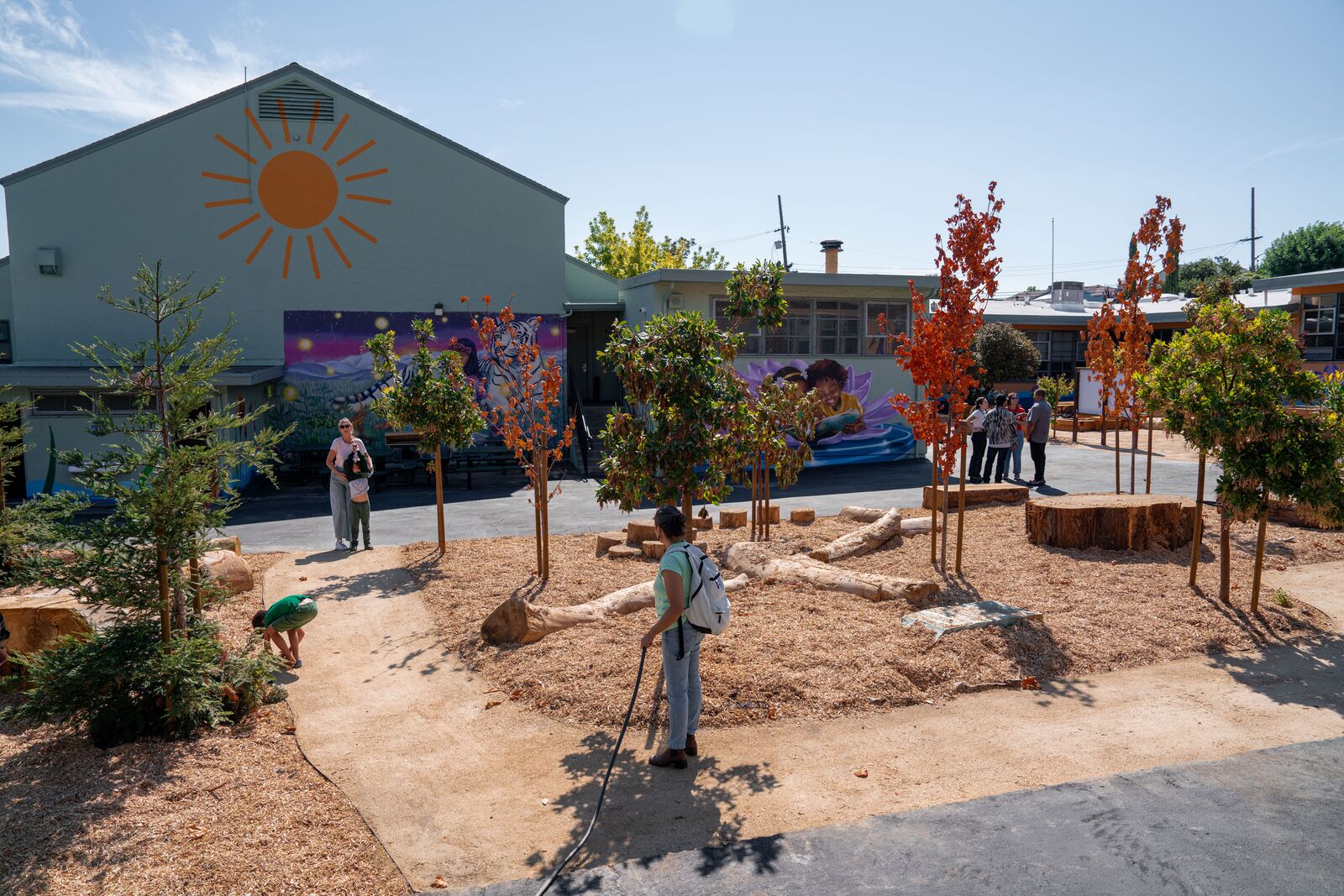
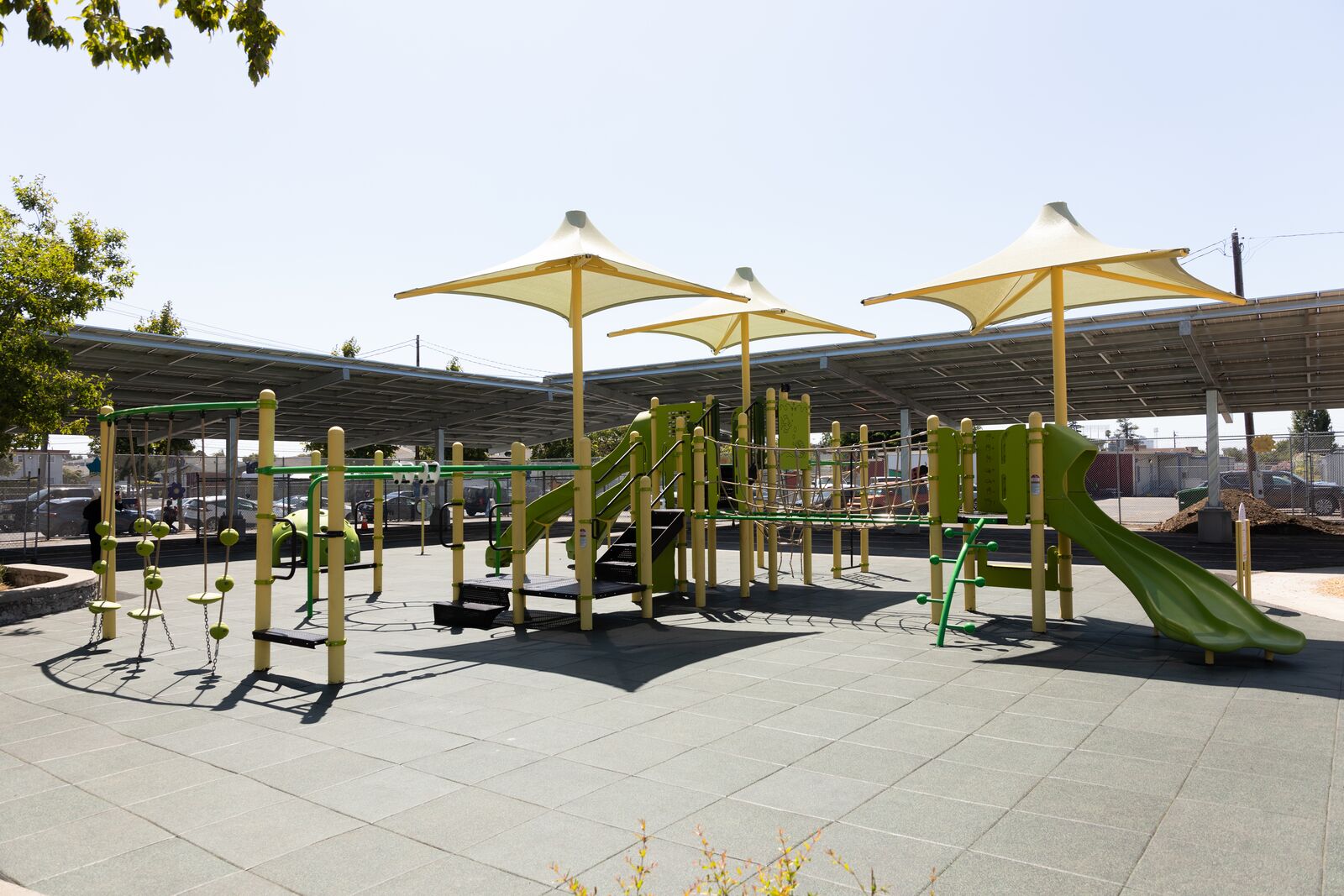
Asphalt-laden schoolyards across OUSD, including at Melrose Leadership Academy (left) and Lockwood STEAM Academy (right) have been upgraded to spaces with more shaded structures, trees, and plants. Credit: Katie Rodriguez and Amir Aziz for The Oaklandside
The next phase, beginning this summer, will address building interiors and cooling systems, prioritizing schools based on an equity rubric that takes into account grade level (classrooms serving young children will be prioritized), student demographics, sun exposure, classroom location, and classroom usage.
“Beginning summer of 2026 we are prioritizing second story, south and west [facing] classrooms at elementary schools,” said JaQuan Cornish, OUSD facilities project manager. “In addition to the window film implementation we’re also going to look at some reflective blinds. This will be case by case. Every school is not the same, so we’ll have to make sure that we do adequate assessments to make sure that we can address those where we can.”
The schools slated to get window films this summer include Horace Mann Elementary, Fruitvale Elementary, Markham Elementary, Lockwood STEAM Academy, East Oakland PRIDE Elementary, Greenleaf K-8, Lincoln Elementary, Franklin Elementary, Allendale Elementary, Sankofa Elementary, Burckhalter Elementary, Piedmont Avenue Elementary, Hoover Elementary, and Reach Academy. Other case-by-case improvements could include exterior shade screens, such as window canopies, and reflective roof coatings to help reduce the heat gain from roofs, Cornish added. Also this summer, every elementary school without air conditioning will get a designated cooling room with a ceiling fan or air conditioning unit.
Some community members are worried that the plan doesn’t go far enough with specifics for secondary schools or elementary schools that don’t have a second floor. Jasper LaFortune, a teacher at Elmhurst United Middle School, read a letter signed by half a dozen teachers at Elmhurst criticizing the district’s lack of urgency around bringing relief to middle schools and high schools, arguing that the lack of investment will continue to drive families away from OUSD, worsening the district’s financial picture.
“When you start investing in dignified learning conditions, you’re going to have the money,” LaFortune said. “Oakland parents are making rational choices based on the options that you are providing them, and they’re choosing to go where their kids are going to have dignity.”
Every Oakland classroom will get a sensor installed over the summer, which will relay temperature, humidity and ventilation in the room. That data will allow district officials to identify where classrooms are the hottest so they can build strategies around those locations, Thomas said.
The most involved upgrades, such as installing comprehensive cooling systems, will cost many millions of dollars and would have to be covered by future bonds, district officials said. Measure Y, passed by voters in 2020, is currently supporting major renovation projects at Garfield Elementary, McClymonds High School, Roosevelt Middle School, Melrose Leadership Academy, Fremont High School, and Coliseum College Prep Academy. All of those projects will include heat mitigation systems, accounting for 231 classrooms — around 11% of the district’s total classroom space. Those classrooms are among roughly 2,100 in OUSD that lack cooling systems.
“Do not slow down the immediate work and do not over complicate it,” said Rachael Kirk-Cortez, a Sequoia Elementary parent who has been urging the district to take action. “The group of us in the room today are the current faces of over a decade of advocacy on this issue, and you can be the board that says that children’s safety does not need to wait until we have a perfect plan.”
On Thursday the facilities committee, which includes directors Valarie Bachelor, Patrice Berry, and Clifford Thompson, voted to advance a resolution from Berry to the full board that directs staff to take heat mitigation action by August 2026 and provide regular updates to the board on that work. The full school board will take up that resolution at an upcoming meeting.
“*” indicates required fields