
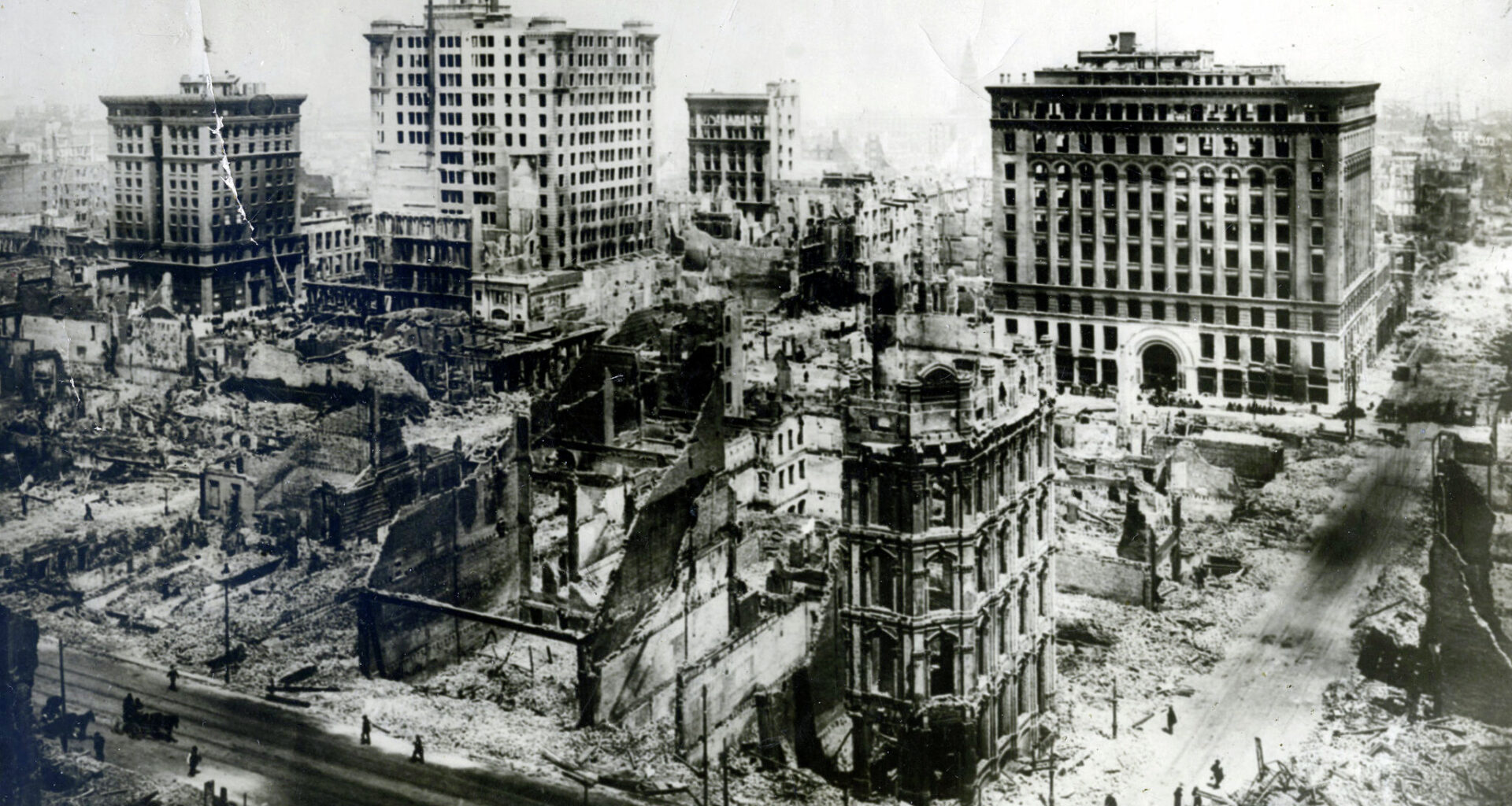
The 1906 earthquake and fire destroyed buildings along Montgomery Street in San Francisco. Scientists have used sediment layers to identify numerous large earthquakes they believe occurred along the San Andreas Fault over the past 3,000 years.
Chronicle fileA new study found signs of 19 major earthquakes on the northern San Andreas Fault over the past 3,100 years, with an average interval of 210 to 220 years between events.In eight out of ten cases, evidence suggests large Cascadia Subduction Zone quakes may have triggered subsequent San Andreas Fault earthquakes, a few within minutes or hours.In 2014, scientists estimated the Bay Area had a 72% chance of experiencing a magnitude 6.7 or greater earthquake by 2043.
One hundred twenty years ago — on April 18, 1906 — a massive, 7.9 magnitude earthquake devastated San Francisco, rupturing nearly 300 miles along the San Andreas Fault.
Much less is known, however, about major San Andreas Fault quakes before the 1906 disaster. A recent study provides new clues.
Article continues below this ad
By probing sediment layers in geologic samples, the scientists assembled a history of strong earthquakes along the northern part of the fault, over thousands of years.
Going back over 12,000 years, the fault experienced dozens of big earthquakes, according to the study. And over the past 3,100 years, the report’s authors described 19 events, including the 1906 quake.
Based on their data, the average repeat time was around 210 to 220 years, said lead author Chris Goldfinger, a marine geologist at Oregon State University. However, the samples could not be precisely dated. Before 1906, the last large quake to hit the northern San Andreas Fault was believed to be in the vicinity of 1800, with an uncertainty range of 1650 to 1930.
San Francisco Chronicle Logo
Make us a Preferred Source to get more of our news when you search.
Add Preferred Source
Goldfinger also led a 2007 study that investigated some of the same San Andreas-associated sediment samples. The magnitude of the earthquakes, that paper suggested, was in the range of 7.8 to 8.2. The San Andreas Fault maxes out around an 8.3 magnitude, scientists say.
Article continues below this ad
But the study last year, published in the journal Geosphere, added new, key details: 10 of the 19 major San Andreas quakes in the past 3,000 or so years apparently occurred in a time frame similar to huge earthquakes on the Cascadia Subduction Zone in the Pacific Northwest.
That fault has the potential to generate massive quakes around magnitude 9 and, just as alarming, could trigger a huge tsunami that would swamp coastal areas of Washington and Oregon. In the 10 cases where sediment layers from the two fault systems lined up in time, the authors found age estimates differed by an average of 63 years — close enough, they believe, to suggest a linkage.
In a few samples, the layering suggested earthquakes occurred minutes to hours apart, the authors said, with a Cascadia quake preceding one on the northern San Andreas. The researchers believe that Cascadia may have triggered San Andreas, a scenario supported by previous modeling.
“If you have two faults that are right next to each other, when one goes off … it transfers stress to other areas nearby,” Goldfinger said. “So it can either load or unload a nearby fault.”
Of the 10 cases where there were similarly timed samples from both fault systems, eight fit the proposed pattern of an earthquake in the Cascadia Subduction Zone followed by one on the northern San Andreas Fault. That includes the historic 1700 Cascadia earthquake, which devastated coastal Indigenous communities in the Pacific Northwest and produced tsunami waves that reached Japan. This was also one of the cases where the two fault systems appeared to have quakes in quick succession. The other two cases simply didn’t have sediment layers in a pattern supporting a Cascadia-San Andreas sequence.
Article continues below this ad
The 1906 San Francisco quake was different: It was not preceded by a major Cascadia quake. Over the 3,000 years that the study focused on, eight other major Northern San Andreas earthquakes also showed no obvious association with Cascadia — though the lack of evidence doesn’t conclusively rule one out.
“Earthquakes are chaotic and complicated,” said Roland Bürgmann, a professor in UC Berkeley’s department of earth and planetary science, who wasn’t part of the new study. “It would be weird if we wouldn’t have earthquakes like 1906 breaking the pattern.”
That 1906 quake started near Daly City, Bürgmann said, far from the Cascadia Subduction Zone.
By contrast, the triggering hypothesis “implies that most ruptures would start at the north end next to Cascadia,” Goldfinger explained. A quake rupturing southward toward the Bay Area could mean stronger ground motions than a similar-size event moving away from the region — as 1906 generally did.
“We tend to think of 1906 as the worst-case scenario since it was so graphically imaged and serious,” Goldfinger said. “But it’s not the worst case in the event the rupture starts in the north, as it would in the Cascadia triggering scenario.”
Article continues below this ad
In addition to offshore sediment samples reflecting Cascadia and San Andreas quakes, the new analysis included data from sediment flow patterns in Lake Merced, probably caused by San Andreas temblors.
A view down O’Farrell Street toward Market Street in San Francisco during the 1906 earthquake and fire, with the Call Building in the background.
S.F. Chronicle
Some scientists aren’t yet convinced by the work linking the quake timing of Cascadia and San Andreas. Zoltán Sylvester, a research professor at the University of Texas at Austin, co-wrote a 2024 study that suggested that sediment patterns from different spots in the Cascadia Subduction Zone may not have been truly correlated across different sites.
“You just have to be more careful about saying that these correlate,” Sylvester explained. The sediment layering suggestive of Cascadia quakes preceding those on the San Andreas may also have been produced by counterintuitive flow patterns following a single event, Sylvester said.
Belle Philibosian, a research geologist with the U.S. Geological Survey’s Earthquake Science Center, described Goldfinger’s hypothesis on the Cascadia-San Andreas links as “plausible” but added that “it’s just impossible to say definitively that that’s what happened, especially given the age uncertainties that are involved.”
Article continues below this ad
San Jose State University earthquake geologist Kim Blisniuk described the 2025 study as “amazing” and “a tremendous amount of work.” Additional land-based paleoseismic data for earthquake activity on the northern San Andreas and modeling studies would further confirm whether seismic events can trigger across fault systems, Blisniuk said.
Earthquake scientists previously estimated that the Bay Area faced a 72% chance of at least one quake of magnitude 6.7 or higher from 2014 to 2043, with a 22% chance of an earthquake of that size occurring on the San Andreas Fault. The chances are higher for the Hayward and Calaveras faults: 33% and 26%, respectively.
“We as a community in the San Francisco Bay Area need to just prepare ourselves,” Blisniuk said. “That’s what disasters are: You never think it’s going to happen until it happens.”