
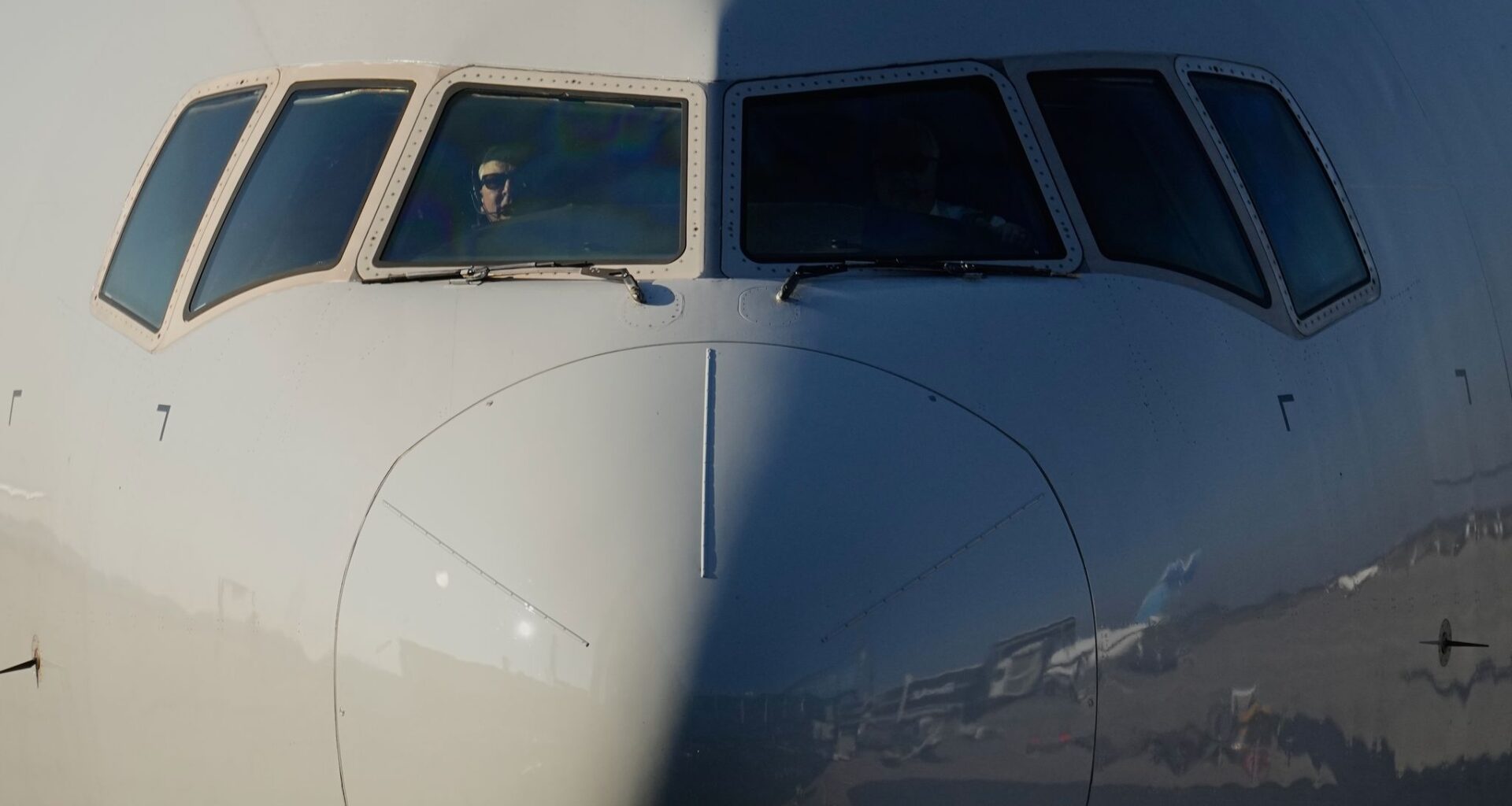
A pilot looks out of a cockpit in Berlin in November 2025.
Martin Meissner/AP
In a busy week for air travel news, a low-cost European airline has removed three Los Angeles routes from its summer schedule due to spiking jet fuel costs; Lufthansa also said it will shrink operations later this year; a European airports group warns of imminent fuel shortages due to the Iran war; new research from the U.S. Travel Association and Kayak shows sharply higher domestic and international air fares as summer approaches; some foreign carriers are tacking on fuel surcharges, and the cost of frequent flyer award tickets is also going up; higher fuel costs and rising debt burdens raise questions about the fate of Spirit Airlines and JetBlue; United reportedly floats the possibility of merging with American, but industry observers give it little chance; Delta plans even more expansion of premium seats on its widebody fleet; Alaska Airlines plans to add more intrastate service from San Diego next week and increase Hawaii capacity from Oakland; there’s international route news from Qatar Airways, United, Condor Airlines, Virgin Atlantic and Air France; a large premium passenger lounge at SFO has rejoined the Priority Pass network.

So far, the Iran war and its doubling of jet fuel costs have led not only to higher fares but also reduced airline schedules. That second impact was initially seen in international flight schedules to the Middle East (obviously) and for some carriers’ operations in Asia and Europe, but now it’s coming to the U.S. As first reported this week by Ishrion Aviation, which tracks airline schedule changes, Europe’s low-cost Norse Atlantic Airways has decided to scrap its summer seasonal schedule of nonstop transatlantic flights from Los Angeles, which are some of its longest and most fuel-hungry routes. Norse Atlantic had previously planned to fly from LAX to London Gatwick starting June 1, to Paris CDG beginning May 29 and to Rome effective May 30.
Article continues below this ad
Meanwhile, Lufthansa this week released plans to shrink its operations, citing “significantly increased” jet fuel costs. The German carrier said when its summer schedule ends in October, it will remove six widebody long-haul jets (A340-600s and 747-400s) from its fleet and make additional winter schedule reductions equivalent to taking five aircraft out of service. Shrinking its overall capacity “is unavoidable in light of the sharply increased kerosene costs and geopolitical instability,” said Lufthansa Group Chief Financial Officer Till Streichert.
A Boeing 787 Dreamliner from Norse Atlantic Airways stands at the gate.
Patrick Pleul/picture alliance via Getty Images
In another potential blow to international air travel, CNBC reported that Europe’s airports have issued a dire warning about their jet fuel supplies if deliveries through the Strait of Hormuz continue to be disrupted. The trade association Airports Council International Europe sent a letter to European Union officials stating that “if the passage through the Strait of Hormuz does not resume in any significant and stable way within the next three weeks, systemic jet fuel shortage is set to become a reality for the EU.”
That would put flight operations in jeopardy as the peak summer travel season approaches, since airports would have to figure out how to allocate reduced fuel supplies to airlines. It would also affect U.S. airlines’ schedules, since their aircraft must refuel at European airports before flying back home.
Article continues below this ad
Make SFGATE a preferred source so your search results prioritize writing by actual people, not AI.
Add Preferred Source
As for the war’s impact on airfares, the U.S. Travel Association’s latest travel price index found that U.S. airfares in March rose 14.9% over the same month a year earlier. By comparison, the overall travel price index increased 5.8% over the same period, while the broader consumer price index went up only 3.3%. Research from the big online booking platform Kayak, citing data from flight searches on its site, showed that from the first week of January to the first week of April (the war started on Feb. 28), the average domestic flight to Atlanta rose from $192 to $248 (up 29%), while the average cost of an international ticket to Amsterdam went up from $685 to $1,278 — a whopping 87% jump.
A Japan Airlines aircraft flies over Tokyo Bay in May 2017.
BEHROUZ MEHRI/AFP via Getty Images
Some foreign airlines have reduced the need for hikes in their base fares by resorting to fuel surcharges instead. For example, the New York Times reported that Japan Airlines is imposing fuel surcharges of up to $164 for flights between North American and Japan, while Cathay Pacific has tacked a $200 surcharge onto some long-haul flights. Meanwhile, major U.S. carriers are gaining some incremental revenue from the higher checked baggage fees they announced over the past two weeks. Travelers hoping to save a bundle on flights this summer by redeeming some of their hard-earned frequent flyer miles or points are also facing a bigger bite out of their accounts.
Article continues below this ad
The Points Guy, citing data from its partners at Points Path, said that the average award cost for a main cabin ticket has increased 14.8% since last summer, while the award cost for a first class, business class or premium economy ticket is up 17.9%. Is there anything travelers can do to avoid big price hikes for their summer vacation? The Points Guy suggests “casting a wider net as you search for flights. The more open you can be to backup travel dates, alternative destinations, and different airlines or airports, the better chance you’ll have of finding lower fares.” It also notes that historically, August tends to have the lowest fares during the summer months.
A JetBlue flight at John F. Kennedy International Airport in January 2018.
Rebecca Butala How/Getty Images
Industry executives have been predicting that skyrocketing fuel costs would have a much bigger impact on low-cost carriers and heavily indebted companies than on legacy airlines, and a couple of reports this week suggest they are right. CNBC, citing “people familiar with the matter,” said that the troubled low-cost carrier Spirit Airlines — currently trying to emerge from Chapter 11 bankruptcy for the second time — could go into liquidation any day and sell off its assets since spiking jet fuel costs have put its recovery plan into disarray. It said Spirit declined to comment on “rumors and speculation.” Meanwhile, View from the Wing reported this week that JetBlue founder David Neeleman, in leaked remarks he made to pilots at his current airline Breeze Airways, said that JetBlue is currently “in a really tough spot.” He said a prominent Wall Street analyst predicted JetBlue is on track to lose $1.3 billion this year, and “that would probably put them, you know, into bankruptcy, I would assume.” Neeleman said that would increase JetBlue’s debt burden to $9 billion, at an annual cost of hundreds of millions of dollars in interest. While there has been speculation about United buying JetBlue, “I know it from pretty good source inside of United that they’re very concerned about JetBlue’s debt. And they’re not really interested in taking that on. So I think JetBlue has very few options,” he reportedly told the pilots.
An American Airlines jetliner lands on a runway as a United Airlines plane waits for clearance to take off as high winds strafe Denver International Airport, Thursday, March 12, 2026, in Denver.
David Zalubowski/AP
Is United Airlines about to propose the biggest merger ever? There has been industry gossip for months about the possibility of United acquiring financially struggling JetBlue, but this week the buzz has switched to a much bigger deal: a United-American Airlines merger. Both Bloomberg News and Reuters reported this week that United CEO Scott Kirby suggested a United-AA merger during a meeting with President Donald Trump in late February, according to “sources familiar with the matter,” but they got no comment from either airline. Certainly the Trump administration has a much friendlier stance toward big mergers than its predecessor did. Reuters noted that earlier this month, Transportation Secretary Sean Duffy said in a CNBC interview: “Is there room for some mergers in the aviation industry? Yeah, I think there is.” But he added that if a merger of “some of the larger airlines” were attempted, “they would have to peel off some of their assets.” Meanwhile, White House Press Secretary Karoline Leavitt said at a press briefing this week that a possible United-American merger is “not something the president or the White House have an opinion on or are weighing in on,” according to Reuters.
Article continues below this ad
Even the Trump administration must have some limit as to how much it would allow competition to be reduced by such a huge merger. According to the U.S. Bureau of Transportation Statistics, American has the nation’s second-largest domestic market share at 17.4% while United is in fourth place at 16.7%. That combined market share of 34.1% would dwarf Delta, which currently leads the pack with a 17.8% market share. Industry observers and experts across the board were dismissive of such a merger’s chances. As Simple Flying’s Luke Diaz wrote, “This merger would be highly unlikely under conventional antitrust policy. Just their combined positions in Los Angeles and Chicago alone would not be allowed. To the extent that Newark and the New York airports are regarded as one market, an anti-competitive share of the New York market would also be a major roadblock.”
One Mile at a Time’s Ben Schlappig commented, “I wonder if Kirby is actually serious? Does he really think there’s any chance on earth that an American and United merger would be approved? I guess under Trump one never knows, but that just seems wild to me.” And even if a complacent antitrust division at the Justice Department did allow it to go through, that might not be the end of it. According to View from the Wing’s Gary Leff, “Even if the Trump administration let a United-American merger close, that wouldn’t prevent President Ocasio-Cortez from suing to break it up. And a coalition of state attorneys general who didn’t sign off on it in a settlement could still sue to block it later, even if they didn’t do so prior to deal close.”
Delta Air Lines aircraft at Orlando Airport.
Boarding1Now/Getty Images
Delta has claimed in its financial reports that its revenue growth is being driven largely by the expansion of premium seats on its aircraft, and its latest product announcement shows that the airline is aggressively following that strategy. Delta said this week that when its first Airbus A350-1000s start to arrive in early 2027, fully 50% of their seats will be premium seats. That includes 53 next-generation Delta One suites in a reverse-herringbone configuration featuring privacy doors or screens, flat-bed seats that are more than 6.5 feet long, a 24-inch “cinema-quality screen” for in-flight entertainment with Bluetooth connectivity, and a wireless charging station for “multiple devices,” Delta said in a news release.
Article continues below this ad
The A350-1000s will also have 48 premium economy seats, 51 Delta Comfort seats (i.e., extra legroom) and 152 main cabin seats. And that’s not all: “Delta’s Airbus A330-200/300 fleet is getting upgraded with suites featuring privacy doors in the Delta One cabin — a first for the fleet — and an elevated onboard experience for all cabins,” Delta said. Another nice touch: Delta One cabins on all three aircraft types will get an always-open snack station. The Points Guy said the new A350-1000 aircraft will be “Delta’s most premium yet.” As for the A330-200 and -300 refits, “Avid Delta flyers may be even more enthused to know that the airline is finally moving forward with plans to upgrade some of its most outdated long-haul jets,” The Points Guy said. “… These are planes Delta once got via its 2008 acquisition of Northwest Airlines. … The cabins are a far cry from the experience the carrier offers in its most modern jets.”
In domestic route news, Alaska Airlines is adding more service out of San Diego next week, including four daily flights to Oakland beginning April 22, using Embraer E175s operated by Skywest, according to Aeroroutes. On the same date, Alaska plans to launch two daily E175 flights from SAN to Santa Barbara, along with new daily service to Dallas/Fort Worth and Raleigh/Durham. Hawaiian Airlines’ Oakland-Honolulu route will be getting more capacity in the months ahead, as the carrier — which is now part of Alaska Airlines Group — phases out its single-aisle Airbus A321neo planes and replaces them with widebody A330-200s. According to Simple Flying, the larger aircraft will be phased into the OAK-HNL schedule during June and July.
The Paris Las Vegas hotel and casino inspired by French culture.
Domingo Saez Romero/Getty Images
In international route developments, Qatar Airways is planning to rebuild its extensive global network after it had been decimated by the Iran war, and those plans currently include a resumption of service from San Francisco to Doha. The carrier will operate five weekly A350-1000 flights on the route beginning June 11, according to Aeroroutes. April 22 is the launch date for United Airlines’ deployment of its new 787-9 model on the San Francisco-Singapore route. It marks the introduction of Polaris Studio Suites for United — eight suites with lie-flat seats, privacy doors and other amenities that are 25% larger than the carrier’s standard Polaris business class seats. On April 24, Germany’s Condor Airlines is set to resume its daily summer seasonal service from San Francisco to Frankfurt, operated with an A330neo. Simple Flying reports that Virgin Atlantic is switching aircraft on its nonstop routes from San Francisco and Los Angeles to London Heathrow. The carrier recently replaced an A350-1000 on the Los Angeles route (flights 141/142) with a 787-9, and it plans to deploy the 335-seat A350-1000 between SFO and London with daily service starting May 16 (flights 19/20).
Article continues below this ad
And even as Las Vegas reckons with lackluster tourism economy, the French still believe in Sin City. Air France this week inaugurated new service from Las Vegas to Paris CDG, operating nonstop flights three days a week with an A350-900.
In airport news, One Mile at a Time reports that Alaska Airlines’ 11,000-square-foot premium lounge in San Francisco International’s Terminal 1 has rejoined the Priority Pass network. The catch is that Priority Pass members must shell out a $15 co-pay to get in, and they must be flying on Alaska or a partner airline. One Mile at a Time notes that the concept of charging Priority Pass members an extra fee for certain locations “isn’t unheard of. We recently saw the Virgin Atlantic Clubhouse Los Angeles Airport (LAX) join Priority Pass, but with a $35 co-pay.” Alaska has eliminated a number of routes at SFO in recent months, including several that it gained with its acquisition of Virgin America in 2016.
Article continues below this ad