
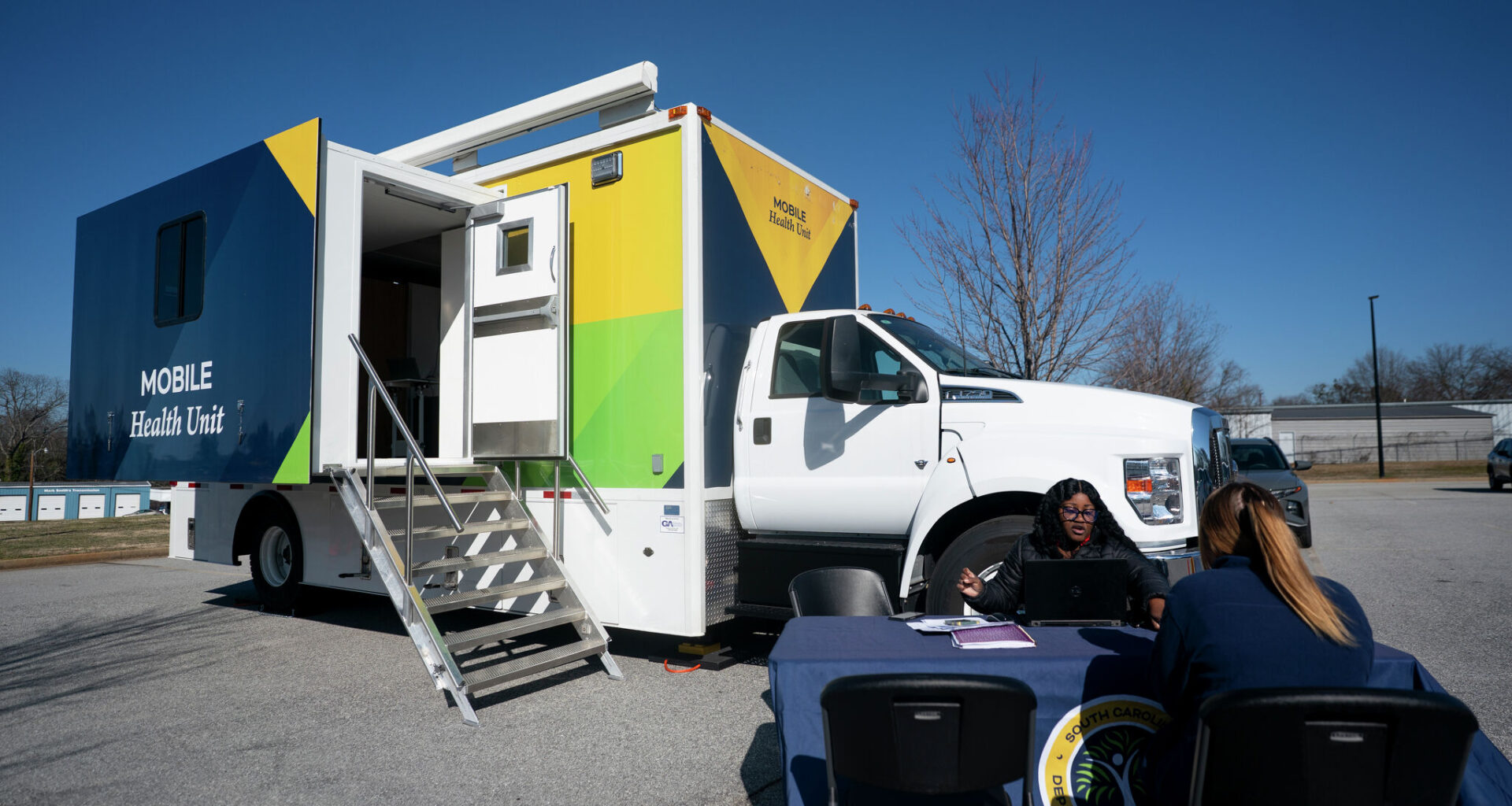
A mobile clinic in Spartanburg, S.C., offers measles vaccinations during a February outbreak that sickened hundreds, part of a broader resurgence of the disease in the U.S. and globally.
Sean Rayford/Getty ImagesA San Francisco infant contracted measles during international travel, highlighting risks for babies under routine vaccination age.Doctors say even families following standard guidelines may face new exposure risks to young babies as measles resurges in the U.S. and globally.Infants as young as 6 months can get an early, extra vaccine dose before travel — but many parents may not know it’s an option.
The San Francisco infant who was diagnosed with measles this week highlights an especially at-risk group: babies who are too young to get the measles vaccine, and who travel to areas where measles is circulating.
The case, announced by the public health department Wednesday, is the first measles case in San Francisco since 2019, and comes as California and the nation are seeing a troubling resurgence of the highly infectious disease.
Article continues below this ad
The infant is less than 12 months old, unvaccinated, and was infected during a recent international trip, according to health officials. The infant is recovering at home, and the rest of the household is vaccinated.
Health officials did not specify where the family traveled to. But it’s not uncommon for unvaccinated U.S. residents to travel abroad to areas where measles is more prevalent — or, increasingly, to areas of the U.S. with major measles outbreaks like South Carolina — get infected there, and start showing symptoms after returning home.
This scenario should not set off a local measles outbreak as long as most people in the home community are vaccinated against measles. In San Francisco, 98.1% of kindergartners have been vaccinated against measles, according to state data.
San Francisco Chronicle Logo
Make us a Preferred Source to get more of our news when you search.
Add Preferred Source
But the case points to a challenge for parents of young babies: Even those following standard measles vaccination guidance — which recommends the first shot at 12 to 15 months — may find their infants exposed to the disease as it resurges globally.
Article continues below this ad
Some families may not know they can get their infant vaccinated before 12 months, or that they’re traveling to areas where measles is circulating.
“It sounds like (the San Francisco family) was doing what’s normally recommended, but unfortunately we’re not living in normal times anymore,” said Dr. Yvonne Maldonado, a pediatric infectious diseases physician at Stanford.
Infants between 6 and 11 months old are especially vulnerable to measles because the antibodies they acquire from their mother’s placenta during the pregnancy — known as maternal antibodies — protect them for roughly the first 6 months of life, but the antibodies tend to wane after that. And they’re not yet old enough for the measles vaccine, which is recommended at 12 to 15 months old for the first dose and then at 4 to 6 years for the second dose. That’s because if the vaccine is given earlier than 12 months, the maternal antibodies still circulating in the infant may prevent an optimal immune response to the vaccine.
If your baby falls into that 6-to-11-month age range and you plan to travel internationally, health experts recommend you talk to your pediatrician about getting them an initial, “extra” dose of the vaccine before you go. In that case, the child should still get the “normal” two-dose vaccine series later.
“It’s really in that 6-to 11-month window that babies will be at highest risk,” said Dr. Daniele Gusland, a pediatric infectious diseases physician at UCSF. “That’s why those babies, when they are going to be traveling internationally, are eligible for the extra dose. They are this uniquely at-risk group.”
Article continues below this ad
The risk of an unvaccinated person contracting measles in another country depends on how prevalent measles is there. The World Health Organization maintains a list of countries with the highest rates of measles — as of March, Mongolia, Kyrgyzstan, Yemen, Lao People’s Democratic Republic and Angola were at the top. But many other countries have measles circulating, including Mexico, which is at risk of losing its measles elimination status, and Canada, which lost its elimination status last year.
The U.S., which declared measles eliminated in 2000, is also at risk of losing that status.
“Generally, if they’re traveling a lot of places, they’ll be in international airports,” Gusland said. “It’s often a good idea to get that extra vaccine before international travel. But that risk-benefit discussion will vary depending on where they’re traveling.”
Very young children are at highest risk of getting severely sick or dying from measles, and face a roughly 1 in 20 chance of needing hospitalization, Maldonado said. Some develop viral pneumonia, which is not treatable with drugs, and wind up on a ventilator.
“It’s not trivial,” she said.
Article continues below this ad
In rare cases, babies who get measles in their first year of life can develop severe progressive neurologic disease and lose all neurological function, which is almost always fatal.
“If you’re going to go to an area you think there’s measles, or traveling internationally regardless of where you’re going, many of us recommend going ahead and getting the extra dose if your baby is 6 to 12 months of age,” Maldonado said.
“Now we’re seeing outbreaks in the U.S. so you don’t even have to travel internationally, you only need to travel to regions with outbreaks. There’s 40 areas of the country that had measles last year. What I expect is we’re going to see more cases, in all age groups, because we’re just not vaccinating kids enough.”