
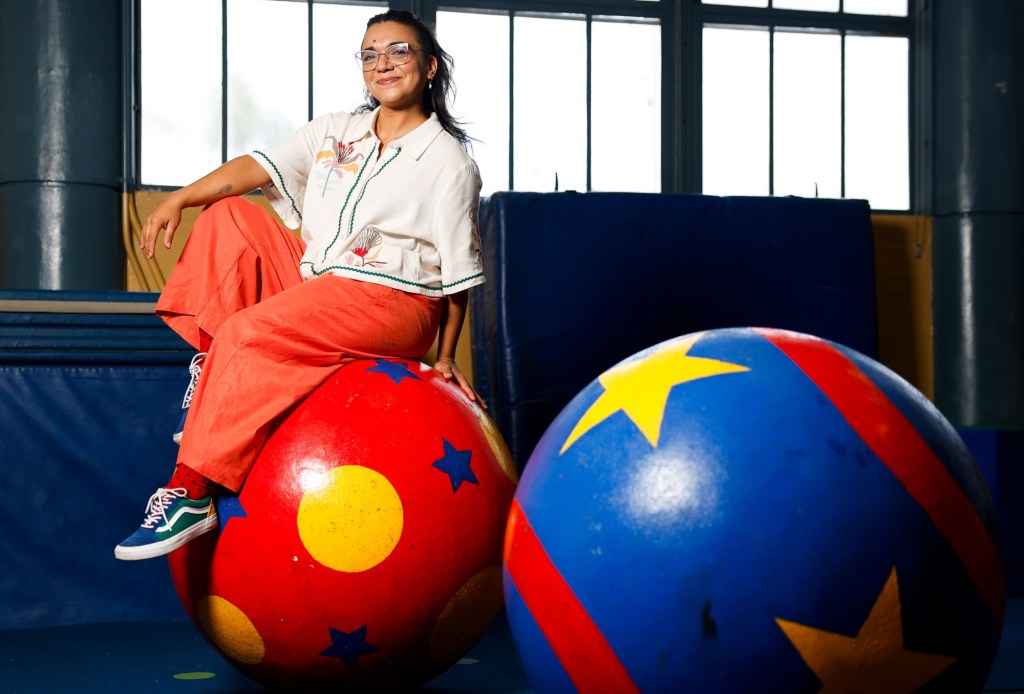
For Catalina Paz, performing as a clown can be serious work. A multidisciplinary performer, director, and teaching artist, she’s studied, trained, and worked in the performing arts from the time she was a kid, starting with working on her future craft with the people who were with her at home.
“I was born in Chile and I’ve always been kind of a dramatic theater kid, imitating family members early on,” she says. “I started through dance. I’ve always loved dancing, and then I had to move to Mexico, and that’s when I went to a fine arts high school and I found my love for theater and dance in a more serious way, where I was very committed to kind of be an artist.”
She went on to study contortion, acrobatics, folk and ethnic dance, toured and performed with dance companies and bands, learned mask work, and eventually connected to the performance art of clowning. With clowning, she’s used her art for humanitarian clown work with Emergency Circus, a nonprofit that takes performances and workshops to migrant and refugee communities, people experiencing homelessness, people in prison, and in hospitals. At Fern Street Circus, a project of Fern Street Community Arts, she is the artistic director and resident clown for the social circus organization that uses the art form as a way to address social justice issues through programs for children and families in San Diego, including after-school programs, in-school residencies, a youth apprentice program, after-school circus clubs, and other instructional programs. The organization’s annual Neighborhood Tour returns April 25 to May 17 with six free performances in San Diego public parks.
Paz, 35, lives in Sherman Heights with her partner, Jesus, and their dog, Onyx, and took some time to talk about Fern Street Circus, her performing work, and the 95-year-old grandmother character she embodies known as “Abuelita,” who will be part of the Neighborhood Tour.
Q: What exactly are the circus arts?
A: Circus arts are performance arts, like acrobatics, juggling, aerial dance, clowning, and we can break it down even more into different acrobatic acts, like tight wire or trampoline, different kinds of balancing acts. We have these on our tour that’s coming up at the end of this month, like a chair balancer that stacks up like five chairs and balances at the top. We have a juggler from Ethiopia that balances on tables with her feet. It’s very broad, but I would describe it as physical skills that require some kind of risk.
Q: How does the work of circus arts become a catalyst for social change? What are some examples of how Fern Street has successfully engaged in this social justice work through its circus arts programming?
A: Fern Street Circus is one of the few entities in California, and I think in SoCal, that does a social circus. That’s a little bit different in that it merges social work and the circus arts, so we’re not fully focused on circus arts; we use that as our medium to bring social skills or teach social skills to our participants. To answer your question, circus arts help in the way that you learn this discipline. There’s a lot of failure, to begin with. A lot of consistency and resilience, teamwork, communication. So, we are able to really teach all of the social skills through the disciplines that that are in our program.
We work in City Heights, which is a very diverse community that we’re serving. A lot of our participants are migrants and they’re adapting to the culture, learning the language, so we’ve seen a lot of success in that, when they come to circus, they don’t feel the need to really get it right. We’ve seen a lot of success in that. Another area is with motor skills and other emotional skills that children are developing in our program. We have had a lot of nonverbal people, and after two months in our program, they start communicating. A lot of what I do in the program is teaching clowning and physical theater, so we do a lot of nonverbal work to begin with, and how to find other ways of communication, so we’re able to really express what we’re feeling or who we are in unconventional ways. I think that really works for our community, especially with a lot of the challenges that we’re facing right now.
What I love about Sherman Heights…
I love the location. It’s kind of in the middle of walking distance to so many great places. I can walk to downtown, I walk to Barrio Logan, to Golden Hill. I just love that. It’s kind of a very chill neighborhood. I’ve definitely heard about it being gentrified and changing, but I like Sherman Heights. It’s very centrally located, and the people are friendly and diverse.
Q: Tell us about the upcoming annual Neighborhood Tour.
A: I direct the educational program and I’m also in charge of the Neighborhood Tour that happens every year, which is a circus tour that performs at public spaces and specific parks in San Diego. The Neighborhood Tour showcases professional local artists and also international artists, and our youth program. From our educational programs, the kids who are building skills to be part of our performance program, then they get to perform alongside professional artists on the tour. I’m in charge of the youth performance group, as well.Fern Street Circus has been doing this tour since the ‘90s. I think this is a staple from the circus, which people wait every year for. It happens in the spring, too, which is a great time for gathering outside of our homes. The purpose of the Neighborhood Tour is to bring visibility to public spaces and as a reminder that we can use those spaces for recreational activities. Sometimes there are parks that are not very visible and people feel like they can’t be there, or that they might be dangerous, or not family-friendly places, so the purpose is to transform those spaces and gather community and have fun. Especially this this year, specifically, we’ve seen a lot of need for joy, so the tour this year is called “Seeds of Joy.” It’s just the intention to cultivate that, to plant it and to grow it. Even right now, we can see that if we can’t harvest that, what we can do together as a collective is to plant those seeds and to care for our garden.
Q: So, this year is about planting this idea of cultivating joy in the community?
A: Yes, and also that joy is accessible, it’s within us, and it requires nurturing, which is not easy. In the literal sense, Fern Street created a small community garden within the family services program, so I was very inspired to see people learning and planting the seeds, and then there’s a little sprout and everybody gets happy. It’s like magic and it’s something that happens every day, and I wanted to kind of amplify that. Like, what can we do together, as a community, where other seeds can be planted?
Q: How were you introduced to the performing arts, generally, and circus arts specifically?
A: I was recruited by a physical theater company at the age of 15 in Mexico; it was also kind of like social theater, social circus, and that’s where I was introduced to physical theater and Commedia dell’Arte technique, which involves, mask work and studying masks, to the end of the journey of mask learning with the smallest mask, which is the clown. That’s kind of when everything clicked for me. I was like, ‘Oh, OK. I guess I’m a clown.’ I studied with them until I graduated, and then I moved to San Francisco and I had private lessons studying contortion and Chinese acrobatics. I also had a dancing career in San Francisco and did different folk dances, ethnic dances from different areas; I performed with an Afro-Caribbean company, as well as did performance art with a band. After that, I came to TJ, and then Fern Street Circus. But, I’ve always been in touch with clowning and wanting to learn how do I train my body to fall on my face safely? OK, I’m going to do acrobatics. I think it’s always been the notion of not having a fourth wall and direct audience connection, which is what clowning is about. It’s more about reacting to the audience than it is to act.
Q: What appealed to you about the circus arts and clowning? How would you describe clowning as an art form?
A: I think the general notion of clowning is to be funny and to make people laugh, and I think that’s a big part of it, but I think the root of it is connection. There’s no fourth wall, meaning there’s no separation between the performer and the audience. Yeah, it can be about making somebody laugh, but it’s really about what the other person wants and needs, so if it’s laughter, you will find that they want you to do something funny. But, sometimes it’s about just being there, being present, being vulnerable. Something that happens in comedy is that people have this catharsis where they can see themselves in you, and that’s where the laughter comes. A clown’s expertise is failure and being kind of at the bottom, but I think a lot of people can relate to that. It’s about how you react to a problem, how you solve it, and who you are throughout that journey. It comes from a place of truth; you can’t fool an audience. When you’re trying to be funny, people usually don’t laugh; but when you’re honest, when you’re real, people can connect to that.
Q: Tell us about “Abuelita.” Who is she and where did she come from?
A: Abuelita is me and it’s my grandmothers and my grandfathers. It started when I went to Mexico City to work with this clown troop. They had this traditional circus show and I was kind of coming in as a plug-in artist. They all had their characters, and I had studied contortion, but at that time I was like, ‘Oh, my God, I cannot put my body through that kind of training again.’ So, I was like, ‘What if I am a 90-year-old contortionist?’ Before all of that, I had a very close relationship with my maternal grandmother. We would talk on the phone and she would always tell me the chisme, like the gossip, between her friends in her neighborhood. They would get together and do crafts together, but a lot of gossip would happen and she would tell me about it. I became so acquainted with some of the characters, that I started pretending that I was one of those friends, like I was one of her girlfriends, and I started doing an older voice and sounding more old. When I started doing the character of the 90-year-old contortionist, that was a lot of what I took from those conversations with my grandmother, and then it just kind of exploded because I realized that, of course there’s an archetype for the grandmother. So many cultures have it and there are so many similarities and what grandmothers mean. In my culture and many others, there’s this immense respect for an elder, and care for them. At the same time, in contrast, there is this discourse of discarding elders at the same time. Like, we want a productive society and there’s a lot of assumptions that elders have information, but that they’re now useless for the workforce or productivity. There is this double-sided thing that happens where we respect our elders and say that we care about them, but we also see this other side where there’s a lot of abandonment and invisibility for elders. So, Abuelita comes to tell that truth. She can be very caring and, at the same time, she comes to break those notions of the idea that elders cannot move, of what elders can or cannot do. She breaks those boundaries in a very absurd way because I consider myself a clown, so that’s kind of how I relate to people.
In terms of character hierarchy, grandmas get away with a lot of things, so it’s a wonderful place where you get a lot of permission and it’s also well received. You’re not offending a lot of people. When I first started, people really thought I was old, so I had to add more playful things to my props and costume. I added padding on my butt, I added a different wig, different things that would show people that it was safe to play because, in the beginning, especially in my humanitarian clown work in TJ, people were bringing me chairs and I had like five people trying to help me walk. It was hilarious and it was beautiful, but at the same time, when I was performing, I am a dancer and Abuelita gets down. I was falling into the splits and getting on top of the walker, and sometimes I would see people get worried. In the beginning, because it was so real, at the end of the performance people were like, “Yeah, no, I can’t trust you. I don’t like to be fooled like that.” That was a big part of adding those extra props where people could take a second look and it would be much more obvious from the beginning that I’m playing. That there’s something wrong with this and then they’re curious and they give themselves permission to play.
In my personal life, yes, I am a clown, but I’m very serious about my clowning. I do have this kind of seriousness about it, so with Abuelita, I get to be myself and call it out when somebody is saying something that could be said better, or when somebody is misbehaving or disrespecting. There’s a lot of that that I also learned from my grandmothers; communicating with being firm, but with a lot of love, too. I think those things can coexist. I think, sometimes, in new generations, young adults right now are very softly cared for. I think, sometimes, that brings problems, or society becomes hypersensitive because you can’t tell them that they’re wrong, and you can’t have a conversation about that because people feel offended right away. There’s no margin for error and people feel uncomfortable. This is why I love clowning and teaching it because it’s being uncomfortable and not being right, learning from that and laughing about it, and not being too serious. How you’re going to make mistakes and having grace for each other, but also accountability. I think Abuelita makes people accountable, for sure.
Q: What is the best advice you’ve ever received?
A: Besides being all of what I told you, I’m also a jeweler and I had a jewelry mentor tell me that people use the phrase, “In life, it’s all about who you know to succeed,” but he said as he grew older he completed it to say, “It’s all about who you know until you become somebody that people have to know.” Meaning that, yeah, it is about building relationships until you are in a position of power and you can be that person who becomes a teacher, to pass it on. I feel so grateful for every single teacher that I had in my life, and I just aspire to be one of those people that planted something along the way in somebody’s life, and that person is able to transform it and have a positive impact.
Q: What is one thing people would be surprised to find out about you?
A: How serious I am about being a clown because my work and life are very intertwined. It requires a lot of being an extrovert and being seen and being out there, but I also have a very introverted side where I can be very quiet and I love solitude.
Q: Please describe your ideal San Diego weekend.
A: I love nature, and I love the ocean and being near water. Any place that’s dog-friendly also makes it better, like going to a dog beach or a dog park. Then, most definitely, getting some tacos.