
Picking up where he left off a day earlier, Santa Rosa Police Department Detective Gino Rantissi on Friday, April 17, stitched together multiple strands of evidence — investigative interviews, phone calls and texts, cell phone tower pings and FLOCK camera captures — to portray Dublin resident Richard Lund as the person who shot and killed Mark Calcagni at his Santa Rosa home Oct. 3.
Rantissi’s testimony at Friday’s preliminary hearing carried enough weight to convince Sonoma County Superior Court Judge Lynnette Brown to greenlight the case for trial.
She scheduled Lund’s arraignment for April 29. He is facing three felony counts of murder, violating a prohibition on firearm access and being a felon in possession of ammunition, along with a number of enhancements.
Calcagni’s death at age 60 stunned patrons of the historic Condor Club, the North Beach San Francisco nightclub he managed. The Condor, which opened in 1958, is credited with being America’s first topless bar.
Lund and his girlfriend, Asia Morton, both worked there until Calcagni fired them for being part of a drug sales operation at the club, prosecutors allege.
Summarizing testimony by Rantissi and other SRPD detectives and officers, Sonoma County Deputy District Attorney Christopher Brown offered an overarching theory of Calcagni’s killing.
Lund drove from Dublin to Santa Rosa on Sept. 26 and spent the day waiting for Calcagni at his Santa Rosa home, but the club manager didn’t show, Brown stated Friday. So Lund returned in the wee hours of Oct. 3. He drove a long route through the South Bay and the San Francisco peninsula, across the Golden Gate and north to Santa Rosa. There he sat in a rental car outside Calcagni’s house for four hours, trading texts about the victim’s location.
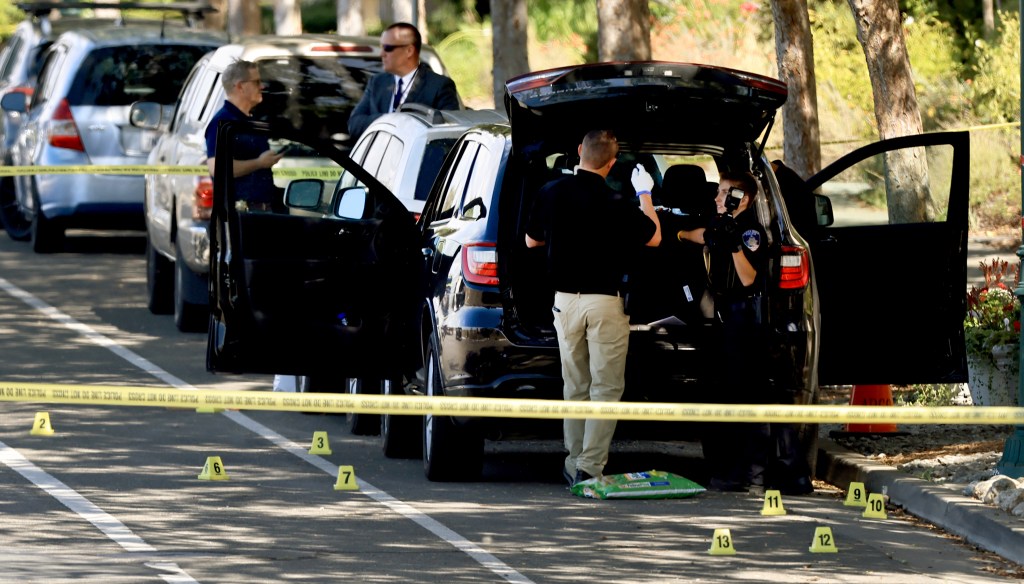
Minutes after Calcagni got home, he lay dead in the Brookwood Avenue bicycle lane.
“There is no other reason for (Lund) to be here other than to confront and to kill Mr. Calcagni,” the prosecutor told the judge. (Chris Brown and Lynnette Brown are not related.)
Rantissi’s testimony cited communications between Morton and both a cell phone registered to Lund, and a VoIP — Voice Over Internet Protocol — service that transmits voice calls over the internet. SRPD traced the VoIP account back to Lund’s email address.
Those phone numbers allowed Rantissi to build out a map and timeline tracing Lund’s whereabouts on Sept. 26 and Oct. 3, he said, a data visualization that was presented in court.
The phone movements were corroborated by FLOCK camera evidence of a Toyota RAV4 that had been rented by a friend of Morton’s. The compact SUV was caught by the “red light cameras” in various places along the same route defined by the cell tower information.
Lund’s cell phone arrived at Calcagni’s home around 1 a.m. the morning of Oct. 3, Rantissi testified. At 4:13 a.m., Lund texted Morton, “still waiting for pizza to get here.” His phone remained at the site until 5:10 a.m.
That’s right about the time a neighbor told SRPD Officer Robert Scalercio he heard “multiple loud pops” in the neighborhood. Another neighbor’s home security camera caught the RAV4 leaving the residence at that time, Rantissi said.
Morton called Lund’s VoIP number at 5:19 a.m. the morning of Oct. 3, according to Rantissi. Unable to reach him, she began calling his cell phone — five times in rapid succession.
About 90 minutes after that, a passerby discovered Calcagni’s body. Near him was a pizza box, and a knife believed to have belonged to the victim.
Lund wasn’t the only person Morton was communicating with in the hours leading up to Calcagni’s death, according to Rantissi. She was also texting her father about Calcagni’s whereabouts. Morton’s father also works or worked at the Condor Club, the detective said.
Rantissi also introduced portions of his interviews with Morton, who he said made between $20,000 and $30,000 monthly at the Condor Club, through a combination of on-the-books employment and arranged drug sales.
Among the revelations offered up by Morton during interrogation, according to Rantissi: Angry when Calcagni fired her, Lund told Morton, “He’s f—ing with your money.” When Morton expressed her fears in the wake of Calcagni’s death, Lund attempted to calm her down.
“What if I told you I shot him in the face?” Lund asked her at one point, according to the detective.
Calcagni was indeed shot point blank in the face, Rantissi said, and it was not a matter of public record.
Morton pleaded no contest to a charge of accessory after the fact in early December.
During cross-examination, Lund’s defense attorney, Joe Bisbiglia, peppered Rantissi with questions about the precision of cell phone tower data, the ability of FLOCK cameras to capture entire license plate numbers, Calcagni’s prior arrest for assault with a deadly weapon, and the Condor Club manager’s relationship with Morton, which Bisbiglia suggested was “more than employee/employer.”
Rantissi acknowledged there is no known video evidence of Lund near Calcagni’s home on Oct. 3, and no eyewitness accounts that place the defendant there. But he said he saw no evidence of an intimate relationship between Calcagni and Morton.
In his summary to Judge Brown, Bisbiglia called the evidence insufficient. He particularly questioned whether Lund was “lying in wait,” one of the murder enhancements.
“There was some sort of confrontation that allowed Mr. Calcagni to produce a dagger,” Bisbiglia said. “The whole purpose of lying in wait is to ambush.”
But in his rebuttal, Chris Brown said Calcagni was “very much ambushed.” The assailant, he argued, approached Calcagni from behind. There was no evidence of a struggle.
“If the intent was to argue with (Calcagni), to fight with him, (Lund) knew where he worked,” Brown said. “Instead, (Lund) drove to his home and waited for hours.”
The judge ruled there was sufficient evidence to charge Lund with murder, and for violations related to accessing firearms and possessing ammunition.
You can reach Phil Barber at 707-521-5263 or phil.barber@pressdemocrat.com. On X (Twitter) @Skinny_Post.