
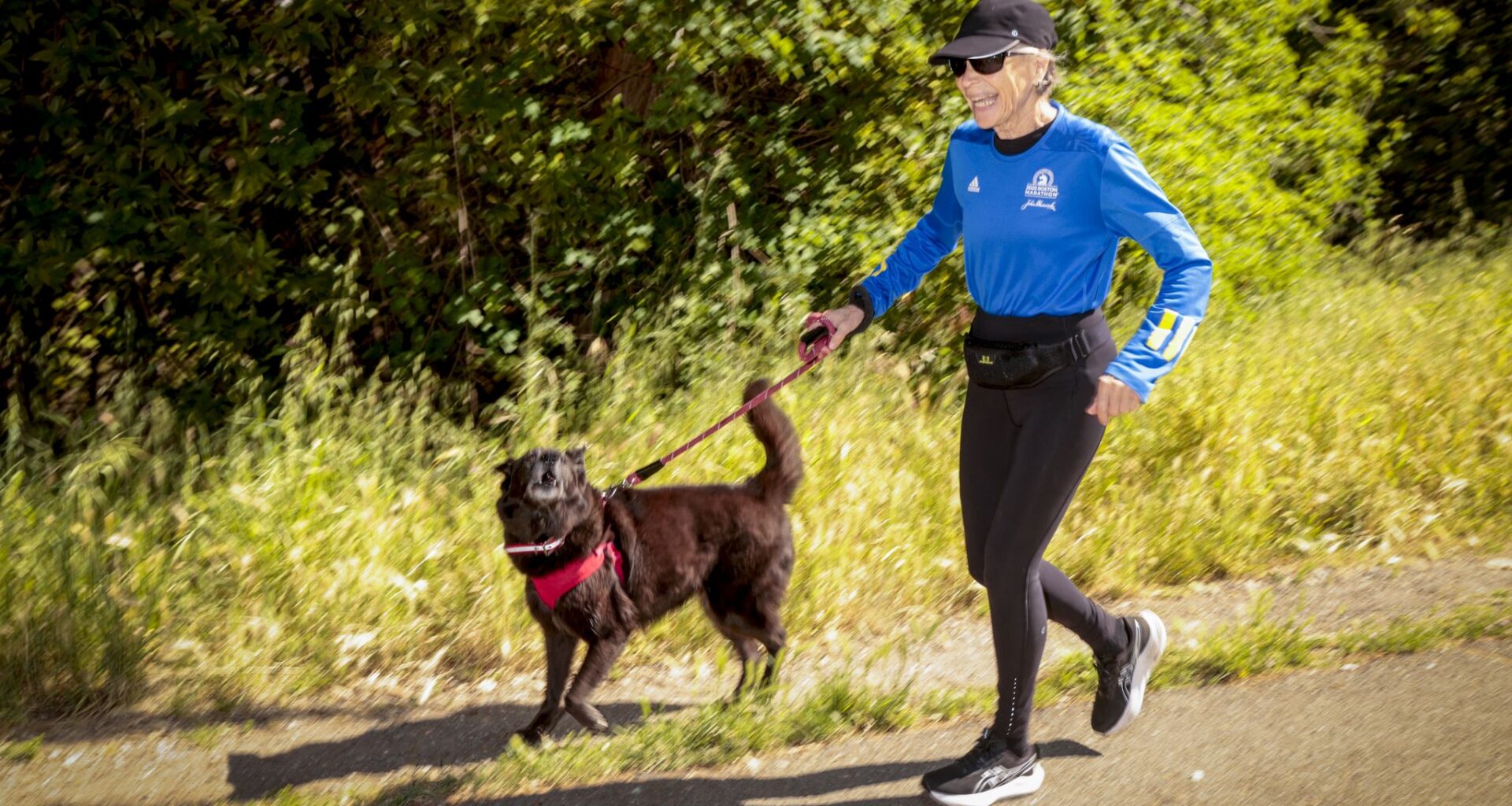
Patty Hung, 80, runs with her dog on the Lafayette-Moraga Regional Trail as she prepares for her 40th Boston Marathon.
Brontë Wittpenn/S.F. Chronicle
On a cool morning early this month, Patty Hung and her chunky dog, Ming, jogged under the oaks of the Lafayette-Moraga Regional Trail. There was nothing remarkable about the lean runner and her pup, unless you knew that Hung was in the history books.
On Monday, Hung will run her 40th Boston Marathon. She is 80.
“I’m not a great runner,” she said in the Boston accent she never lost despite more than 50 years in California. “I’m just persistent.”
Article continues below this ad
Hung is prone to understatement. Three years ago, she broke the women’s record for the most consecutive Boston Marathons ever.
“She shows what a human body is capable of,” said Daniel E. Lieberman, a Harvard professor of human evolutionary biology.
Patty Hung, 80, follows a careful training regimen ahead of her annual marathon.
Brontë Wittpenn/S.F. Chronicle
Lieberman studies how our species adapted to run long distances for survival, chasing and tracking animals. Today, runners like Hung demonstrate its other purpose. “We need physical activity to turn anti-aging mechanisms on,” Lieberman said. Active people on average live longer and are less likely to develop cancer, diabetes, heart disease, Alzheimer’s and other diseases, he observed.
San Francisco Chronicle Logo
Make us a Preferred Source to get more of our news when you search.
Add Preferred Source
Though with aging comes slowing down. Each of the past 38 years, Hung has run slower than the year before.
Article continues below this ad
When she first raced in Boston, she completed the marathon in 3 hours and 21 minutes. Last year, it took 6 hours and 2 minutes.
This year, she wants “to finish before the time stations close,” she said.
When Hung started running the Boston Marathon, just 14% of those who completed the race were women. Now nearly half — 43% — are female.
Back then, “They didn’t even make women’s running shoes. There were no running bras or running outfits,” she said. “I had to buy men’s running shoes.”
Article continues below this ad
When Hung was young, few women ran, and it was not until 1972, 75 years after the first Boston Marathon, that women were allowed to run the race.
Even now, the percentage of women in the 80-and-older age group who complete the Boston Marathon is far from parity. Last year, only two women who were 80 and older finished the race, compared with eight men.
Hung, who is 5-foot-4 with a sun-creased face, a wide smile and unlimited exuberance, will be one of six female octogenarians racing this year.
Patty Hung runs in the 2022 Boston Marathon. Years ago, Hung’s Uncle Joe, her “Aunties” Rose, Ann and Bunny, and her sons and cousins cheered her on. Now, mostly younger family members, including her two sons, are there.
K&R Studios/Boston Athletic Association
As always, family and friends will be there. Years ago, Hung’s Uncle Joe, her “Aunties” Rose, Ann and Bunny, and her sons and cousins cheered her on. Now, mostly younger family members, including her two sons, are there.
Article continues below this ad
Born Patricia Krawczynski — a last name the family shortened to Kraw — she is the daughter of an undertaker and a nurse. She grew up in the Hyde Park neighborhood of Boston, where she walked to elementary school. The first floor of their house was a mortuary, and the Polish Catholic Church was next door. She earned a master’s in mathematics and followed her future husband, Sammy Hung, to California. He entered medical school, and she became a high school math teacher in Orinda.
As a kid, she biked, ice-skated and played softball. As an adult, she tried a gym but only liked the hot tub. She did yoga and “fell asleep,” she said.
In her mid-30s, she was sitting on a park bench beside Oakland’s Lake Merritt, watching a runner go by. “I can do this,” she thought. She rose from the bench and ran the 3 miles around the lake.
Since then, Hung has run through it all. Her divorce. Raising her three boys as a single parent. The death of her son Kevin, a veterinarian. Nursing school in her 60s and working the night shift at Children’s Hospital Oakland until her retirement at 77.
In 2013, she was a mile and a half from the finish line of the Boston Marathon when two bombs went off, killing three people and injuring hundreds more. “It was a war zone,” Hung said, “a nightmare.”
Article continues below this ad
She was back the next year.
Usually, her runs are peaceful and cerebral. She doesn’t listen to music or podcasts. She meditates, though she also calls her sister in Florida.
Broken bones might incapacitate others, but not Hung.
Patty Hung smiles after completing the 2025 Boston Marathon.
Courtesy of the Boston Athletic Association
In August, near the end of a 9-hour trek, climbing 3,500 feet in Italy’s Dolomites with her boyfriend, Don Maxon, Hung slipped and fell backward, breaking her right ankle in two places. She had to be carried down part of the mountain to an ambulance.
After surgery, Hung had to learn not to limp. Maxon, who ran with her until he strained a hamstring this year, helped coach her back to health.
Did she doubt she’d run the Boston Marathon again? “There was no question,” she said.
Every year she begins training on New Year’s Day. On Jan. 4 this year, she was racing to take out the garbage and get to church and slipped on her wet front steps. She broke her wrist.
After an X-ray, Hung asked the doctor, “Are you sure?” He was. “Here’s the thing,” she remembers telling him, “I’m going to be running a marathon.”
On Monday and Tuesday, she runs 2 to 5 miles. On Wednesday, her runs progress from 6 to 20 miles. (The last 3 miles, she runs as fast as she can.) Thursday is her only day of rest. Friday and Saturday, she is back at 2- to 5-mile runs. On Sunday, she does a speed track workout, starting with one 800-meter sprint, and increasing over the months to 12 of them. Maxon coaches from the track.
Hung doesn’t stretch much. She doesn’t do resistance training. Before her runs, she does 10 minutes of modified pushups and pullups. She never feels pain.
Patty Hung, 80, doesn’t stretch much before her runs, she just does 10 minutes of modified pushups and pullups.
Brontë Wittpenn/S.F. Chronicle
The other day, while running 20 miles, Hung, who has been slowed by her swollen ankle, was pleased to break a 13-minute mile.
“A marathon is really about endurance,” said professor Lieberman. That does not necessarily mean people should run as fast as they can for 26.2 miles. Running a marathon, the professor said, “is a little crazy.” Lieberman understands the attraction. He’s run the Boston Marathon 14 times.
“She’s a role model to celebrate,” he said, “but you don’t need to be Patty to get the benefits of exercise.”
A few days before she was flying to Boston, Hung was asked what advice she has for people. Despite her success, Hung believes she’s not unique. “There’s something special about everybody,” Hung said, “but we have to find it for ourselves.”
Carol Pogash is a Bay Area journalist who worked at the Hearst-owned San Francisco Examiner. She’s the author of three books and is a longtime contributor to the New York Times. She can be reached at carolpogash@gmail.com