
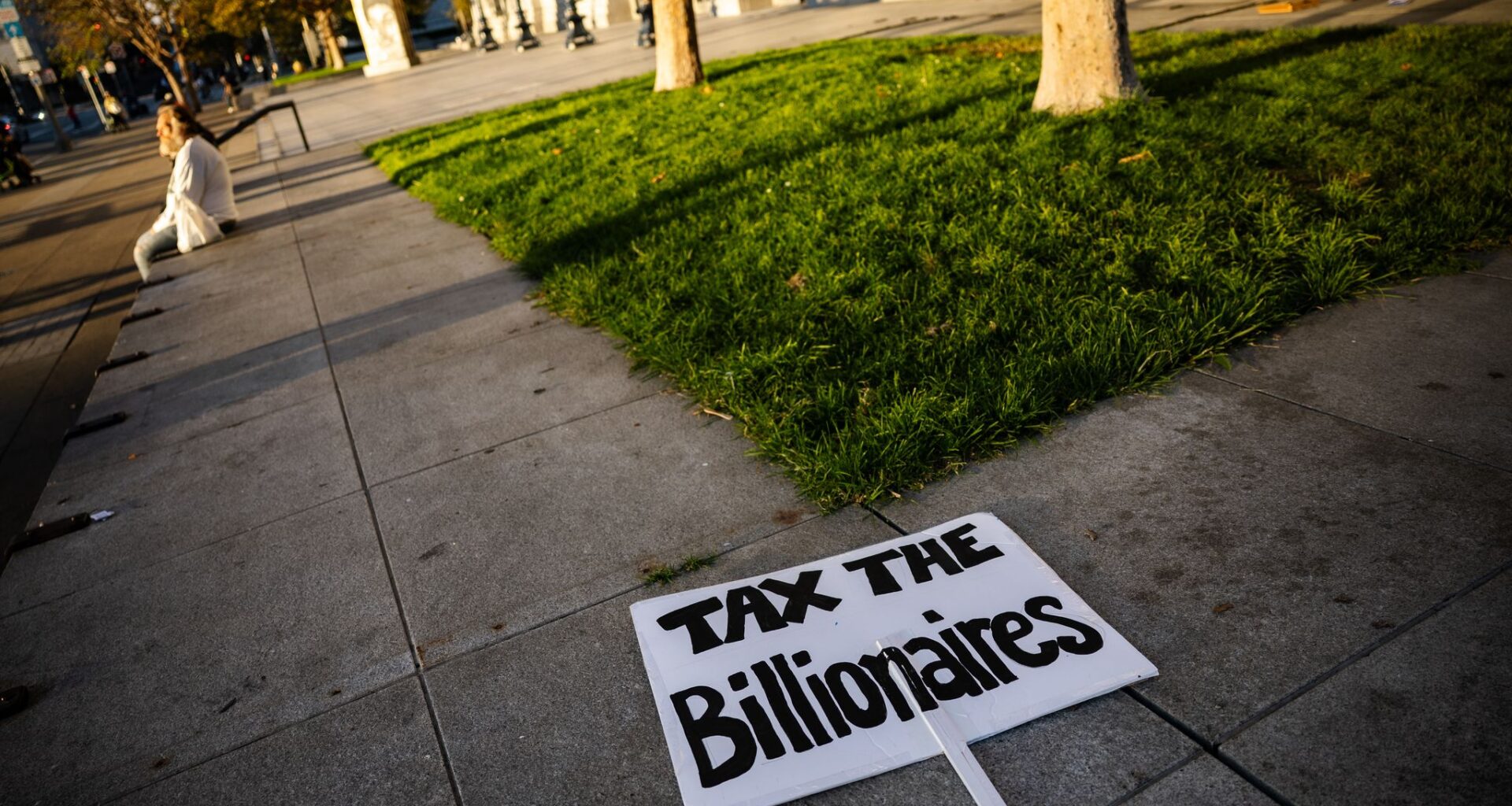
A sign in favor of taxing billionaires lies outside the San Francisco Public Library after a No Kings rally in San Francisco in October of last year.
Manuel Orbegozo/For the S.F. Chronicle
Is California really trying to tax your retirement assets?
If you received a text or letter sent out by the backers of a proposed ballot initiative called the “Retirement and Personal Savings Protection Act,” you may be asking that question.
An “URGENT” text message reads: “Even though California has some of the highest taxes in the country, Sacramento politicians and special interests are still pushing to pass new taxes on retirement and savings accounts.”
Article continues below this ad
The short answer is that California has not attempted to tax the value of savings or retirement assets for all state residents.
So what’s going on? This is one of three prospective ballot initiatives that could weaken or block California’s proposed billionaire tax, whose proponents are also trying to get enough signatures to qualify the measure for the November ballot.
What would the ‘Retirement and Personal Savings Protection Act’ do?
The Retirement and Savings initiative’s main funder is Building a Better California, a political action committee financed by a group of billionaires, many from the Bay Area. It would prevent the state from taxing any assets in retirement and other savings accounts after Jan. 1, 2026.
San Francisco Chronicle Logo
Make us a Preferred Source to get more of our news when you search.
Add Preferred Source
The group’s website, Protectretirementca.org, says the measure would benefit “Working Families and Middle Class Californians, Seniors and Near-Retirees, Teachers, Firefighters and Construction Trades,” veterans, young workers and small-business owners.
Article continues below this ad
But the immediate winners would be the wealthiest Californians — those who would have to pay the billionaire tax.
The retirement and savings initiative would prevent any new state tax on the “ownership or control” of a resident’s “personal property.”
This includes financial assets within or outside of retirement accounts, business interests, digital assets, intellectual property and tangible personal property such as boats or planes.
It would not prevent new taxes on “real property,” such as homes, land and buildings.
It also would not prohibit new taxes on income from assets, such as Social Security (which the state does not currently tax), pensions, interest, dividends, capital gains or retirement-plan withdrawals. “We are prohibiting the state from imposing new taxes on the paper value or mere ownership of these accounts,” said Nathan Click, a spokesman for the initiative campaign.
Article continues below this ad
What about the billionaire tax?
California has not attempted to tax the value of savings or retirement assets of middle-class residents, although it has made previous attempts to impose a wealth tax on the uber-rich.
Since 2020, state legislators have introduced three bills that would have taxed the worldwide net worth of residents with more than $30 million, $50 million or $1 billion in net worth. All three died without even a committee vote.
Taking matters into its own hands, the Service Employees International Union — United Healthcare Workers West launched the 2026 Billionaire Tax Act initiative late last year. It would impose a one-time tax of 5% on the entire net worth of California residents (singles or couples) with “covered assets” valued at more than $1 billion.
Covered assets include publicly traded securities, stock in private companies, art, collectibles, intellectual property and vehicles. They do not include real property held by individuals or their revocable trusts. Nor do they include most retirement assets.
Article continues below this ad
The net worth calculation would exclude pensions, traditional IRAs, 401(k)-type accounts, deferred compensation plans and up to $10 million in Roth IRAs — which some wealthy investors have used to shelter millions or even billions of dollars from taxes.
Ninety percent of the billionaire-tax revenues would go to health care, to offset federal cuts to Medi-Cal and other programs, and 10% to food assistance and public education. The measure would exempt these tax revenues from constitutional requirements for school funding, budget reserves and the state spending limit.
The one-time special tax would apply to about 200 to 250 people who were California residents on Jan. 1, 2026, even if they subsequently left the state.
The Retirement and Savings measure, on the other hand, would prevent the state from imposing any taxes retroactively.
Click, the spokesman for that campaign, said the initiative was not a response to the proposed billionaire tax. “Californians deserve to know that their hard-earned savings will be there when they need them.” This measure would deliver that certainty, he said.
Article continues below this ad
Although the billionaire tax would impact a tiny percentage of Californians, Click pointed out that “the federal income tax started as a narrow class tax on the wealthy and now reaches much of the working and middle class.”
As of March, both initiatives had collected at least 25% of the 874,641 signatures needed to place a constitutional amendment on the November ballot. The Secretary of State has until June 25 to certify initiatives for the ballot, but it has recommended that campaigns turn in their signatures by April 17 to allow time for validation.
If both measures make it to the ballot and pass with a simple majority, because they are conflicting, the one that gets more “yes” votes would take effect, and the other would not.
Who’s behind the initiative?
The retirement initiative is one of three in circulation sponsored by Building a Better California that could upend or undermine the billionaire tax if they make it to the ballot and pass.
Its political action committee has received $79 million since January from billionaires including Google co-founder Sergey Brin, Kleiner Perkins Chairman John Doerr, Stripe CEO Patrick Collison, venture capitalist Michael Moritz, Doordash CEO Tony Xu, Affirm CEO Maksim Levchin, Ripple Executive Chairman Chris Larsen and former Google CEO Eric Schmidt.
The group has not taken a stand on the billionaire tax. It is also supporting two affordable housing measures. “We are focused on long-term policy reforms that will improve government accountability, protect the state’s jobs and economic engine, and prioritize affordability and a better quality of life for Californians,” Abby Lunardini, a spokeswoman for Building a Better California, said via email.
Darien Shanske, a UC Davis law school professor, calls the group’s three initiatives “revengements,” short for revenge amendments. “They are all deceptive,” Shanske said. People who vote for the billionaire tax might not realize they could “frustrate” that vote by also voting for one or more of the “revengements,” said Shanske, who helped draft the billionaire-tax proposal.
The other initiatives
One of Building a Better California’s other initiatives, the Protect Schools and Taxpayers Act, could redirect a big portion of the billionaire tax revenues to schools and possibly tax refunds.
California law, under voter-approved Proposition 98, guarantees that a significant portion of general fund revenues go to K-12 schools and community colleges. If the Legislature or a voter initiative raises taxes that go into the general fund, that same portion must go to schools. If they raise taxes that go into a special fund, however, that money is not subject to Prop 98 requirements.
Another law, Proposition 4, capped how much state and local governments can spend from tax revenues. If tax revenues surpass that cap, often called the Gann limit, over two years, the excess generally must go to schools and taxpayer refunds. In 2022, California issued $9.5 billion in Better for Families/Middle-Class taxpayer refunds to avoid exceeding the limit.
Some voter-approved special taxes for a specific purpose can bypass the Gann limit if structured properly. The proposed billionaire tax is designed to be exempt from both Proposition 98 and the Gann limit.
The Protect Schools and Taxpayers measure, however, says that any new tax enacted after Jan. 1, 2026 must be subject to those two requirements and cannot be exempt.
New tax-audit requirement
The group’s third initiative, the Improving Transparency, Effectiveness, and Efficiency in California Government Act of 2026, would apply to special taxes, ones that go to a specific purpose such as health care or homelessness.
It would require the state auditor to conduct a detailed review of any proposed special tax before it reaches the ballot. For any special taxes enacted after Jan. 1, 2026, it also would have to conduct a “financial and performance audit” of any program that receives money from the tax every four years.
“This will offer more transparency and accountability by requiring audits of tax measures so people can more clearly understand what tax measures would do” and what they actually do, said Molly Weedn, a spokesperson for the campaign.
“It seems like a common sense idea: How is the government spending money?” Shanske said. But “hidden in there” is another provision that would prohibit any state tax enacted on or after Jan. 6 from being exempt from the state spending (Gann) limit.
“These revengements represent a cynical bait and switch that would frustrate the will of the voters to impose a billionaire’s tax,” Shanske added.
Suzanne Jimenez, chief of staff of the health care workers union sponsoring the billionaire tax, said, “A few billionaires are spending tens of millions to deny Californians the opportunity to save their local hospitals and ERs — but so far, those billionaires are failing. The public is crystal clear on the fact that keeping ERs and clinics open is more important than more tax giveaways to billionaires.”
Email Kathleen Pender at kathpender@gmail.com