
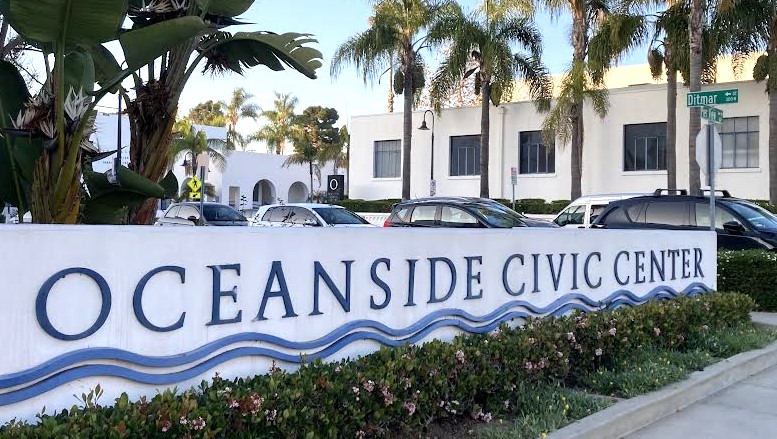
Oceanside’s City Council got its first look at a 2026-27 general fund budget Wednesday with about $240 million in revenue and $236 million in spending, and gave the proposal a green light while advising caution.
The preliminary numbers include money to hire three additional police officers, two more firefighters and some part-time assistants in the the library and parks and recreation departments, said Financial Services Director Jill Moya. A final version will go to the City Council for approval in June just before the new fiscal year starts July 1.
Staff members gave credit to forward-thinking residents and elected officials for keeping the budget in the black, while other cities such as San Diego are looking at deficits and layoffs.
One reason for Oceanside’s good fortune is Measure X, a temporary half-cent sales tax that provides millions of dollars annually for public safety, homeless assistance and other high-priority services. In November 2024, Oceanside voters approved a 10-year extension of the original seven-year tax increase.
The city’s general fund reserves in fiscal 2026-27 are expected to remain at $38 million, the same amount as this year and up from $34 million in fiscal 2022-23. City Manager Jonathan Borrego and council members emphasized the need to maintain healthy reserves.
“We’re in a period of a lot of economic uncertainty,” Borrego said. “A lot of things going on nationally could have an impact locally. We’re very mindful of keeping an eye on all the economic indicators.”
He and others recalled difficult financial times such as the COVID pandemic that began in 2020, slashing revenue from hotel and sales taxes.
Mayor Esther Sanchez said the Great Recession of 2008 and 2009 may have been worse.
“Oceanside laid off 100 employees,” Sanchez said. “We are still below, in terms of personnel, what we were before the Great Recession.”
Meanwhile, the city’s population and service needs have grown, and it could see cuts in federal and state funding, such as the Community Development Block Grants that pay for social service programs every year.
“We are not out of danger in terms of our funding,” Sanchez said, and she advised against using any money from reserves.
Measure X has its own separate spending plan.
Fiscal 2026-27 is the eighth year the measure has been in effect and the first year of the 10-year extension. The city anticipates $19 million in revenue and $21.5 million in spending, with some of the money for capital projects rolled over from previous years.
So far, the city has set aside $15 million in Measure X money for the replacement of the Pier View Way Bridge, said Assistant City Manager Michael Gossman.
The Pier View Way bridge is the concrete-and-steel access ramp from Pacific Street to the wooden part of the city’s much-loved public pier. The bridge, unlike the wooden part rebuilt in the 1980s, is almost a century old and badly in need of replacement.
An additional $11 million from Measure X is expected for the pier project in the 11th year of the measure, but the city will need grant money to cover the anticipated construction costs of $60 million or more.
Measure X spending also includes $4 million next year in addition to $5 million already set aside for the Police Department’s new firearms training facility on Oceanside Boulevard. Construction is expected to start by the end of this year.
There’s also $400,000 in next year’s budget for the city’s new “homeless evaluation, assistance and resource team” (HEART) program. The HEART program will replace the Police Department’s homeless outreach team (HOT) program, Gossman said.
Additional details on the new police program will be presented at next Wednesday’s council meeting, he said.
The financial outlook has greatly improved for the city’s harbor district, which is overseen by the City Council and has a separate budget. The district includes a marina with shops and restaurants and about 900 rental boat slips.
The harbor district faced a financial crisis a few years ago, dipping deeply into reserves to cover dock repairs and other maintenance.
Since then, the district has made a dramatic turnaround because of recent changes approved by the City Council and its Harbor and Beaches Advisory Committee, said Public Works Director Hamid Bahadori.
Boat slip fees were increased to boost revenue and bring Oceanside in line with fees charged by other, similar-sized marinas, Bahadori said.
Also, for the first time, the district began requiring slip renters to pay for the utilities they hook up to on the dock. Previously, the utilities were covered by slip fees or simply paid by the district.
As a result, the anticipated harbor budget for next year calls for $12.7 million in revenue, up 25% from the previous year, with $10 million in revenue, which will allow $2.7 to be placed in reserves.
“We are doing much better,” Bahadori said. “”Three years ago, we were barely putting about $80,000 into reserves.”
The council also reviewed budgets for the water utilities and capital improvement programs.