
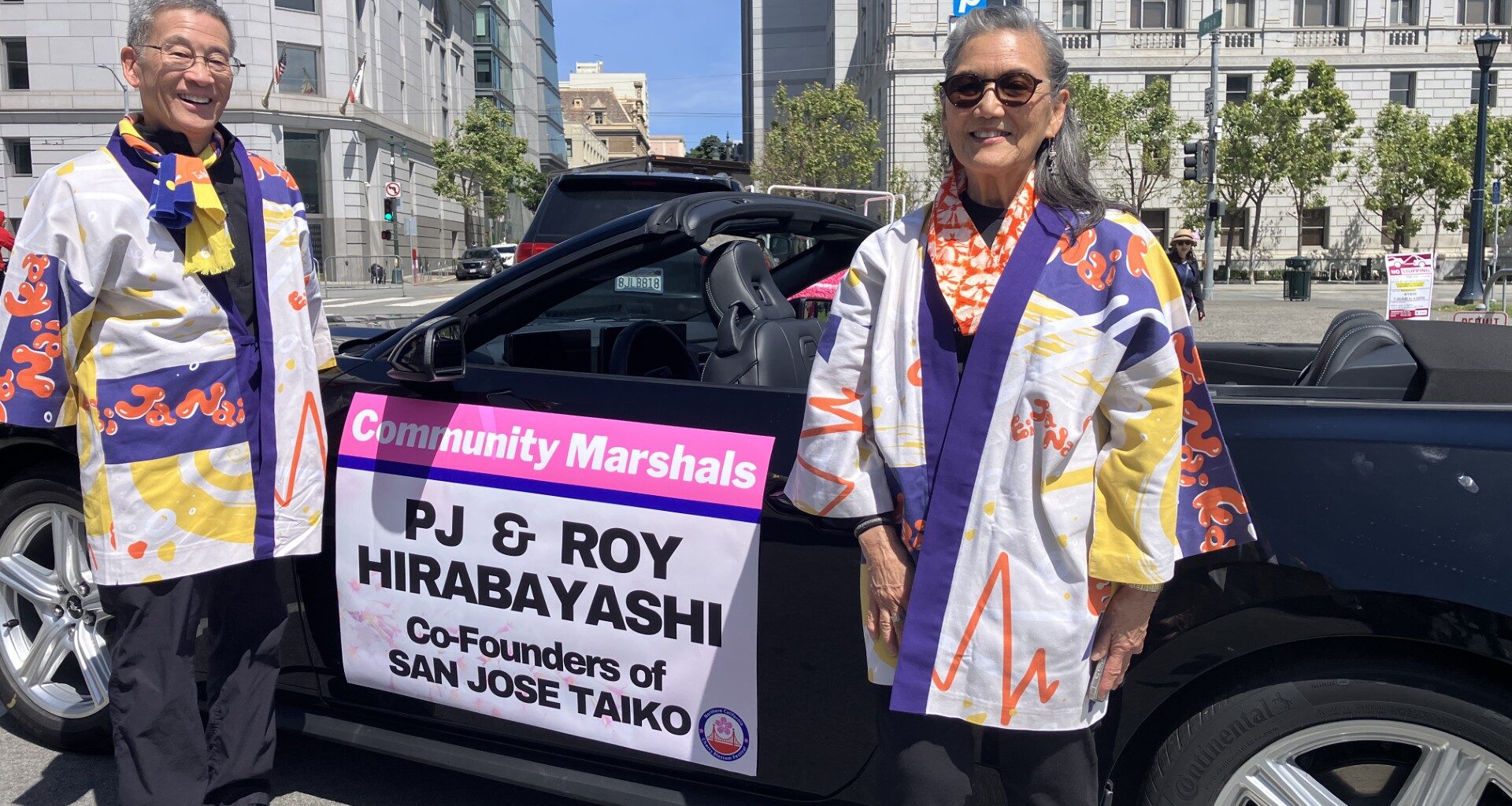
Roy and PJ Hirabayashi, who founded the San Jose Taiko Group 53 years ago, served as community marshals for Sunday’s grand parade closing out San Francisco’s Cherry Blossom Festival.
Sam Whiting/SF Chronicle
Taiko drummers are the heroes of San Francisco’s Cherry Blossom Festival grand parade in the same way that a high school marching band that came by bus from Iowa is the hero of the Rose Parade. On Sunday, this was recognized when Roy and PJ Hirabayashi, who founded the San Jose Taiko Group 53 years ago, were riding in a convertible Mustang at the front of the Northern California Cherry Blossom Parade.
“This is our first time ever,” said Roy, 75, who served with his wife as community marshals for the parade, “and we get the privilege to ride in a car. It’s a great honor.”
There were 53 entrants in the parade, up from in the low 40s last year, including three or more taiko drum corps. Most prominent among them is the 40-member strong San Francisco Taiko Dojo, which merits its own decorated float and a contingent of ceremonial dancers. But they were far back in the pack, behind the proud six-drummer contingent from San Jose Taiko, pounding and walking behind entry No. 6, the founder of their group.
Article continues below this ad
“The car is above our pay grade,” said drummer Trish Kume. “Taiko is the heartbeat of the Cherry Blossom Festival both here and in Japan, and we bring the spirit of the Japanese people here in America.”
The Northern California Cherry Blossom Festival, one of the state’s largest celebrations of Asian traditions, is a two-weekend event that culminates with the parade on the final day. Tradition that goes back to its founding in 1968 is that the parade starts in front of City Hall and climbs its way up Post Street to a festival in front of the landmark pagoda at Japantown’s Peace Plaza. That tradition has been upended for several years while the Peace Plaza undergoes a $34 million renovation that will include a new grove of cherry trees that give the event its name.
San Francisco Chronicle Logo
Make us a Preferred Source to get more of our news when you search.
Add Preferred Source
It is expected to reopen in time for next year’s festival, while in the meantime the parade ends with a block party on Post Street. For the participants in the parade, it doesn’t matter where or how it ends. It is the marching to the cadence of all those taiko drums that is the point of it. The Berkeley-Sakai Association, which sends high school students to Japan for cultural exchanges, was marching to the beat of Oakland Taiko.
“I’ve never marched in a parade, so I’m really excited,” Oak Griffin, a 15-year-old Berkeley High School student, said before the parade.
Article continues below this ad
“This gives us a lot of exposure, and we get to be on TV,” explained the group’s chaperone, Kate Lucchese of Emeryville. “We’re promoting the fact that we still exist and promoting peace through friendship.”
Oak had more personal expectations for the parade experience. “I’m expecting,” he said, “my feet to get tired.”
As the parade got underway, Cindy and Ron Vasquez were seated on a stone plinth at the starting point, having driven in from the Central Valley community of Manteca (San Joaquin County).
“I’ve been wanting to check this parade out for so long,” Cindy said, “to see if it is as big and as good as the Chinese New Year Parade.” If it wasn’t, it was trying. That six-member group of San Jose Taiko retirees behind the community marshals kept it up all the way from City Hall to Japantown.
Article continues below this ad
“We’re here for the vibe and the energy of taiko that Roy and PJ have passed on to us,” Kume said. “It’s not just playing the drums. It’s about what we can do to help the community.”