

San Diego has put nonprofit groups that oversee city parking districts on a two-year hiatus after a city review found mismanagement and the county grand jury raised additional concerns.
The change, which the City Council approved 8-1 Monday, marks a retreat from Mayor Todd Gloria’s proposal in September to permanently dissolve the districts and give City Hall total control over parking meter revenue.
Gloria’s staff will have two years to demonstrate they can spend parking meter revenue more efficiently and effectively than the nonprofit parking districts, council members said.
“We are giving the city an opportunity to prove that it can quickly deliver improvements to neighborhoods with parking meters, while ensuring that it also reflects community priorities,” Councilmember Stephen Whitburn said.
Councilmember Henry Foster III said he plans to hold officials at City Hall and in the Transportation Department to a high standard.
“Understand I’m going to be very critical when this comes back, because I want to make sure we cross our Ts, dot our Is, and that we are transparent, and the districts know what’s taking place,” Foster said.
City officials say their internal review showed the kind of widespread mismanagement that makes eliminating the parking districts the right move.
They say the districts are essentially middle-man panels that spend money earmarked for neighborhood upgrades on sometimes-frivolous expenses.
Councilmember Kent Lee, who cast the “no” vote, said he was pleased the mayor had retreated from fully eliminating the districts. But he criticized the mayor’s staff for not working with the districts to solve any problems.
“It’s only fair that I express my utter frustration and disappointment with how the administration has chosen to enact changes to this program,” Lee said. “Essentially what we’re seeing is a gutting of community parking districts — even if it’s only for the next two years — without genuinely working with them.”
The mayor’s staff has promised greater transparency on how parking meter revenue will be spent.
Transportation Department officials said they plan immediately to start spending $1.8 million they are taking from the districts, including on downtown streetlight repairs that began Tuesday.
The change in policy on parking districts comes just months after the city slashed the share of parking meter revenue that the districts controlled from 45% to 15%.
Monday’s vote transfers all money that would have gone to the districts in fiscal year 2026 to the mayor’s office. The same will happen in fiscal year 2027, which ends June 30, 2027.
San Diego’s four community parking districts are in downtown, Pacific Beach, the Mid-City area centered on El Cajon Boulevard, and Uptown, a term the city uses to describe Hillcrest, Bankers Hill, University Heights and Mission Hills.
Leaders of those districts gave the changes mixed reviews, with some of them saying city officials have distorted facts and failed to tell the full story of what’s happening behind the scenes.
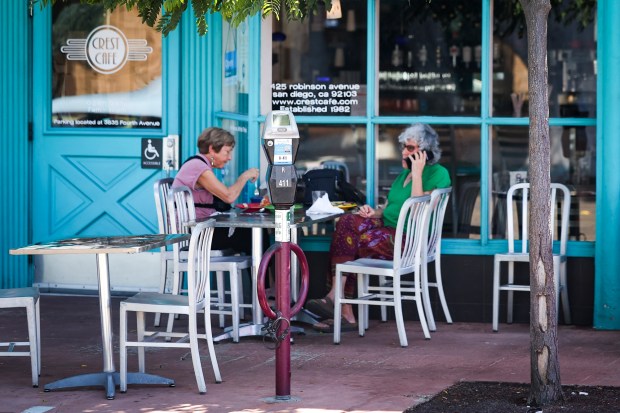 A parking meter is seen as guests dine at Crest Cafe along University Avenue in the Hillcrest neighborhood on Tuesday, Sept. 16, 2025 in San Diego. (Meg McLaughlin / The San Diego Union-Tribune)
The Hillcrest Business Association expressed grudging support for the change, but stressed that the city must show that areas with parking meters get enhanced funding compared to areas without meters.
The Mid-City district requested a delay, contending the proposal was an improper attempt by the mayor’s office to take funds away from neighborhood leaders.
The Gaslamp Quarter Association said the change is evidence that City Hall doesn’t want to collaborate with nonprofit groups.
“Community parking district organizations have spent decades building effective neighborhood-based programs that reflect the unique needs of the communities they serve,” said Michael Trimble, executive director of the Gaslamp Quarter Association. “That collaboration should be strengthened, not discarded.”
Sunny Lee, executive director at Discover Pacific Beach, said city officials have not worked well with the parking district her group oversees.
“We are reluctantly agreeing to this two-year pause only because it is being presented as a done deal with no other options,” she said. “The Transportation Department’s report is not telling the full story in relation to Pacific Beach.”
The districts, which date to 1997, were created by the city to oversee how parking meter money is spent within them, including proposing and sometimes coordinating specific projects.
A report by the county grand jury in April called the districts an unnecessary layer of bureaucracy, and the city’s Mobility Board in May slammed them for lack of accountability.
But neither the grand jury nor the Mobility Board recommended a complete takeover by the mayor. The Mobility Board recommended reforms and improved policies on transparency and accountability, while the grand jury recommended the districts be taken over by neighborhood planning groups.