
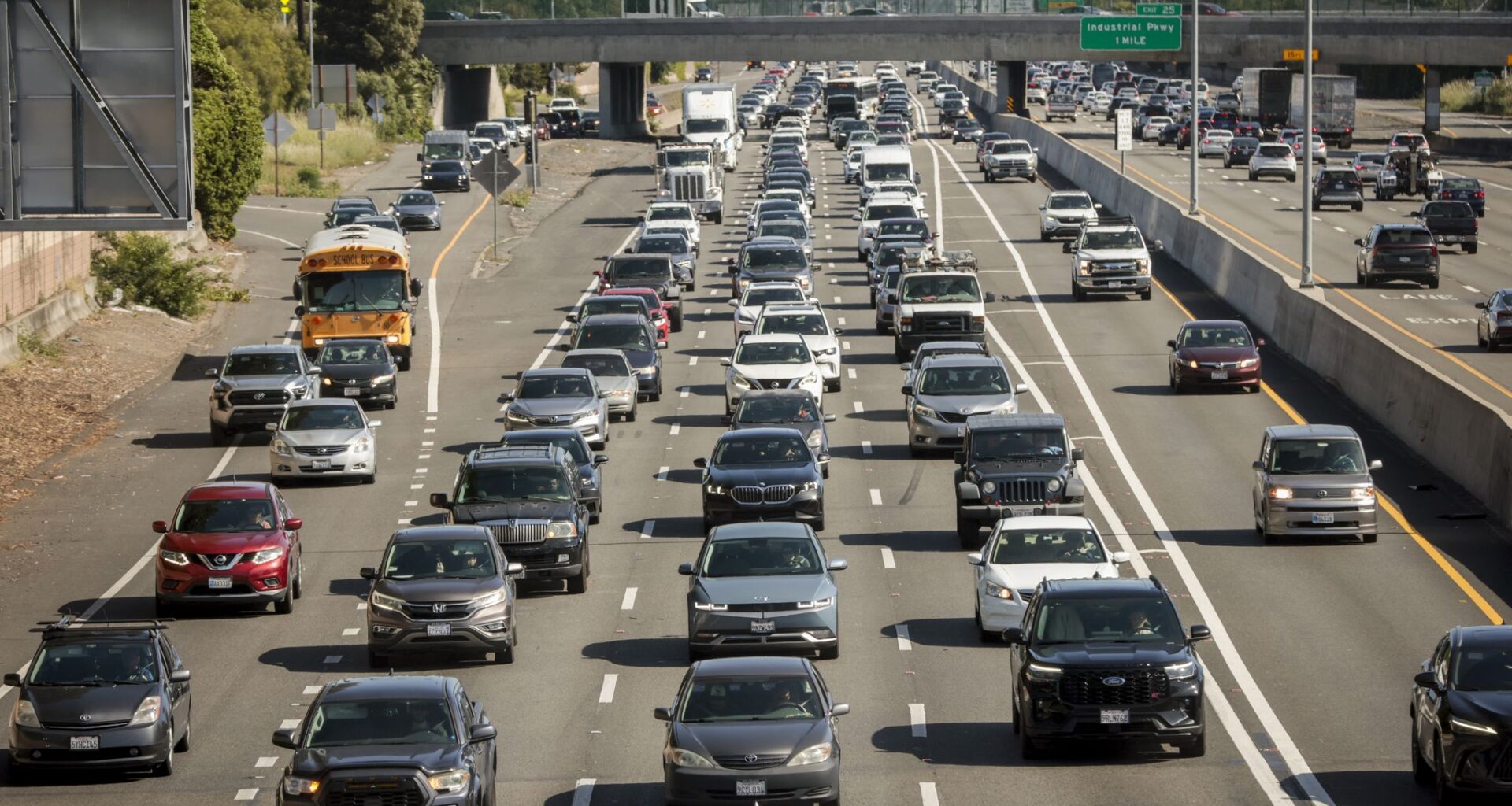
A crush of evening rush hour traffic is seen from the pedestrian bridge over the I-880 northbound freeway in Hayward. That stretch of road contains the worst spot for bottlenecks in the Bay Area.
Brontë Wittpenn/S.F. Chronicle
At 5 p.m. every weekday, cars pour from Silicon Valley tech campuses onto northbound Interstate 880, many of them converging at one notorious chokepoint.
It starts near the pedestrian overcrossing that connects Eldridge and Peterson avenues in Hayward, a horseshoe of asphalt swooping over an extremely jammed freeway. In the gathering dusk, drivers swarm from the cloverleaf interchange at Tennyson Road, headed toward another spaghetti tangle where I-880 intersects with Highway 92.
Engineers at Caltrans have identified this stretch of freeway as the Bay Area’s No. 1 bottleneck — not in the technical sense of lanes merging, but in the more colloquial sense of traffic routinely slowing to a crawl. The agency has a bespoke definition of “bottleneck,” meaning a 20 mile-per-hour drop in speed that continues for several miles, or for five “contiguous” five-minute detection points.
Article continues below this ad
On average, the late afternoon jam on I-880 north lasted for nearly 6.5 miles when Caltrans measured speeds during the second quarter of last year. Drivers who slogged through that miserable crush of vehicles collectively wasted 173,003 hours in estimated travel delay.
Among them is Eric Koppelson, who drives three days a week from a tech campus in Mountain View to his home in Berkeley. While much of the journey is tedious, Koppelson said his frustrations peak after crossing the Dumbarton Bridge to merge into I-880 at Decoto Road. The next several miles toward and past the Highway 92 interchange are “literally stop-and-go,” he said.
San Francisco Chronicle Logo
Make us a Preferred Source to get more of our news when you search.
Add Preferred Source
“You think you’re going, and then you stop,” Koppelson explained, estimating that he plods along at 5 to 20 miles per hour through much of Hayward.
His experience captures the human toll of Caltrans’ bottleneck numbers. I-880 North in Hayward has hit the Bay Area’s Top Ten list for two consecutive years, largely due to the heavy volume of cars that pack the freeway at about the same time, headed in roughly the same direction. A theme that emerges from Caltrans’ data is the predicament of Silicon Valley workers, many of whom have return-to-office mandates, and few alternatives to driving.
Article continues below this ad
Four of the 10 worst bottlenecks from Caltrans’ data in the second quarter of 2025 — the most recent period available — are located on freeways in Santa Clara County. They reflect travel patterns as workers head south from jobs in tech or aerospace companies, into suburbs of San Jose or Morgan Hill. Other bottlenecks represent the flood of vehicles heading eastbound on Interstate 80 in Alameda and Contra Costa counties, where the majority of drivers are coming off the Bay Bridge.
Nine out of the 10 bottlenecks measured slowdowns in the evening rush hour, while only one occurred during a morning commute, westbound approaching the interchange of Highway 4 and Interstate 680 in Concord.
“Consistently, the heaviest locations are into and out of Silicon Valley, or into and out of San Francisco,” said John Goodwin, a spokesperson for the Metropolitan Transportation Commission. “Because those are the biggest job centers.”
Transportation planners recognize the problem, and have launched multiple projects to unclog a few particularly vexing locations. One focuses on the Highway 4 and I-680 junction in Concord, and would involve construction of an elevated ramp to replace the existing “tight loop” ramp that, according to Contra Costa Transportation Authority, forces drivers to weave. Another seeks to untangle traffic on northbound I-680 in Walnut Creek and Pleasant Hill by building an express lane from Livorna Road to Highway 242. Past projects have added express lanes in both directions of Highway 237, a packed corridor that links the “Golden Triangle” tech district of North San Jose to bedroom communities in Milpitas.
Article continues below this ad
Many of these efforts to alter ramp geometry or reconfigure freeways provide at least temporary relief to beleaguered Bay Area drivers. Yet they don’t address other systemic issues, like the inadequacy of transit or the unpredictable nature of traffic in an era of hybrid work.
Aaron Jaques, a public defender who lives in West Oakland, and commutes to work in San Jose, has long endured the persistent, low-level anxiety of driving along I-880 North. And he’s tried just about every hack he can think of to bypass traffic.
Traffic congestion on the I-880 northbound freeway in Hayward can be attributed to tech workers driving back home from their jobs in the South Bay.
Brontë Wittpenn/S.F. Chronicle
“If I’m in trial, I might be able to leave the office at 5 p.m.,” he said. “But I’ll consider doing more work to stay until 7 p.m.,” when rush hour has abated. Some days, he joins the queue of cars following their navigation apps onto side streets that twist around the more tortured sections of the highway. On other days, he might stop for dinner to break up the commute. He and other motorists have memorized all the best restaurants in Hayward.
To be sure, Jaques and his colleagues have tried to ride public transit, though their options are imperfect. He can catch Amtrak from the Jack London Square Station in Oakland, or ride BART from West Oakland Station to North Berryessa. Trains are generally less stressful than driving, though they come with a downside, he said. Both Amtrak and BART drop him off at stops that lie more than a mile from the courthouse in San Jose. Riding a bike for that final leg of the trip is uncomfortable for someone wearing a suit and dress shoes. Walking on a muggy summer day is worse.
Article continues below this ad
Koppelson acknowledged that he could take a corporate shuttle to work, but it leaves Berkeley at 7 a.m. and doesn’t return until 7 p.m., hours that would keep him away from his family for too long. So he joins the throngs of drivers on I-880 instead.
From his perspective, traffic has completely rebounded since 2020, when pandemic shutdowns forced the whole tech industry to work from home.
In fact, he said, “overall it’s only getting worse.”