
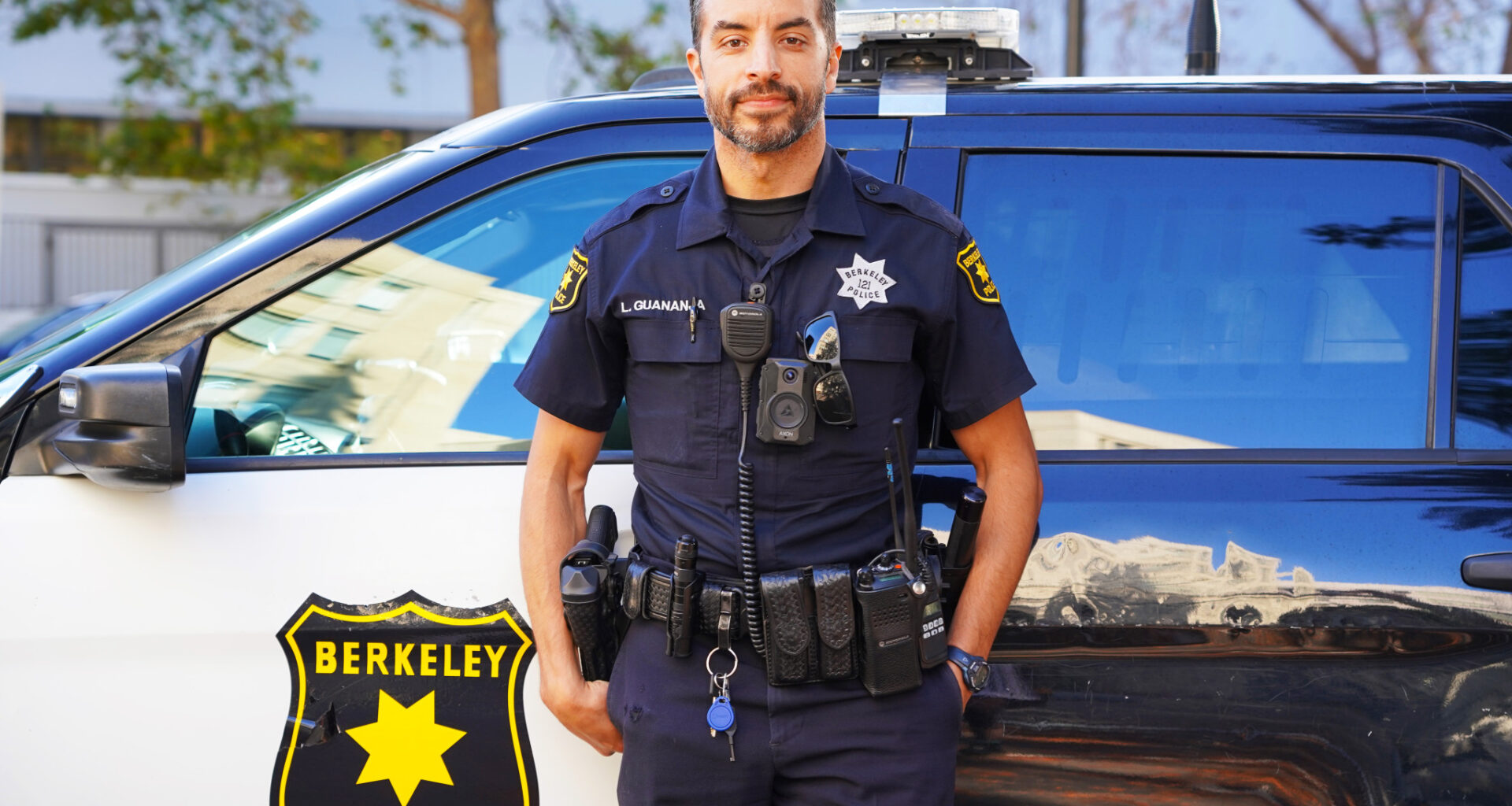
 An arrest of a student initiated by Lino Guananja, Berkeley Unified’s only school resource officer, has been the focus of a lawsuit from the family against the Berkeley school district and police department. Guananja is not named in the suit. Credit: Sunny Bevis-Lipton/Berkeley High Jacket
A family has filed a lawsuit accusing a school resource officer employed by the Berkeley Police Department of assaulting a student last year after a required therapy session the 17-year-old attended on the Berkeley High campus.
This story was written in partnership with the Berkeley High Jacket, the student newspaper of Berkeley High School.
After the therapy session mandated by the student’s Individualized Education Program on March 4, 2025, the officer, “without provocation, slammed him and injured him, then led him off campus to a side exit where the [officer] knew cameras could not record the encounter, further assaulted [the student] and falsely arrested him,” according to the lawsuit, filed exactly a year later in Alameda County Superior Court.
The now former student, Justin Richardson, who is Black, and his mother, Erica Johnson, are suing the school district and the police department, alleging civil rights violations, negligence and discrimination based on race and disability. The suit claims Berkeley High didn’t report the incident to the California Department of Education, in violation of child abuse reporting laws, and that the district failed to adequately train, supervise and investigate its staff to “ensure that students are not subjected to unsafe, unfit and violent adults.” The family is seeking at least $35,000 in damages for “significant physical and mental injury and pain,” in addition to attorneys’ fees.
Berkeley High Dean of Students Cassandra Tesch said Richardson became agitated when a safety officer employed by the Berkeley Unified School District (BUSD) questioned him as a possible trespasser. Richardson was a student at the Berkeley Technology Academy (BTA), the district’s alternative public high school, serving students who need credit recovery or a more flexible learning environment.
Tesch said that, after she had defused the situation, the school resource officer (SRO) — Lino Guananja — again questioned Richardson and brought in more police to arrest him. Tesch said, though she only saw part of the arrest, she didn’t “personally witness any harm.”
The encounter has reignited longstanding questions about the role of police and the school resource officer program in Berkeley schools. It has raised concerns about whether students at Berkeley Tech, and students with different needs, experience more discrimination in BUSD. It has also caused a firestorm on the Berkeley High campus, where the Black Student Union organized a walkout last year calling for Guananja’s removal, citing concerns that campus police disproportionately target students of color.
Guananja, who isn’t mentioned by name in the lawsuit, told Berkeleyside in a statement that a core part of his role is to protect student safety.
“I view arrest as a last resort, and plan to continue to collaborate with the school administration and families, grappling with the best way to ensure BHS is as safe an environment as possible for all students, while supporting approaches and resourcing for addressing root causes of harmful behavior and long term healing for students who are struggling,” he wrote.
He said he could not comment directly on the lawsuit and the statement reflected his personal views, not those of BPD.
BUSD said it cannot comment on pending litigation, and the superintendent, school board directors, the city attorney’s office and the Berkeley Police Department declined or did not respond to requests for comment. Court records do not indicate criminal charges have been filed against Richardson.
School resource officers are armed and can arrest students for unlawful activity, though the role is also intended to emphasize relationship‑building and mentorship with youth and is not meant to handle student discipline matters. After George Floyd’s murder in 2020, the Berkeley school board tasked a committee of students, administrators, parents and others to imagine school safety without an armed police officer. The committee found that the district’s sole school resource officer, Geoffrey Mitchell, a tutor for students on the football team, was seen as having a positive impact and recommended that the SRO position remain, possibly with an increased mentorship component or additional hours. Mitchell has since left the role.
Guananja has served as BUSD’s only school resource officer since fall 2024 and as a Berkeley police officer since 2022. As SRO, he has primarily been stationed at Berkeley High but has occasionally also worked out of Berkeley Technology Academy.
According to Tesch, BPD reassigned Guananja last year while officials investigated the incident and reviewed video footage. BUSD Superintendent Enikia Ford Morthel and other district leaders, in collaboration with BPD, brought Guananja back on campus for the 2025-26 school year, Tesch said.
Tesch, who doesn’t believe SROs should be on campus at all, said the incident with Richardson should have been handled differently and that when she saw him arrested by multiple officers, she “feared for his life.”
“That could likely have been de-escalated by a social worker or someone trained to support individuals in crisis, especially those who might be triggered by the sight of someone wearing a gun,” she said.
School resource officer’s appearance at author talk about police abolition led to tensions
After Guananja became a school resource officer, he told the Berkeley High Jacket he saw his role not just in terms of safety but also to “be a friend and a teacher figure to the whole Berkeley High community.”
Yet frictions arose even before the March 2025 incident that led to the walkout and lawsuit.
Tesch said Guananja’s predecessors were locals who had already built trust within the community, whereas he came from Southern California and had more of a “rocky start.”
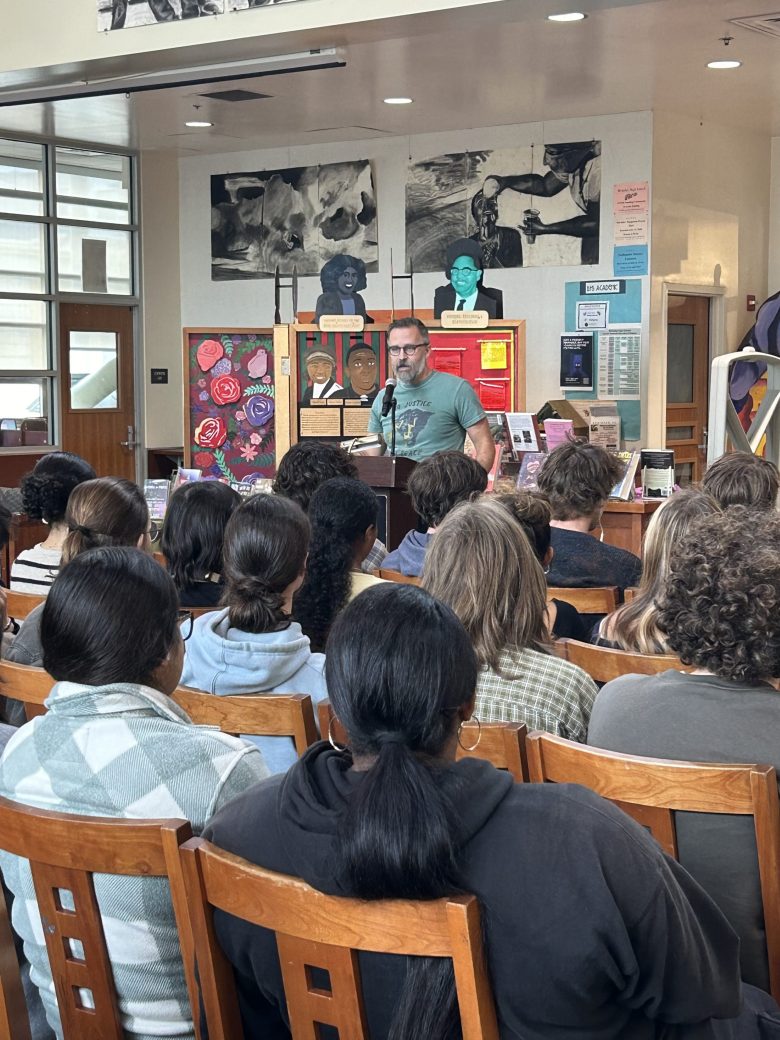 Author Geo Maher talks about his book “A World Without Police” at Berkeley High on Sept. 20, 2024. Credit: Allyson Bogie
In one instance soon after he started in September 2024, she said, Guananja attempted to sit in on a talk by the historian and abolitionist activist Geo Maher about his book “A World Without Police,” hosted by Berkeley High’s African American Studies Department. He was invited by Law and Social Justice teacher James Dopman, but other teachers were not made aware of this ahead of time. He arrived long after the talk began, according to attendees, and Tesch said his presence “caused immediate distress among students and staff, with some students fearing an arrest was imminent.” After Tesch asked Guananja to leave, she said he first took a place at the podium and introduced himself. His actions were “seen as unprofessional and disruptive to the learning environment,” Tesch said.
“I made a lot of people uncomfortable [by being here] because this talk is about defunding the police [but] I want to hear what [the author has] to say as well,” Guananja said at the event, according to a short video clip provided by Berkeley High librarian Allyson Bogie. “I’m not here to steal your limelight. … I was invited … and I’m happy to be here with you.” Some students in the clip can be seen whispering to each other and exchanging looks. One audience member says in the video that Guananja’s explanation for his presence seems “real sus[picious].”
Guananja told Berkeleyside in a statement that he arrived when Dopman told him to and “sat quietly in the back of the room to listen,” but that after a few minutes Berkeley High English teacher Jenell Marshall stood up and said she felt unsafe with a police officer in the room and directed her class to leave. (Marshall declined to comment.) “Students were visibly confused and it was an incredibly awkward moment,” he said. He said he apologized to Maher for the interruption and left when asked by Tesch.
Sophia Castillian, a former communications director of Berkeley High’s Black Student Union, described separate experiences in which she said Guananja watched her and other students of color more closely than others. “It was never a shared experience with our white counterparts; they never experienced that sort of high surveillance,” she said in an interview.
“As a person of color myself, I have made a concerted effort to proactively get to know as many students as possible and prioritize positive and neutral interactions with students on campus,” Guananja said in response. “[I] remain committed to serving the school community as best I can.”
About a month before the incident with Richardson, two Berkeley High students were involved in a fight that led one of the families to press criminal charges against the other, resulting in a warrant for a student’s arrest, Tesch said. Before notifying the principal of the warrant, as school policy dictates, Guananja identified and removed the student from class, she said.
“The school was not notified … until after the fact. This presented a procedural error and eroded trust between our SRO and the school administration,” Tesch wrote in an email.
Guananja said he “informed the school there was a warrant for her arrest which I needed to carry out.” He didn’t respond to a question seeking clarity on whether he did this before or after the arrest.
BTA special ed teacher said student was ‘in emotional crisis’
What exactly preceded the altercation between Richardson and the school resource officer is not entirely clear.
Tesch said Richardson became upset after a safety officer came up to him and began asking who he was. The safety officer, she said, sent a message on his walkie-talkie saying a trespasser was on campus, but when Tesch got there, she recognized Richardson and was able to persuade him to leave campus.
But as Richardson was leaving, Tesch said, Guananja arrived on the scene and tried to question him. Richardson again became agitated, yelling at and threatening the officer, she said.
More BPD officers arrived at Berkeley High and took Richardson off campus and arrested him, Tesch said. Tesch stayed behind to call Richardson’s mother. She said she exited the school about two minutes after the officers left with Richardson and saw them handcuffing him. She said at that point, Richardson was physically “resisting arrest” and shouting expletives at the officers.
Mainak D’Attaray, the attorney representing Richardson and Johnson, disputed Tesch’s description of events and said that the incident occurred as described in the lawsuit. He said his client couldn’t have resisted arrest since there was no legal basis to arrest him. D’Attaray told Berkeleyside last month that BUSD’s attorneys had yet to share video footage of the incident.
In a prepared statement at a school board meeting last year, BTA special education teacher Amanda Cardno said Richardson had been authorized by her, by his Individualized Education Program counselor and by Berkeley Tech Principal Vincent Toan to be on campus for his therapy session. (It’s unclear how long Richardson stayed after the end of the therapy session before he was stopped and questioned.)
“This was a student in emotional crisis looking for help. They were met with aggression and a lack of de-escalation tactics,” according to Cardno’s statement. “BHS often treats our BTA students as trespassers.”
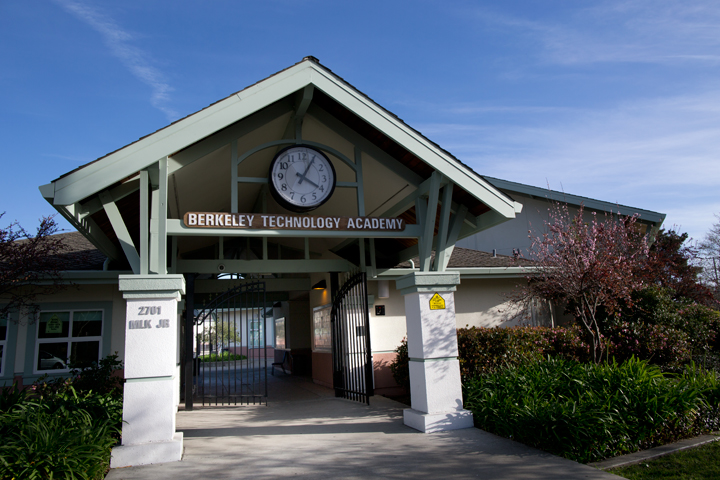 Berkeley Technology Academy, BUSD’s alternative public high school. File photo: Emilie Raguso/Berkeleyside
More than half of Berkeley Tech Academy’s students are Black, and more than a quarter are Latino, with half the school population socioeconomically disadvantaged, according to 2025 data from the California School Dashboard. A disproportionate number of students in alternative programs also have special education plans.
Tesch said there are “false perceptions of BTA [that] students go over there because they get in trouble.”
“I know all the [BTA] students, they’re all fabulous,” she said. “And they all have a unique set of needs that our school did not meet. And that is our school’s failure.”
Tesch, who also serves on Berkeley High’s safety committee, said that instead of the SRO program, the district should increase funding for social workers, therapy and restorative justice.
She said the safety committee will review the impact of on-campus policing next school year and, following recent incidents, aim to move from “informal interactions toward a data-driven, regulated relationship with the SRO.”
Guananja told Berkeleyside he believes “there’s a valuable dialogue to be had on the best way to protect students’ safety at a time when gun violence, sexual harm, minors, abuse, neglect, and suicide are all too commonly impacting our youth.” He said most of his time as an officer is spent following up on disclosures of such incidents.
Co-author Penelope Purchase is a reporter with The Jacket, the student-produced newspaper at Berkeley High School. Berkeleyside Editor-in-Chief Zac Farber contributed reporting to this story.
“*” indicates required fields