
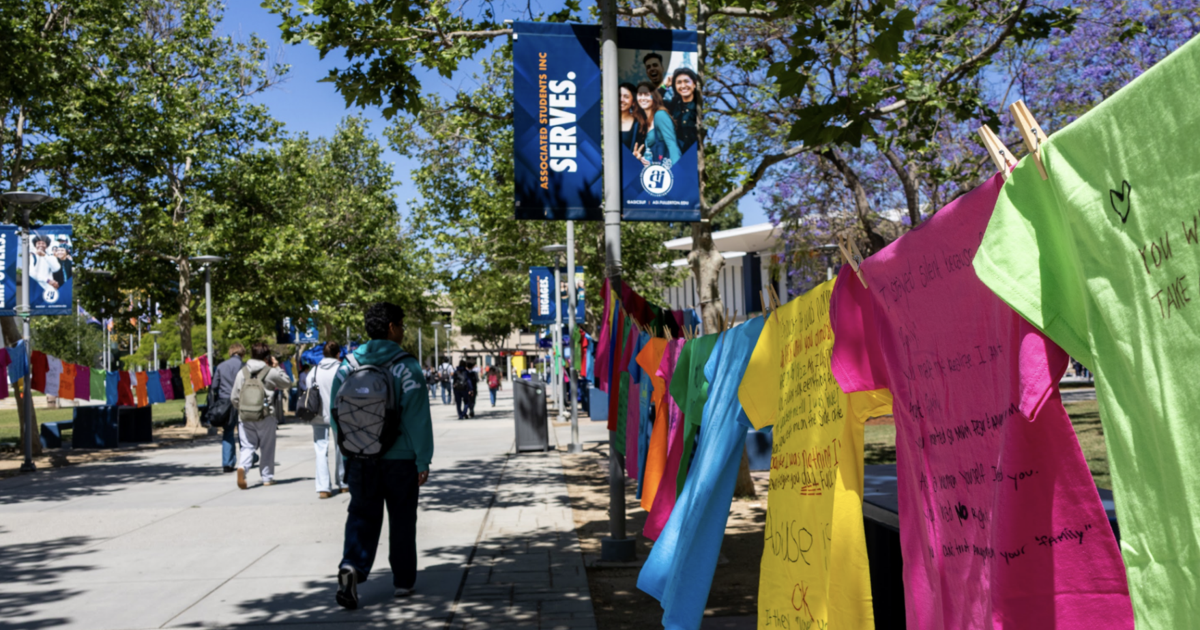
More than 150 colorful T-shirts lined Titan Walk on Wednesday to mark the 25th anniversary of the Waymakers Clothesline Project at Cal State Fullerton.
The traveling installation, held during Sexual Assault Awareness Month, uses shirts to represent individual stories of sexual assault, domestic violence and human trafficking.
Vanessa Reyna, a program director for Waymakers, said the project originated in 2001 with only eight shirts. Today, the collection has grown to more than 1,500.
“It’s just such a powerful display that really not only empowers and helps survivors heal and feel heard in a safe manner, but it also helps educate our community,” Reyna said. “We don’t want to put the responsibility on survivors who have to teach us about how not to hurt or harm others, but it does help create that platform for them without that responsibility.”
From 10 a.m. to 3 p.m., the collection of color-coded shirts hung to denote specific types of violence, alongside a key describing what each shirt represented.
Red, orange or pink shirts represented cases of sexual assault, green or blue represented child sexual abuse, yellow represented domestic violence, black represented sexual harassment, white represented homicide, purple represented cases of rape due to sexual orientation and gray represented human trafficking.
Reyna noted that clotheslines were historically safe spaces for women to have conversations about the violence they were experiencing while hanging their laundry alongside one another, prior to the invention of washers and dryers.
The exhibit aims to turn personal experiences into a collective call for awareness while providing resources for the campus community through a partnership with TitanTHRIVE, the university’s confidential advocacy group.
“We live in a culture of violence, and this is an opportunity to expand that conversation,” said Brett Goldberg, assistant director of advocacy services and community engagement with TitanTHRIVE and TitanHEALTH.
TitanHEALTH, TitanTHRIVE and TitanWELL were present at the event in conjunction with Waymakers and advertised the resources available for CSUF students in need of support.
“As a nonresidential campus, the needs that they (students) are looking to have met are better met by folks who are community-based versus campus-based,” Goldberg said. “When folks graduate, or if they move to other places, our partnerships with other agencies help us ensure that they have ongoing support and services when they leave this community.”
Due to the nature of the exhibit, signs and staff were placed at the top and bottom of Titan Walk’s pathway to provide a content advisory for students.
Fourth-year communication science and disorder major Elly Calles and third-year gender and sexuality major Estrella Perez describe their reactions to the exhibit as they walked down Titan Walk.
“As soon as I saw the T-shirt, it was like ‘I was 12.’ ‘I was eight,’” Calles said. “There are so many stories, like in these T-shirts, that are not nearly close to the amount of numbers we have of sexual assault.”
While Waymakers informs itself through the Rape, Abuse & Incest National Network (RAINN) — the common statistic hub for rape crisis centers — Reyna cautions those who turn to quantifiable data as holistic education.
“Statistics are captured by reporting,” Reyna said. “And a lot of times, too, as a rape crisis center, we help survivors who also choose not to report. Justice can look different for everyone. Healing can look different for everyone. So if they come and share with us, that’s never getting reported anywhere or documented.”
Also available at the event was a workshop wherein Waymakers allowed participants to create their own shirt in the privacy of a tented area.
Any shirt made would then join their rotation system for not only their traveling installation, but also allow enough inventory for their partners, like the Orange County Family Justice Center in Anaheim, to borrow for display in their own spaces.
“There’s a call for healing and a call for action,” Reyna said. “You have power to keep the people around you safe by being an individual that practices consent, and also the power that we have when we do intervene safely.”