
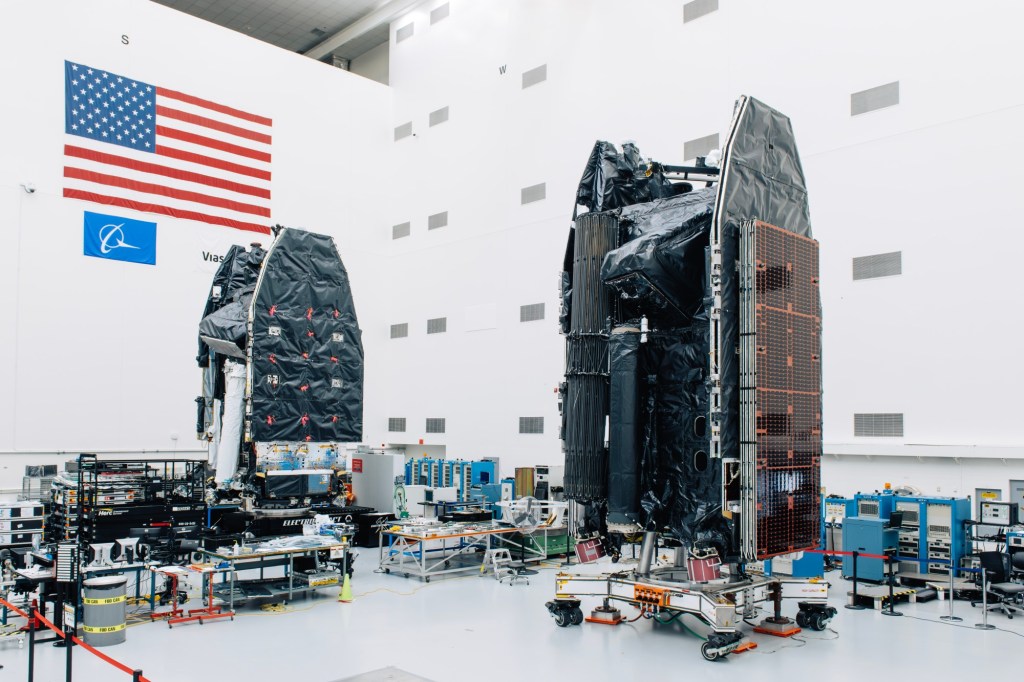
Viasat on Sunday announced plans to launch its third and final satellite, completing its multi-billion-dollar constellation project that would place its highest-capacity communications satellite system into orbit.
The ViaSat-3 F3 satellite will launch via a SpaceX Falcon Heavy rocket at Kennedy Space Center on April 27. This satellite will reach its orbital slot, some 22,000 miles away, and cover the Asia-Pacific region. The company did not disclose how much it costs.
The three-satellite constellation aims to provide global coverage, with each satellite originally assigned to a different region, and helps to position the Carlsbad-based company as a top competitor to SpaceX’s fast-growing Starlink satellite Internet service.
Viasat’s first satellite, launched in May 2023, sits above the Americas. The second sister satellite, ViaSat-3 F2, has reached its orbital slot after four months of space travel, and has begun in-orbit testing.
After the first satellite malfunctioned, the second was repositioned to cover the Americas after originally being targeted at Europe.
ViaSat-3 F2 cost more than $950 million to build and launch. It will provide one terabit per second — a giant leap in geostationary satellite technology — offering capacity 100 times greater than satellites from the 2000s.
When fully operational, the second satellite could double the bandwidth of the company’s entire fleet.
But these high-tech satellites come with high risk.
First, space expeditions are notoriously perilous: electrostatic storms and collisions with meteoroids, decommissioned spacecraft or other debris stand to derail the mission.
That’s not accounting for the challenges of rocket science itself.
There can be physical malfunctions of the satellites, “such as those we experienced in connection with the launch of our ViaSat-3 F1 and I-6 F2 satellites,” the company said in federal filings.
The first satellite, ViaSat-3 F1, cost $700 million but malfunctioned. When it reached its designated slot, the internet antenna did not fully expand, cutting coverage to the Americas, where it currently operates at less than 10% of its original capacity.
This malfunction hit the company hard. Following the disclosure, Viasat’s stock fell nearly 30%. It also filed a $420 million insurance claim, at the time one of the largest in the space industry.
ViaSat-3 F1 now provides in-flight Wi-Fi, while Viasat’s second satellite has been repositioned to cover the Americas. Europe will not receive a dedicated satellite. Instead, Viasat is relying on its lower-tech KA-SAT and S-EAN satellites to cover the continent.
The third satellite remains targeted toward the Asia-Pacific region, though the company has not indicated whether or how it will be repositioned.
Despite the disruption, Viasat does not plan to deploy an additional satellite.
“ViaSat-3 F3 will substantially increase capacity that is secure, reliable and highly flexible,” said Mark Dankberg, chairman and CEO of Viasat. “Once in service, the completed ViaSat-3 constellation will become a cornerstone of our unified, global, high-capacity network.”