
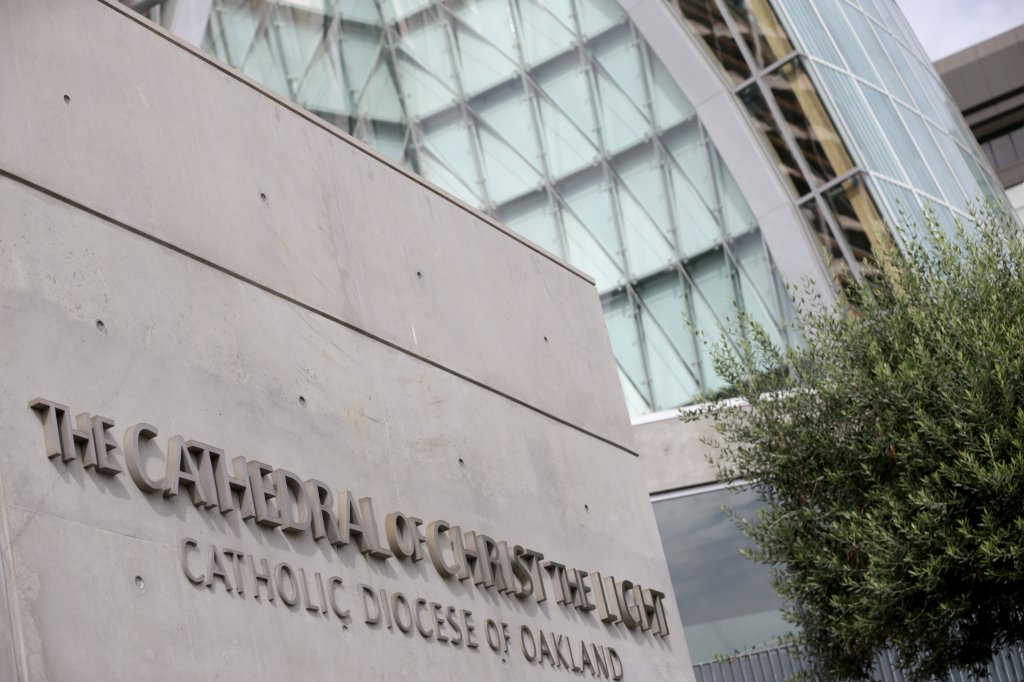
More than 50 years ago, a notorious Catholic priest in Union City used the pretext of overnight church sleepovers to repeatedly molest a fifth-grade altar boy — forbidding him from telling another soul.
Now, an Alameda County jury must decide how much money that boy – grown into a 61-year-old father of four – is owed by the Roman Catholic Diocese of Oakland for enduring that abuse.
Closing arguments are scheduled to begin Tuesday in the the lawsuit, which could have far-reaching consequences on plodding settlement talks between the diocese and hundreds of other victims claiming years of similar abuse. The case is one of six so-called “bellwether” lawsuits, which were allowed to proceed toward trial after years of delays brough on the diocese’s decision to file for bankruptcy protection in 2023.
In hours of testimony Monday, that former altar boy, who is named as John Doe in the lawsuit — described in searing detail being made to undress in the rectory bedroom of notorious East Bay priest Stephen Kiesle during a sleepover in 1975, before being molested alongside another child as part of a role-playing bedtime story. The repeated sexual assaults left the long-ago altar boy with decades of post-traumatic stress that he often buried “with two feet of concrete,” and led to thousands of dollars in therapy treatments, according to court testimony.
“The mind swirl that I experience – even to this day – is so disorienting,” the man added. “I never let go of that 10-year-old boy. And he stays with me.”
The verdict could have broad consequences for hundreds of other people claiming to have been abused by East Bay priests.
Until now, the case had ranked among the hundreds of lawsuits that had been placed on hold when the diocese declared bankruptcy in May 2023. But last year, a bankruptcy judge allowed six of those lawsuits to proceed to trial, so that each side could gauge how juries would react to their claims and potentially hasten an all-encompassing settlement. The next such case could begin in the coming months.
Both sides remain far apart on any potential deal. A committee representing the abuse victims most recently demanded $314.1 million over the course of three-and-a-half years from the diocese and a related corporation overseeing its schools. That compared with an offer of $180 million from the diocese and that corporation, including an additional $44.3 million from its insurers; the victims’ committee wants to negotiate its own settlement with those insurance companies, on the premise that they could secure significantly more money from them.
Kiesle is alleged to have abused victims in more than five dozen of the 350 or so pending lawsuits against the Oakland diocese.
The former priest pleaded no contest in 1978 to a misdemeanor charge of lewd conduct for tying up and sexually abusing two other boys at Our Lady of the Rosary in Union City. Yet despite his conviction — and the three-year sentence of probation that followed — he remained a part of the church during the 1970s and ’80s.
Kiesle continued working with the church after being defrocked in 1987; a subsequent wave of molestation charges led to a six-year prison sentence in 2004, after which he was forced to register as a sex offender. He has not appeared in court this month due to the fact he is currently serving another prison sentence in a 2022 vehicular manslaughter case.
During opening statements last week, Doe’s attorney, Rick Simons, decried the betrayal of trust that accompanied the abuse. After the rectory sleepover, Kiesle drove the boy home and told him that later that “this is our secret – don’t tell anyone.”
Simons told the jury that “carrying this inside is a very painful burden and that’s the burden of secrecy,” adding: “That’s why we’re here – we’re here to get justice.”
Attorneys for the diocese do not dispute that Kiesle abused the boy. Rather, they questioned during opening statements whether the man’s decades-long mental struggles were caused by the abuse or by a series of other traumas he experienced in his life, including the death of his best friend from a brain tumor in fifth grade, bullying in middle school and his mother’s alcoholism.
“We come to this court and admit that we fell down on the job – we failed to properly supervise a Catholic priest,” said Thomas Carlucci, an attorney for the diocese, told the jury during opening statements Thursday. “But your job is different.”
One of the man’s sisters, as well as a childhood friend, testified last week that the former altar boy’s demeanor appeared to change after the sleepovers – assuming the personality of someone who was “severely depressed.” On Monday, a clinical psychologist hired by the accuser’s attorney said he suffered from post-traumatic stress disorder and major depressive disorder, much of it linked to the sexual abuse.
Struggling with depression, the man sought psychological help in 2002 — telling his wife for the first time after, having lived in fear of the end of their marriage.
In 2004, the man’s sister asked the diocese to pay for the treatment. The diocese initially agreed — writing a check for nearly $15,000 and reimbursing him from that point forward with no questions asked. However, the church ended that aid in 2010, after the man’s clinician objected to demands by the diocese to share information about his diagnosis and prognosis.
Attorneys for the diocese hounded the man on Monday over how he was willing to share his diagnosis with his personal insurer, but not the church. They showed the jury letters from diocese leaders imploring the man to cooperate with them and receive financial assistance, highlighting portions that read “your peace is very important to us,” and “please help us so we can continue to support you.”
The reversal took the man by surprise, he said. He has since gone without financial assistance from the diocese.
“It hurt me, because in a way, I felt like this was them not believing that something did happen to me,” the man testified. Often choking up on the stand, he later spoke of the great difficulty he had in even testifying at trial.
The man told the jury of his fear of even testifying, concerned that “I was going to have a stroke or a heart attack and never get to this place … and tell this story.”