
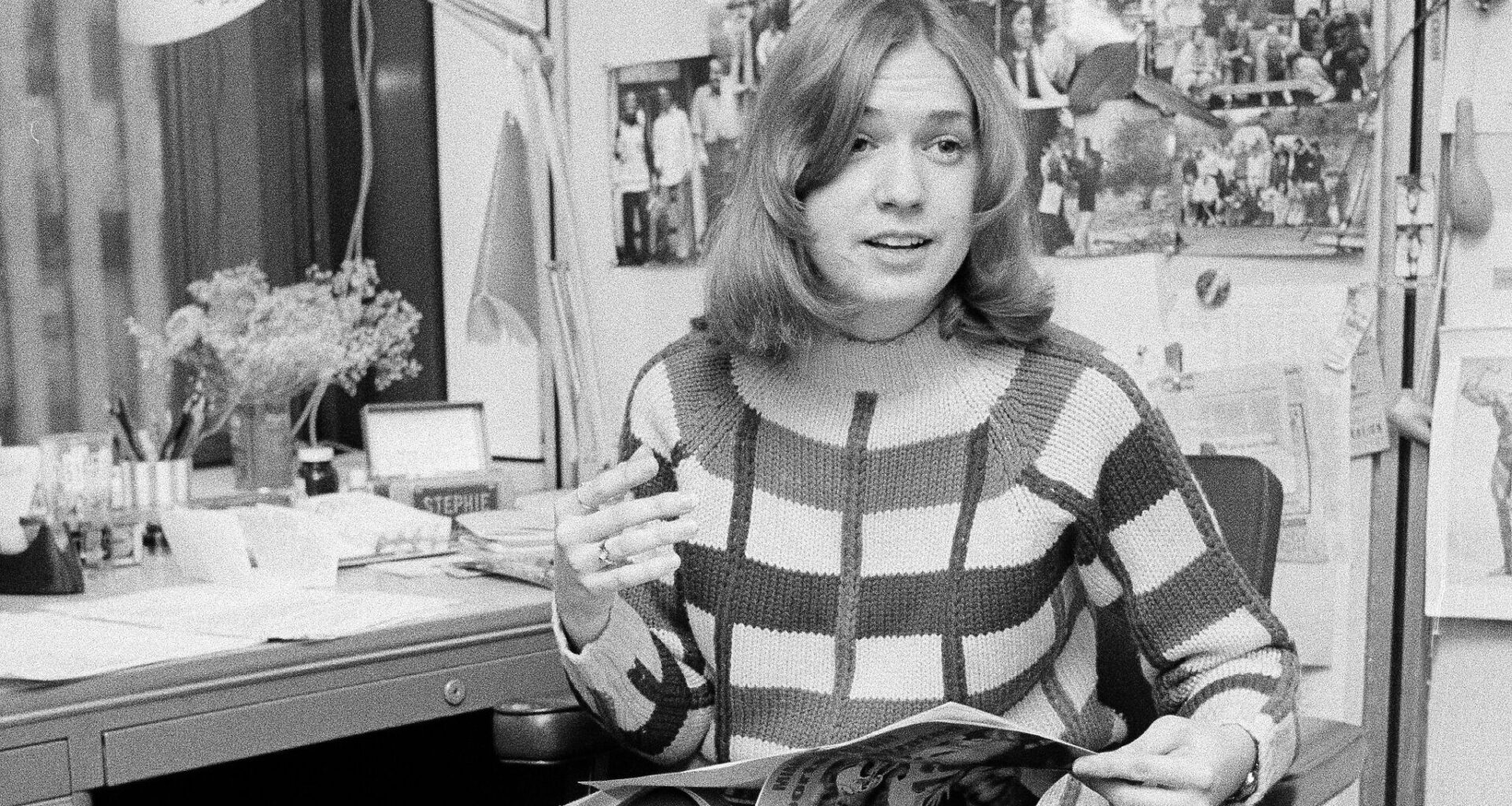
Stephanie Salter of Sports Illustrated in her office, Feb. 2, 1973. At the time, she was suing baseball writers for sex discrimination.
Harry Harris/AP
The news filtered through the sports writing world in the past few days. Stephanie Salter, a pioneering female sports journalist and later a well-regarded op-ed columnist, died last week at age 76.
I didn’t know Salter well, but I always felt a connection to her. An invisible string ties Salter to Joan Ryan to Gwen Knapp to Susan Slusser and to me. A lineage of women who have covered sports in the Bay Area.
There are plenty of others in this line, of course. But Stephanie is widely acknowledged as the first. And being the first is the hardest.
Article continues below this ad
“She didn’t get enough credit for being a pioneer, because all the attention went to anybody back East who was breaking through,” said former Chronicle sports editor Glenn Schwarz.
Schwarz first met Salter in the 1970s, when they were both covering baseball for the Examiner.
San Francisco Chronicle Logo
Make us a Preferred Source to get more of our news when you search.
Add Preferred Source
“Stephanie was getting access to the clubhouse for the Giants and the A’s and Warriors,” Schwarz said. “She was a traveling beat writer with the Warriors and A’s.”
Longtime Chronicle columnist Bruce Jenkins also knew Stephanie, through covering baseball.
Article continues below this ad
“This was a time when women were first allowed access to the locker room, or denied at the door,” Jenkins recalled. “I remember going into the Giants clubhouse one night and seeing Stephanie outside, having been turned away by the Neanderthals. She wasn’t one to scream and yell and beat down the door, but I was so offended by the injustice that I shared my quotes with her. She finally realized she had better things to do in life than deal with this nonsense every night and went off to grander pursuits.
“It’s a big loss for sportswriting and humanity.”
Salter was born in 1949, in Vincennes, Ind., and got hooked on journalism in college at Purdue University. After graduation, she was hired as a fact-checker at Sports Illustrated, at the time the only path in the door for a woman.
That was where she met Melissa Ludtke, who was hired in 1974, when both women were junior reporters. Ludtke would be the centerpiece of a 1978 groundbreaking federal court case, when Time, Inc. filed a complaint on her behalf for equal access after she was barred from the clubhouse during the 1977 Yankees-Dodgers World Series by then-Commissioner Bowie Kuhn.
Salter was already fighting the battles. In 1973, she got an unused ticket to the Baseball Writers’ Association of America’s annual gala, but was forced to leave by the male writers, ushered out by security. Her ouster made headlines. One Florida writer devoted his column to applauding her exclusion and warned of further female infiltration, writing “the average baseball writer insists upon an ‘unmixed’ press box for the same reason that he wouldn’t be stupid enough to take his wife or girlfriend to a stag party.”
Article continues below this ad
Sports Illustrated’s managing editor wrote a letter protesting Salter’s treatment, but no legal action was taken. She left Sports Illustrated two years later, following her boyfriend at the time, writer Ron Fimrite, to San Francisco, where she freelanced before being hired by the Examiner.
In 1977, acting on a tip, Salter wrote the first story hinting that Time Inc. would take baseball to court in the Ludtke case. She also wrote a column about her own experiences:
“While trying to cover my beat, I have been screamed at, called a bitch, (not far enough behind my back), addressed as a ‘little girl’ and advised to find a new line of work because ‘You’re trying to do a woman’s job in a man’s world.’ Whatever that means. I have explained to a black ballplayer that his vote to bar me from the clubhouse was discrimination and watched as he smiled and said, ‘You bet it is.’ I have been asked by a major league manager if I was still a virgin.”
Eventually, Salter tired of what she called the “insular and repetitive world of sports,” and moved over to cover news. That’s where she was when Joan Ryan arrived at the Examiner as the new sports columnist and the two became fast friends.
Salter was part of a fun-loving sportswriting crew that hung out at the Washington Square Bar and Grill in North Beach and at Perry’s on Union Street. It was Salter who convinced Bay Area sportscaster Barry Tompkins, who had a rule to never date anyone younger than 30, to go out with Ryan, telling him, “Break your rule.” Ryan and Tompkins have been married 38 years.
Article continues below this ad
“She was definitely a mentor,” Ryan said. “She was so kind and she was always the smartest in the room.”
When Salter was inducted into the Indiana Journalism Hall of Fame, Ryan called her “the journalist’s journalist, the writer’s writer. She was fearless and elegant, analytical and homespun.”
Some of Salter’s key work came in 1994 on the Examiner’s investigative series into corruption and sex abuse in the Catholic church. Salter, a convert to Catholicism, remembered that the Archbishop called the award-winning series, “journalistic terrorism.” When editors tried to take her column away, after the merger of the Chronicle and Examiner in 2000, hundreds of readers protested outside the Chronicle offices.
Protesters picket outside the Chronicle building to show their support for columnist Stephanie Salter when editors tried to take her column away after the merger of the Chronicle and Examiner in 2000.
MICHAEL MACOR/S.F. Chronicle
Salter remained with the Chronicle for only a few years. In 2004, her father developed metastatic lung cancer and she moved back to Indiana to help care for him. She took a job as a columnist for the Terre Haute Tribune-Star. She didn’t know how her liberal opinions would play in the heartland, but she soon learned that there were many closet liberals in her hometown.
Article continues below this ad
She wrote a column about the hardest thing she had to deal with since leaving San Francisco, which was “right-wing, fundamentalist Christianity — or rather the fact that local government, business and fair chunks of the news media allow right-wing fundamentalist Christians to drive the municipal bus of public life. I’ve never had a problem with rabid God squatters riding ON the bus — front, rear or middle, in any seat they choose. They just can’t be permitted to sit behind the steering wheel. Ever.”
At age 61, Salter married for the first time. She and her husband Bill spent winters in Scottsdale, Ariz., which is where I had dinner with her a few years back. Bill died in recent years.
Former Chronicle journalist Peter Fimrite, who considered Salter a big sister figure when she was dating his father, stayed close with her over the years but, like many of her friends, was surprised to hear the news of her death.
“She probably didn’t tell any of us she was sick because she didn’t want her friends to worry or make a fuss,” Fimrite said. “That was her, too. To the end, she was more worried about the well-being of her friends than about herself.”
“She was,” Schwarz said, “the best of us. She had the clear eye, the clear voice, the clear liberal point of view. She really connected with everything she wrote.”
Stephanie Salter broke down barriers so the rest of us could follow. Thank you.