
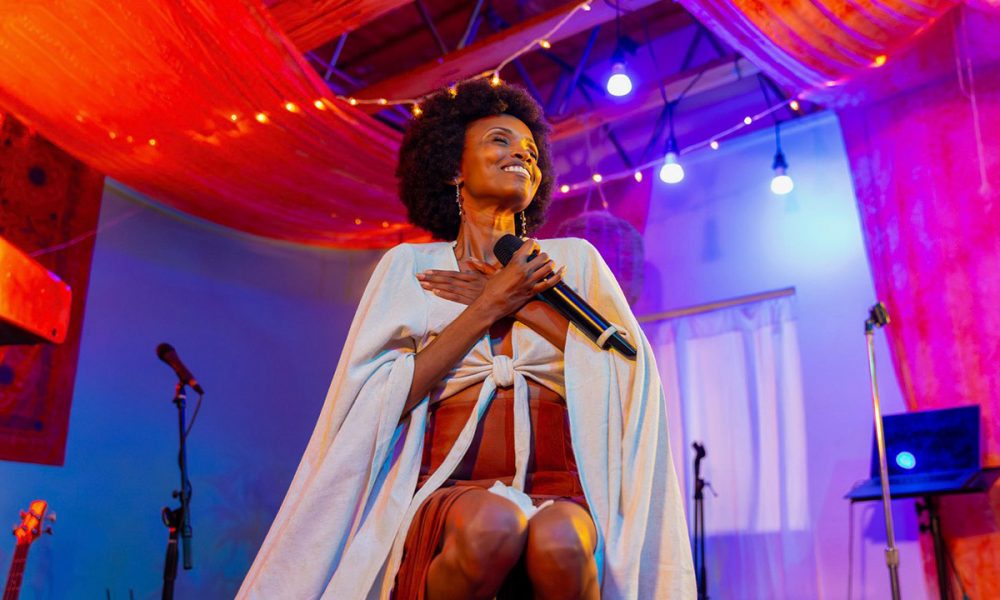
Sapphic exaltation can be found poolside at The Dinah, where for the last three decades, sapphic people have gathered to dance, find long-lasting community, and celebrate their own sacred queer joy. Affectionately dubbed “lesbian Coachella,” The Dinah is one of the largest music festivals held for queer women and sapphic people, including trans and nonbinary community members.
The Dinah has always been loud and proud, and was brought to fruition by renowned party thrower Mariah Hanson. In 1991, she organized the festival’s first iteration, molding the Palm Springs Modern Art Museum into a lively, safe bubble for sapphic people to experience high-voltage, unfettered togetherness and belonging — without shame, harm, or discrimination.
Over 30 years later, The Dinah has become a sapphic “utopia”: a multi-day gathering where people can find community, revel in sapphic excellence, and see some of the biggest superstars in their space thrive on stage. Previous performers include Doechii, Margaret Cho, the Indigo Girls, Tegan and Sara, Princess Nokia, and Lauren Jauregui.
In 2026, the festival sees another evolution: new leadership. Bella Barkow and Rose Garcia have acquired the festival from Hanson and are aiming to make the event more inclusive, accessible, and joyful than ever. They want to preserve the alchemy of queer parties — these are the very spaces that they, as queer youth, discovered liberation and love.
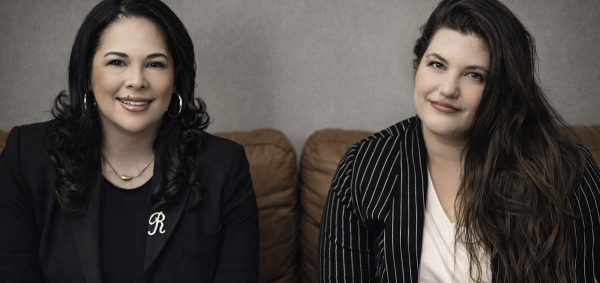 On Feb. 11, it was announced that Rose Garcia and Bella Barkow are the new co-owners of The Dinah. (Photo courtesy Mona Elyafi)
Barkow grew up in Toronto’s rave scene and would spend time hanging out in Church and Wellesley, the city’s queer-friendly nucleus. 2,000 miles away, Garcia was stirring up L.A.’s club scene, her infectious wiles becoming the real-life inspiration for a character in the lesbian TV bible, The L Word.
They both also have history with The Dinah: Barkow, a queer event producer, managed the festival’s operations before their recent acquisition. Garcia was hand-plucked by Hanson to host and emcee the festival for over a decade.
Wild, rebellious, and uplifted by community, Barkow and Garcia are now dedicated to preserving and multiplying this space for other sapphic people across generations. As co-owners of the festival, they speak with great care about carrying this torch forward: of preserving this ecosystem that Hanson constructed and maintained, alone. Their challenge is two-fold: how do they preserve its history and essence while also creating enough breathing room for change and transformation?
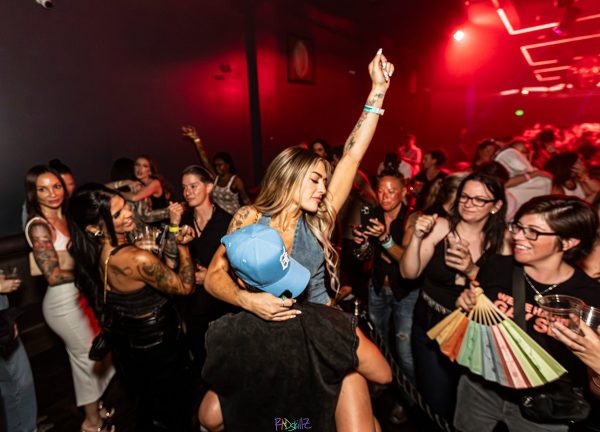 The Dinah 2025 (Photo by RADskillZ)
The Blade sat down with Barkow and Garcia to talk about their vision for The Dinah and its future.
Rose, before you were an emcee and now co-owner of The Dinah, you were attending the festival as a young queer person. What was that like for you?
Garcia: When I first discovered the Dinah, it was in my early twenties, and I couldn’t afford to go for the whole weekend. I was young, working, going to school, and figuring things out, so my friends and I would hop into a car and drive up for Sunday’s pool party. When I first showed up there, I was like: this is incredible. I’ve never seen so many sapphic women in one space. It was thousands upon thousands of women. And even though I’m in a big “market” in LA, we still didn’t have a lot of places to go back then. We had the Palms bar and a couple of clubs, but nothing to this scale.
So when I walked [into the Dinah], I was meeting people from Australia, Europe, Canada — people from all over the world. And it was so amazing, because I never knew something like this existed. It became my go-to place and a part of my life, honestly: [I could] congregate with my friends, take this amazing trip, and be around thousands of folks and feel a sense of acceptance and safety.
You’ve both been upfront that you want to make sure The Dinah is affordable, inclusive and accessible. Tell me more about the value of that and how you’re making this happen.
Barkow: It’s nice to think that LGBTQ rights are on a linear path towards betterness, but unfortunately, the world is not working like that. We both believe that this event needs to keep being accessible to the younger generation, to the people who, like us, came out when they were young, and perhaps saw it on The L Word, or The Real L Word, like myself. I remember seeing it when I was in Toronto and being like: “Oh my God. This place exists. This is a real thing. I can actually go there and be myself.” We do think it’s important that this event is for everyone. I’ve had women in their 70’s who are first timers coming up, so you never know.
Garcia: I also want to interject that even though it’s been open to everyone, we want to actually scream it from the top of the mountains: that it’s not only a sapphic, women-loving-women (WLW) event. It’s open to all of our friends, and we accept and want everyone to feel welcome. That’s really important to Bella and me. We want to make sure our trans community feels welcome, [our] nonbinary community. We want everyone to feel that they can come to this space and feel accepted.
Barkow: I started gender sensitivity and proper pronoun usage training with the front-of-house staff at Dinah about two years ago, and we’re hoping to expand that and make sure that all staff, including hotel and security, are aware of that. There’s always the fear that [they could] misgender or misrepresent someone based on how they look. [We make it clear] you need to understand that our community is very, very specific. You need to support that and be a part of it.
What are you most excited about in this new era of The Dinah?
Garcia: I’m excited to see the people who are going to come. When we launched the tickets, we got an overwhelming, warm, amazing reception. That was something that I was initially worried about [in] the change of hands. “Is it going to fare well with the community?” And we’ve been accepted. So, we’re excited to see what the community says about our first production and to see the faces of people just being happy, celebrating, and enjoying the weekend, and to look at my partner and be like: Man, we did this. Our blood, sweat, and tears for the last 10 months are finally coming to fruition.
Bella: I’m really excited to see how the community takes to the new initiatives that we’re bringing out that are community building-specific activations, so things for the solo and single travelers and things for the sober community that really expand the event. [It’s] a music festival first and foremost, but also a space to build lifelong friendships. As Mariah used to call it, this five-day utopia [is] a place where the outside world doesn’t matter and we’re all there to be together and enjoy community together.
You’ve acquired The Dinah and you’re deep in the planning of this year’s festival. Does all of this, and the reception you’ve received, give you hope for the future of sapphic spaces?
Garcia: Yes, I think it does. Mariah used to have a partnership program [and] we’re going to reignite that. [We’ll] reach out to a lot of sapphic spaces throughout the country and all over the world, and [become] promotional partners. Not only does it support them in any events that they plan on having, because Dinah does have a big draw and a big reach, but it also helps us reach out to those markets as well. And we support each other. It’s a win-win for both. We [also] see a lot of the younger generation working on bringing more events to the community, and Bella and I are big supporters of all of them.
Barkow: It’s the understanding that there’s enough room at the table for everyone. We need to support each other as a community. Historically, it’s always been like a woman is sitting at the table and she says: “Oh, this is my seat, and it’s the only seat, and so I have to protect my seat.” And that’s not true. I see this as an opportunity for us to help pull other women up to come join the table because there’s a seat for everyone.
Dinah 2026 takes place from Sept. 30 to Oct. 5 in Palm Springs. More information can be found on their website.
Kristie Song is a California Local News Fellow placed with the Los Angeles Blade. The California Local News Fellowship is a state-funded initiative to support and strengthen local news reporting. Learn more about it at fellowships.journalism.berkeley.edu/cafellows.