
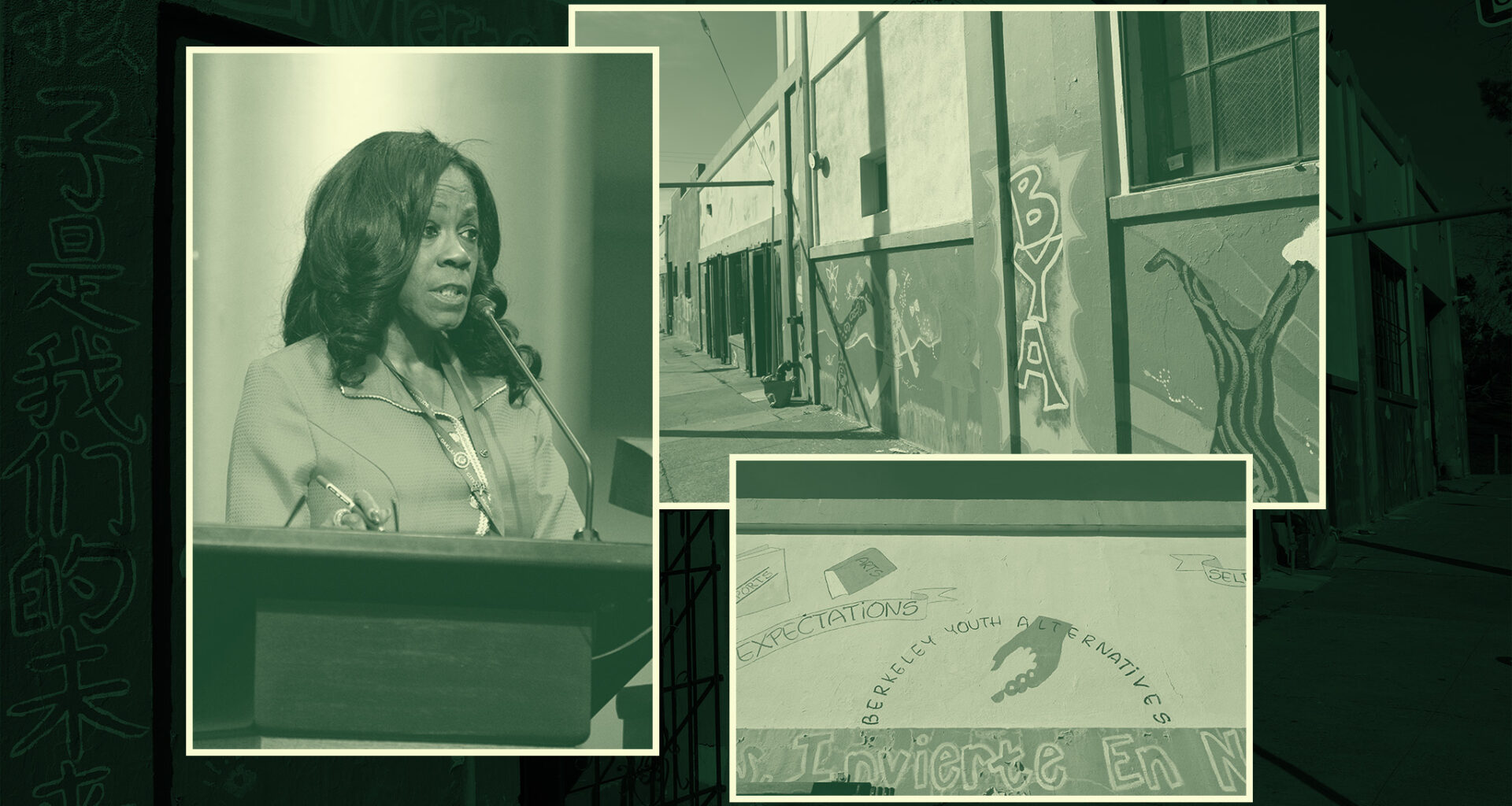
Patricia Brooks, who currently serves as chief of staff to Oakland Council President Kevin Jenkins, pictured left, and Berkeley Youth Alternatives, whose Berkeley offices are shown above, got a contract to develop a youth-focused cannabis program for the city of Berkeley, but fell short in delivering a number of the project’s goals.
Chronicle photo illustration; photos by Benjamin Fanjoy/For the S.F. Chronicle, left, and Lea Suzuki/S.F. Chronicle
A nonprofit and a politically connected subcontractor were awarded a six-figure contract from the city of Berkeley to run a marijuana education program between 2022 and 2024, but failed to complete key parts of the project and still got paid.
The City of Berkeley ultimately paid the nonprofit, Berkeley Youth Alternatives, and its subcontractor, Patricia Brooks — now chief of staff to Oakland City Council Kevin Jenkins — a total of $607,000 of the $1 million it initially received from the state for the program. They don’t appear to have faced consequences for failing to deliver parts of the contract.
The struggles of the grant are reflective of larger problems that have dogged California since voters passed Proposition 64 in 2016 to legalize recreational marijuana. Lagging revenue has disappointed the state and the industry — thanks largely to a thriving illicit market.
Article continues below this ad
State leaders have canceled several planned tax hikes on cannabis and eliminated a tax on growers, but still haven’t reduced the rate as far as the industry had hoped, in part to protect funding for equity, education and youth programs. Prop 64 directed a large portion of cannabis tax proceeds toward those efforts, a provision included in the ballot measure to address concerns that legalization could increase teen use.
Some of the equity-focused initiatives haven’t lived up to expectations. In San Francisco, a program intended to elevate minority entrepreneurs benefited well-connected city hall insiders. Richmond had to return over $1 million in state funding after the city failed to get an equity program off the ground.
San Francisco Chronicle Logo
Make us a Preferred Source to get more of our news when you search.
Add Preferred Source
The money for Berkeley’s project came through a Prop 64 grant program run by the California Board of State and Community Corrections. Since 2020, the agency has distributed roughly $123 million of cannabis taxes to cities and counties for programs aimed at preventing youth drug use and addressing its causes. Much of the funds have flowed to nonprofit groups and subcontractors.
But the Berkeley contractors’ performance raises questions about whether the city or the state are ensuring that these organizations follow through on work paid for by the public. Issues with nonprofit contractors have roiled other Bay Area cities, most prominently in San Francisco, where groups have been accused of billing for uncompleted work and keeping improper records.
Article continues below this ad
In its application for the state grant, Berkeley said it would build a sweeping marijuana education and youth violence prevention program with multiple elements: a cannabis education ad campaign; a peer education program with up to 20 paid interns who would help run drug abuse trainings; counseling services for teens; and a task force of community leaders that would develop programs for young people who had been incarcerated or involved in gang violence.
The state corrections board notified the city of Berkeley in July that it had “met all grant obligations” and that “project deliverables have been completed.”
Patricia Brooks, chief of staff to Oakland City Council President Kevin Jenkins, makes remarks at a City Council meeting on April 14.
Benjamin Fanjoy/For the S.F. Chronicle
But city records and an April 2025 evaluation by Alameda County show that both BYA and Brooks’ company, Upline Solutions, failed to implement many of the contract’s key objectives.
Though Upline was hired to create an ad campaign, it never did. The task force Upline was meant to organize did not launch until early 2024 — two years into the grant term, and nearly 18 months after Upline started getting paid.
Article continues below this ad
Brooks said Upline’s work on the Berkeley contract faced setbacks related to Covid delays as well as changes in staffing at the city. She said Upline discontinued the ad campaign “because of the change in cannabis policy.” She declined to elaborate on what policy had changed and how that impacted the campaign.
“Not every contract works out super well… it was a hard contract,” Brooks said.
Likewise, BYA also struggled to complete the contract, even after it convinced the city to reduce the scope of the project in the wake of the pandemic.
BYA was supposed to create a “peer educator” program, in which it would hire and train 16 young people to lead a minimum of 10 presentations on cannabis use to fellow students, with the goal of reaching 1,000 students. While the organization did train students to act as educators, they never led training sessions for other students, according to the county evaluation.
The BYA employee managing the peer-educator campaign, the evaluation report said, told Berkeley city staff that “many young people were simply not interested in cannabis prevention and education,” and that he decided to focus on helping teens meet needs they expressed, like finding stable housing and getting a driver’s license.
Article continues below this ad
Berkeley Youth Alternatives billed the city of Berkeley $607,000 for a youth cannabis education program that was only partially completed. City records and an evaluation by Alameda County show that both BYA and subcontractor Upline Solutions failed to implement many of the contract’s key objectives.
Lea Suzuki/S.F. Chronicle
Berkeley told the state it aimed to provide counseling and “wrap-around services” to 75 to 180 students in middle school and high school over the three-year grant term. But when it executed its contract with the city, BYA negotiated to reduce that to 25 to 60 new students. BYA reported to the evaluators that it served 48 counseling clients over three years — a third of those in high school, another third in middle school and another third in elementary school.
According to the county evaluation, it was unclear how many of the clients were new, or if they came from BYA’s existing clientele.
“Since BYA offers tailored interventions to each client and enrolls many in multiple program components … it is difficult to determine which strategy resulted in observed outcomes,” the evaluators wrote.
Davina Hurt, who directs the government ethics program at the Markkula Center for Applied Ethics at Santa Clara University, said that “the buck stops with the city.”
Article continues below this ad
“It breaks the public’s trust that their money isn’t being well spent,” she said. “It’s upon the city to ensure that they handle things appropriately by either stopping payments, retrieving their money back, or demanding that the contract be fulfilled.”
In a statement, Berkeley spokesperson Seung Lee said that throughout the grant term, staff returned multiple invoices and progress reports to BYA for corrections and additional information, and that payments were withheld until documents were complete.
BYA’s co-Executive Director, Tiffany Lockett, declined to be interviewed, saying she was not serving in an executive role at the time of the grant. She did not make others available, and did not respond to detailed questions about how the nonprofit and Upline spent the city’s money.
Kevin Williams, who led BYA when it got the grant and left the organization in December 2024, did not respond to multiple requests for comment. He is currently listed as an assistant professor of public health at Touro University California in Vallejo, and owns a business that resells nutritional supplements online.
The cannabis contract landed nearly two years into the pandemic, when the city’s public health department was directing most of its resources to stopping the spread of Covid. BYA was also struggling with significant staff turnover and vacancies, Lee said.
In a statement, state corrections board spokesperson Jana Sanford-Miller said that some small nonprofits that received funds that year were challenged by “limited administrative and staffing infrastructure” and had their programs impacted by the pandemic. “While the city did not reach every program objective, there were successes,” Sanford-Miller wrote.
It’s unclear how Brooks got connected to the Berkeley project.
She began working as Jenkins’ chief of staff in January 2023 and as an aide to Council Member Ken Houston in 2025. She has also worked as an aide to former Council Member Desley Brooks, who was in office from 2002 to 2018, and as a cannabis policy advisor to Alameda County Supervisor Nate Miley, who has been in office since 2001.
Berkeley City Council Member Ben Bartlett’s wife was connected to a company that won a portion of a contract to develop a youth cannabis education program for the city but failed to complete the work. Bartlett said he was not involved in the award of the contract.
Constanza Hevia H./Special to The Chronicle
State filings show that Upline Solutions was incorporated in October 2019 by Brooks and the wife of Berkeley Council Member Ben Bartlett, Yelda Bartlett. When it incorporated, the business listed its address as Yelda Bartlett’s law office in downtown Oakland.
Brooks said Yelda Bartlett was not associated with the company, but was one of the few lawyers she knew and that she was “doing a solid for us” by filing the paperwork to form the company. Brooks said neither Yelda nor Ben Bartlett benefited financially from Upline’s contract with Berkeley.
Ben Bartlett said Brooks is a friend, but that he had no role in helping her company get the contract. “I wasn’t aware that Yelda had been the agent of service for Patricia,” he said.
Bartlett said that he was disappointed and concerned that BYA and Upline hadn’t completed all of the work they had been contracted for.
“Maybe there’s a world where they could still fulfill the missing elements,” he said.
Upline’s 2020 filing with the state also lists Jenkins as a registered agent of the company. In an interview, Jenkins said he was not financially involved with Upline and had never worked on the Berkeley grant with Brooks. Brooks said Jenkins was listed as an agent for the company because he had helped her to fill out paperwork on the LLC when she was in a hospital.
Hurt, the ethics expert, said that the number of players involved “brings up questions of influence.”
“This is a very complex group of actors that are related and connected, and then in the end, the work wasn’t done,” Hurt said. “Ethics isn’t just about corruption — it’s also about preventing the appearance of it.”
The Board of State and Community Corrections grant funded similar programs in other cities and counties that saw greater success. In San Francisco, the grant paid for an ad campaign plastered along 12 Muni bus routes that passed by middle and high schools, encouraging youth to visit a website with facts about cannabis.
San Francisco used some of the funds from a grant through the Board of State and Community Corrections Proposition 64 Public Health and Safety Grant Program to place ads on bus routes near 63 middle and high schools.
Courtesy of 510 Media
Even though it did not complete the ad campaign for Berkeley, Brooks continued to be paid. Invoices submitted to the city described her work broadly as “negotiating the RFP,” “contract deliverables,” and “project planning.”
For the first seven months of the contract term, from January to July 2022, Brooks’ company was the main recipient of the funds. BYA did not invoice for any of its own personnel or programs. The only expenses listed on the invoices it submitted to Berkeley were for $5,000 for Upline and $1,697 for BYA’s administrative fees. BYA only began billing the city for its own personnel and programs starting in August 2022, eight months into the contract.
Though the original contract was worth $842,000, BYA billed only $607,000 by the project’s end. Around $235,000 of the $1 million grant was returned to the state, a Berkeley spokesperson said. The city also spent $125,000 on its own staff members, who were meant to oversee the project and BYA’s compliance.
Despite the county’s evaluation highlighting BYA’s shortcomings, Berkeley has continued to award contracts to the nonprofit.
Since the 2010s, the city has paid BYA $30,000 a year for its afterschool center and $30,000 for counseling programs. Starting in the 2023 fiscal year, under Mayor Jesse Arreguín, the city also began to give the nonprofit $125,000 a year for counseling programs, plus $35,000 for the Summer Jam Day Camp, from the Mayor’s Reimagining Public Safety initiative.
The nonprofit also received a $106,000 grant funded by the city’s soda tax to run its Urban Agriculture and Team Nutrition Program in fiscal years 2024 and 2025. In June 2025, the council voted to reauthorize the grant.