
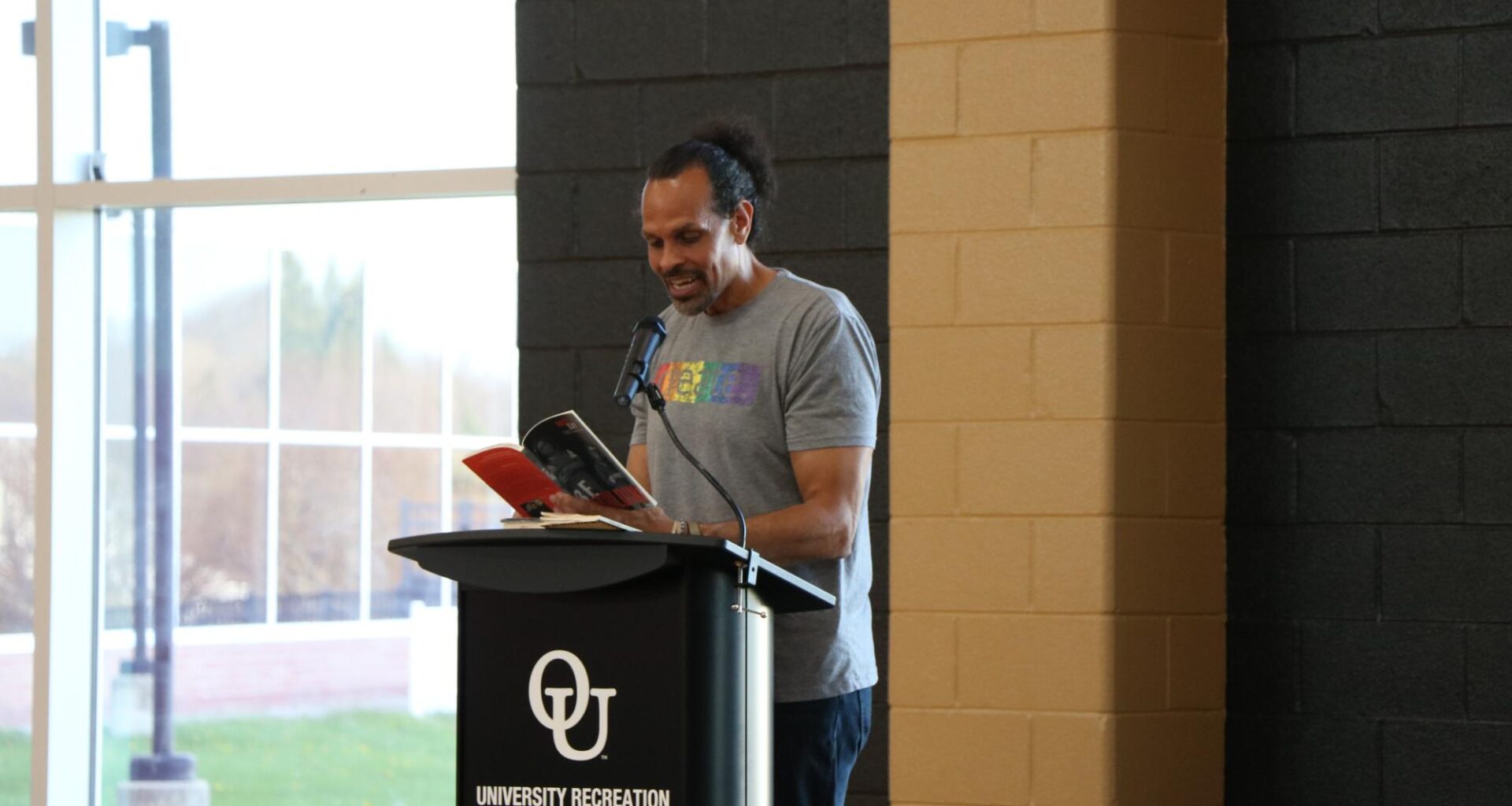
Students and community members gathered on Oakland University’s Recreation and Well-Being Center basketball courts April 14 for the 38th annual Maurice Brown Memorial Poetry Reading, an event that blended literature, athletics and campus tradition in an interactive setting.
This year’s theme, “Poem Month Madness: Celebrating Poems and Basketball” brought a unique energy to the event as attendees sat along the court, listening to poetry in a space typically reserved for sports.
The nontraditional venue created a relaxed and engaging atmosphere, allowing participants to experience the reading in a new and accessible way.
The event featured acclaimed poet and essayist Ross Gay, whose work often explores themes of joy, community and everyday life. Known for incorporating elements of basketball into his writing, Gay was a fitting choice for this year’s theme.
Throughout the reading, Gay shared selections that reflected on topics such as memory, gratitude and connections between personal experiences.
The annual reading honors Maurice Brown, a former Oakland University English professor who taught at the university from 1961 until Brown’s death in 1985. Established in 1988, the series continues to celebrate Brown’s passion for poetry while bringing nationally recognized writers to campus.
Oakland University professor Katie Hartsock, who organized this year’s event, said the decision to invite Gay came after discussion among faculty in the Creative Writing Program.
After discussion, the Creative Writing committee selected Ross Gay to read basketball-themed poetry, aligning with the goal of connecting literature with shared cultural experiences.
“The faculty of our Creative Writing program committee always discusses our choices of visiting writers to invite to our campus to read and share their work,” Hartsock said. “We all knew we wanted to bring Ross Gay, especially as he is noted both as a poet and essayist.”
Hartsock said the idea to combine poetry and basketball developed from experience teaching Ross Gay’s work and involvement in community arts programs, where blending creative expression with shared activities helped engage a wider audience.
“It struck me, what if we had poetry reading devoted to basketball, bringing people together who know they love poetry, and people who love poetry but might not yet know they love basketball,” Hartsock said.
The event transformed the basketball courts into a space for storytelling and reflection, as attendees listened closely to Gay’s readings.
“It brings together students who are majoring and minoring in English and Creative Writing, but it also invites students of all majors who love literature,” Hartsock said.
Gay’s readings emphasized a wide variety of themes, including adolescent romance, self-discovery and familial tension.
In one of the readings, Gay discussed a note written to a childhood crush. During school, Gay realized that the note had been left in a pair of pants hidden behind the couch.
Eventually, Gay found the pages of the note scattered across the bed. Gay revealed to the audience that the note had been discovered by Gay’s father after picking up the discarded pair of pants.
Gay explained that the discovery of the note encouraged continued writing, a moment that helped shape an early interest in storytelling.
Hartsock emphasized that creative writing can enhance a wide range of careers by helping individuals express complex concepts more effectively.
“For example, our environmental sciences majors can do so much by crafting stories, beyond pure data, regarding climate emergencies,” Hartsock said.
The event welcomed members of the surrounding community, including alumni, local writers and literature enthusiasts. This open format allowed for a broader exchange of ideas and reinforced the role of poetry as a shared cultural experience.
“We love to have community friends, Southeast Michigan writers and professors, OU alums, local lit fans, join us for these events,” Hartsock said. “It’s an acknowledgement of the power of poetry to bring people into a shared space.”
Students who attended the event described the experience as both unique and engaging, particularly due to the unconventional setting.
Maggie Quinn, a senior public relations major, said the basketball court setting made the reading stand out compared to previous experiences.
“It was a very unique experience,” Quinn said. “I have been to poetry readings in the past, but doing it on a basketball court was very interesting. A lot of the storytelling was very interesting, and it was cool to see how different parts of life connected to basketball.”
Quinn added that the event expanded the understanding of what poetry can be, especially when exploring nontraditional topics.
“It was kind of nice to see you can write about stuff that isn’t traditional,” Quinn said.
Natalie Ornette Corchi, a freshman English for education major, said the setting created a different perspective on both poetry and sports.
“For me, it felt like an interesting disconnect that made me focus more on the writing itself and how it relates to sports,” Corchi said.
Corchi said the event changed previous perceptions of poetry as rigid or structured.
“I always thought that poetry was this stiff rigid thing, but with this, it felt more personal and conversational,” Corchi said.
Shannon O’Connor, a senior majoring in women and gender studies and professional and digital writing, said the environment enhanced the emotional impact of the reading.
“I loved the way it echoed through the basketball court,” O’Connor said. “It felt like being at a basketball game and elevated the sense of connection with the topic.”
O’Connor added that the setting demonstrated how poetry can exist in a variety of environments beyond traditional spaces.
“It made me feel like poetry could be in any setting,” O’Connor said.
Following the reading, audience members had the opportunity to ask Gay questions about the work, writing process and inspiration.
A table was also set up where attendees could purchase copies of Ross Gay’s poetry collections and have books signed, providing a more personal connection between the author and audience.
As the Maurice Brown Memorial Poetry Reading continues its decades-long tradition, the event demonstrated how poetry can evolve to reach new audiences.
By combining literature with the familiarity and energy of basketball, organizers created an experience that resonated with both longtime poetry enthusiasts and those encountering poetry in a new way.