
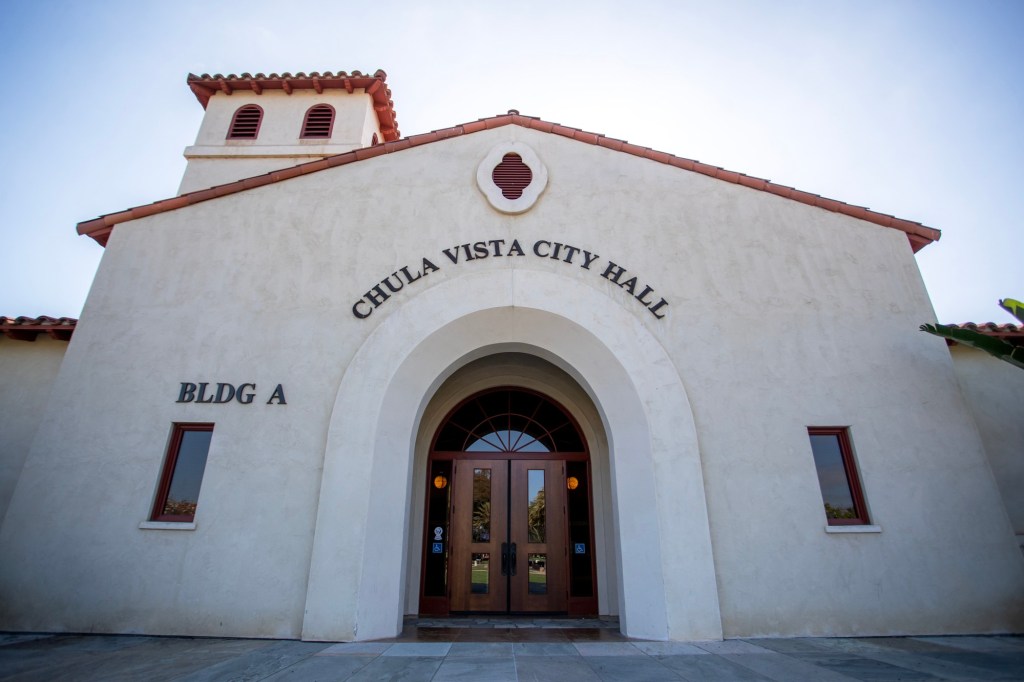
The Chula Vista City Council voted 3-2 Tuesday to approve an ordinance that would implement district-based nominations for seats on five city boards and commissions, capping a months-long process that exposed a sharp divide among council members over the role of residency in local representation.
Deputy Mayor Cesar Fernandez and Councilmembers Michael Inzunza and Carolina Chavez voted in favor, while Mayor John McCann and Councilmember Jose Preciado cast dissenting votes.
The ordinance, which will require a second and final reading, would redesignate four of the seven seats on the Board of Library Trustees, Charter Review Commission, Sustainability Commission, Traffic Safety Commission, and Veterans Advisory Commission to use a district-based nomination process — meaning each of the four council members would nominate one person to fill a seat designated to their district.
The remaining three seats on each body would continue to be filled through the existing citywide general appointment process. All nominations, whether district-based or general, must be ratified by a majority vote of the full City Council per the City Charter.
However, the district-nominated appointees would not be required to live in the district whose council member nominated them — meaning, for example, a District 4 council member could nominate someone who lives in District 1 to fill the District 4 seat.
The sole exception is the Traffic Safety Commission, where district-nominated appointees must reside in — and maintain residency throughout their tenure in — the corresponding district, a reflection of the view that firsthand familiarity with a neighborhood’s streets and traffic patterns is relevant to the role.
The effort began Dec. 16, 2025, at the request of Fernandez, who had flagged a geographic imbalance in commission representation after his office reviewed a list of open appointments across city bodies.
“I noticed that the lowest amount of representation in our commissions is from D4,” said Fernandez, who represents District 4, during that meeting. “It’s not by design. I just don’t think there’s really been the opportunity to put more residents of D4 on these commissions.”
Jorge Marroquin, a Traffic Safety Commissioner for the city, spoke during public comment in support of the proposal’s intent while raising procedural questions about implementation.
“We’re not thinking about what district we’re serving or not serving,” Marroquin said. “We’re serving the city of Chula Vista — period.”
Inzunza voiced support for Fernandez’s concern during the December 2025 meeting, noting he had raised the issue previously and framing it as part of a broader push by the council toward equitable citywide representation.
“What we’ve been doing at the city over the last year with this new council is really trying to get just representation from all areas of the city of Chula Vista,” Inzunza said, adding that commission representation “is just not stacked heavy in the predominantly middle income or upper middle income communities of our city.”
McCann voted against the ordinance, arguing it was contradictory.
“The goal of this ordinance is to increase participation from residents within each council district,” McCann said. “However, as it is written, it allows appointees to live anywhere in the city of Chula Vista and does not require district residency for these appointments. I find it contradictory to establish district-based appointments while allowing appointees to live anywhere in the city, rather in the districts that they are meant to represent.”
Preciado also voted no, drawing a parallel to council elections themselves.
“Only people who live in my district can vote for me as a council member,” he said, adding that he found “the incongruity of the whole thing” to be “absurd.”